

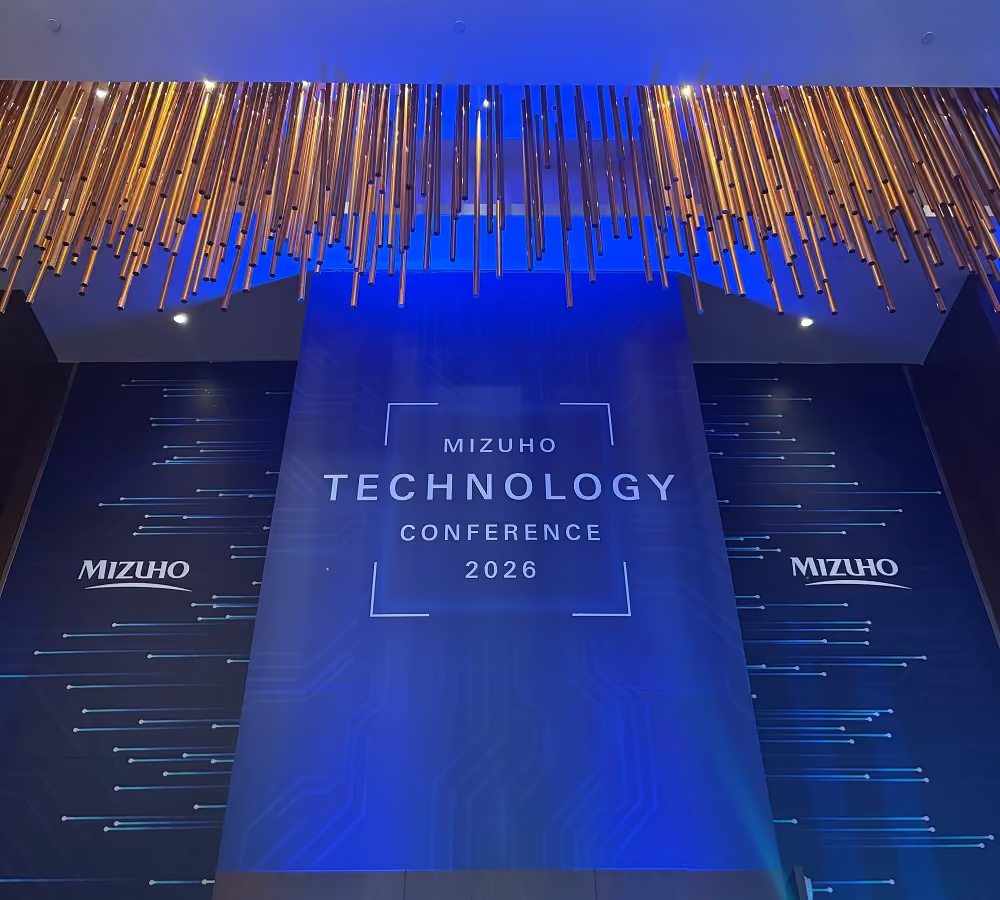
Last month, Mizuho held its annual Technology Conference in New York. Attended by investors and technology executives from leading public and private companies, the event examined achieving growth, productivity, sustainability and information security amid the global technological transformation underway. Over the course of two days, attendees chose from nearly 30 sessions with leading executives discussing everything from AI adoption and semiconductor innovation to the next wave of cloud and cybersecurity infrastructure.
Unsurprisingly, AI was a discussion point present in almost every conversation. Perhaps most notable was that, at least for some presenters, the impact of AI on employment is not all doom and gloom. While some noted potential for dramatic labor disruption in an AI world, with significantly less reliance on junior staff, Arvind Krishna of IBM, one of the conference keynote speakers, struck a more positive tone noting that IBM tripled their entry level intake because they believe that cohort of talent will be the most adept users of AI.
And while it is still clear that the AI evolution is still in the early innings, as David Golub of Golub Capital noted, AI will inherently create concentration and predicts there will be one to two leaders in each industry as a result.
Despite strong recognition by speakers that the capital markets have largely powered through the many macroeconomic and geopolitical headwinds that exist, there was a shared sentiment of significant uncertainty as to whether and when those impacts might be felt more strongly.
If you were unable to attend the sessions in person, below is a brief overview of some of the key takeaways noted by speakers.
Software
In contradiction to popular beliefs around AI, the software company presenters shared an optimism about the impact of AI on employment. In fact, many noted having increased headcount in order to exploit the opportunities and productivity unleashed by AI, rather than seeing the implementation of the technology as an opportunity to cut positions. Similarly, collective skepticism exists around whether AI will displace mission-critical system-of-record software as evidenced by increased recognition of the significant costs and frictions involved with switching from existing workflows and software to newer AI workflows. This is especially true when the cost of the existing system is small relative to overall enterprise spending.
In further contradiction of general public discourse, the payments processing companies present expressed optimism that AI will in fact create many more opportunities than it will displace. Attendees expect transaction flows and payment volumes to grow faster than they have historically as new software is created more quickly, new players enter the market, and agentic commerce grows.
Cybersecurity
In the age of AI, cybersecurity continues to remain highly critical. As the proliferation of AI continues, enterprises will be faced with the need to defend against attacks that leverage AI. Indeed, AI is expected to drive an increase in cybersecurity spending, while companies making these investments are expected to see a significant benefit over time as AI becomes more prevalent across the enterprise. New AI products are already spurring incremental demand; and new “flex pricing” is becoming popular, with a number of cybersecurity companies having already rolled out consumption-based pricing instead of pre-packaged security bundles.
Similarly, strong cybersecurity capabilities that leverage AI will continue to be a critical differentiator for vendors, as they strive to maintain their market positions by staying ahead of AI enabled attacks. To that end, acquisitions of novel cybersecurity companies with AI-forward capabilities will be an important lever used by larger consolidators to remain competitive and at the bleeding edge of technology. As companies strive to stay ahead of attacks that leverage AI or are directed at AI systems, the “arms race” to secure against both is expected to continue, signaling a positive outlook for continued investment and growth for the sector.
Semiconductors / Data Infrastructure
The network is the new bottleneck. As Graphics Processing Unit (GPU) clusters scale to tens of thousands of chips, interconnect bandwidth—not compute—is increasingly the binding constraint on AI token throughput. Although the industry is in the early stages of an “optical super cycle” driven by the fundamental physics limits of copper at scale, 800G → 1.6T → 3.2T speed migration is accelerating faster than expected. Similarly, demand is structurally outpacing supply across the photonics chain as the global AI optical transceiver market is projected to expand from ~$16.5B in 2025 to $26B in 2026. This represents more than 57% year-over-year growth, with supply-demand imbalances running 25–30% across key components like Electro-Absorption Modulated Lasers (EMLs) and Silicon Photonic Integrated Circuits (PICs). This will be a multi-year constraint, not a near-term blip, as capacity expansions take 18–24 months to come online.
Beyond transceivers, optical circuit switching (OCS) is emerging as the next major infrastructure layer. With AI factories driving a new architectural shift toward reconfigurable optical fabrics that dynamically route traffic between GPU pods, OCS revenue is expected to exceed $3.5B by 2029, more than two times greater than they were in 2025. This is creating a structurally new market that did not meaningfully exist three years ago.
A fundamental reshaping of demand driven by AI inference architecture is afoot, with data centers on track to become the largest NAND Flash end-market in 2026, displacing mobile. Although Key Value (KV) cache persistence, retrieval-augmented generation (RAG), and embedded storage dramatically increase storage intensity per server and data format conversion expands storage requirements 5–1,000x versus plaintext, the new demand wave for KV cache is still in its early innings. Preliminary industry estimates suggest KV cache alone could add 75–100 exabyte (EB) of incremental NAND demand in 2027, doubling again in 2028—a figure that was essentially zero two years ago and is not yet fully reflected in most supply planning models. With enterprise Solid State Drive (SSD) contract prices rising 33–38% quarter-over-quarter in Q1 2026, and meaningful new capacity not expected until after 2027, the pricing environment remains constructive. Unlike prior cycles driven by speculative inventory builds, this cycle is being driven by genuine end-demand from hyperscalers deploying AI infrastructure at scale—making the current upcycle more durable than historical NAND cycles. Keeping up with AI-driven capacity demands will be a significant challenge for manufacturers, making capital investment and strategic alignment critical. We expect the resulting supply constraints across optical networking and memory to support favorable pricing dynamics and earnings for these providers.
Quantum Computing
Quantum computing has moved past skepticism into concrete deployment timelines, with several players publishing fault-tolerance roadmaps targeting the back half of the decade. The prevailing view among CEOs and decision-makers is a hybrid architecture, with Quantum Processing Units (QPUs) running concurrently alongside Central Processing Units (CPUs) and GPUs to attack problems previously deemed intractable. Quantum machines are expected to become an integral layer of the compute stack (CPU-GPU-QPU). In parallel, the security implications are already driving investments in post-quantum cryptography and quantum-safe networking, well ahead of a quantum machine coming online and breaking existing cybersecurity protocols.
There are still unknowns regarding which specific quantum architectures will prevail but either way, the next two to three years are going to be defined by partnerships, capital raises and consolidation activity as the field narrows towards achieving quantum supremacy.
Telecom
As more AI infrastructure is brought to the inference layer, telecom companies are raising their hands to help make that link and are emerging as a growing player in AI connectivity. Fiber is the critical plug to data center connectivity, and as telecom carriers expand their fiber reach, they become a larger part of the AI conversation. AT&T is farthest ahead with plans to have 60MM homes covered with fiber by 2030. As the fiber buildout continues to progress, more fiber laterals will be able to grow from this network and help drive further AI connectivity. This will be especially true as inference connectivity hubs proliferate.
Until Next Year…
Technology moves at warp speed, so it will be exciting to see how the industry changes over the next year. We hope you will save the date for Tuesday, June 8 and Wednesday, June 9 in New York City for the Mizuho Technology Conference 2027, where our experts and guest speakers will share their insights on all of the latest developments propelling the industry forward.
