
Research Report
- Environmental risk assessment of MEA and its degradation products from Post-Combustion CO2 Capture Pilot Plant:Drafting technical guidelinesJuly, 2017July, 2017
- Life Cycle Greenhouse Gas Emissions Analysis Report of Hydrogen Supply ChainDecember, 2016December, 2016
- Well-to-Wheel Analysis of Greenhouse Gas Emissions of Automotive Fuels in the Japanese Context - Well-to-Tank Report -November, 2004November, 2004
Well-to-Wheel Analysis of Greenhouse Gas Emissions of Automotive Fuels in the Japanese Context - Well-to-Tank Report -
Reseach Report (PDF)
Outline of Study
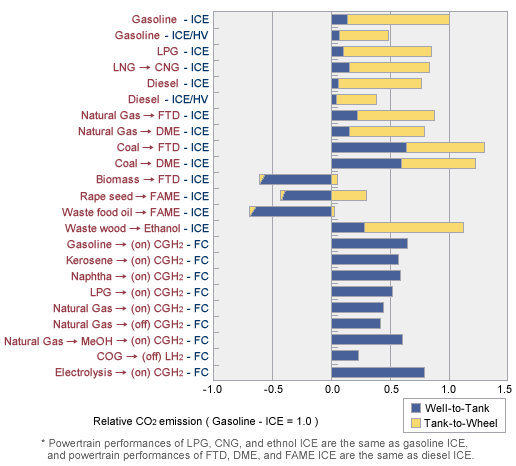
This study focused on estimating well-to-tank energy consumption, greenhouse gas (GHG) emissions and the energy efficiency of current and near-future automotive fuels in Japan. The results of this study were subsequently combined with data related to tank-to-wheel studies previously conducted by TMC, and a case study showing well-to-wheel GHG emissions under fixed conditions, calculated using sedan-type vehicles.
Example of calculation of well-to-wheel GHG emissions
Glossary
ICE: Internal Combustion Engine
LNG: Liquefied Natural Gas
FTD: Fisher-Tropsch Diesel oil
FAME: Fatty Acid Methyl Ester
CGH2: Off-site Compressed Hydrogen (Off)
MeOH: Methanol
GHG: Greenhouse Gas
LPG: Liquefied Petroleum Gas
CNG: Compressed Natural Gas
DME: Dimethyl Ether
CGH2: On-site Compressed Hydrogen (On)
LH2: Off-site Liquefied Hydrogen
COG: Coke-Oven Gas
76 Fuel Pathways Considered
Regarding well-to-tank studies, the 76 fuel pathways considered, broken down into six categories, were: 1) 21 petroleum-based fuels, 2) 20 natural gas-based fuels, 3) eight coal-based fuels, 4) 19 biomass resource-related fuels (three bio-diesel fuels, 10 dry biomass-based fuels and six wet biomass-based fuels), 5) power grid mix (Japan average) and 6) hydrogen production through electrolysis (six byproduct hydrogen pathways). No fixed timeframe was set for the data collected, with efforts focused on understanding and organizing existing data. Additionally, in order to ensure data impartiality, efforts were made to improve credibility by seeking varied advice, ranging from third-party evaluations by specialists (Advisory Committee) to obtaining calculation methods from the data sources. Moreover, where data used in calculation had a broad range, the range is indicated through minimum to maximum values.
Drawing Conclusions and Problems of Comparison
For well-to-wheel studies, and in concurrence with previous research for the 10-15 test cycle (example of calculations are made in this study), which is mainly a comparatively low-speed run, significantly superior results were obtained for hybrid-electric vehicles (gasoline, diesel) in relation to GHG emissions. For synthetic fuels, such as Fischer-Tropsch diesel oil, dimethyl ether (DME) and hydrogen, large variations in well-to-tank GHG emissions were apparent depending on the primary energy used as feedstock, and it is clear that an important aspect of future considerations will be the production of fuels through low GHG emission pathways. Regarding hydrogen, during transition, hydrogen derived from fossil fuels, such as natural gas, has also shown results similar to that of hybrid electric vehicles, and depending on trends in CO2 capture and storage, possibilities of further reductions in GHG emissions with these pathways are conceivable. In addition, fuels derived from biomass resources have comparatively low GHG emission values, and future utilization is anticipated.
The credibility and applicability of calculations in this study depends greatly on calculation preconditions, such as implemented load distribution methods and quality of data. In reality, some fuels, such as petroleum products, city gas, liquefied petroleum gas (LPG) and electricity, are already in industrial use, while biomass resources, synthetic fuels, hydrogen and so on, are still in the early stages of technological development. In addition, even where calculation results of this study are based on actual values?as there is a high degree of uncertainty concerning future technological innovation, market size, new laws and regulations and such?many problems exist concerning the simple comparison of these fuels.
Regarding load distribution between main products and co-products/ byproducts?although this study has been conducted under the premise that, in principle, byproducts will be disposed of?the usage of certain byproducts has been considered in prior studies, although the possibility of realizing this usage is unclear (load distribution considerations). Also, regarding the sphere of the system, the environmental load from the production process of byproduct hydrogen feedstock, such as coke-oven gas (COG), was not taken into consideration during this study.
For these reasons, the calculation results of this study are not unlike preliminary approximations, and in order to contribute further to the initial objectives, the consistency of preconditions and the accuracy of data used in calculations must be improved, and the credibility of the results must be enhanced.
Future Considerations
In the future, these results of well-to-tank analysis will be combined with various tank-to-wheel analysis results and basic data, and various further analyses are scheduled in relation to overall efficiency?from extraction of primary energy to the actual vehicle fuel consumption of well-to-wheel. At such time, it may also become necessary to modify or adjust the calculation results of this study in order to comply with analysis preconditions.
Well-to-wheel analysis results will be an important factor in the selection of future technologies and fuels. However, the technologies and fuels that will be implemented in the future will not be determined by this factor alone. This is because a variety of other factors such as cost, infrastructure and completeness of the technology and its supply potential and usability will also be taken into consideration. In the future, it will be necessary to seek out optimum vehicle/fuel combinations according to energy circumstances, available infrastructure and regulations that apply in each country or region.
Life Cycle Greenhouse Gas Emissions Analysis Report of Hydrogen Supply Chain
Abstract
- With the launch of commercial fuel cell vehicles (FCVs), new propulsion options have emerged alongside conventional gasoline and hybrid vehicles. In addition, automotive fuels are becoming increasingly diversified. While hydrogen-powered FCVs present the advantage of not emitting greenhouse gases (GHGs) during driving, GHGs are emitted during hydrogen production pathways. This study was conducted to quantitatively evaluate the GHG emissions of different hydrogen production pathways, and to consider future possibilities for reducing the emissions. The reference flow was set as the refueling of an FCV fuel tank with 1 Nm3 of hydrogen.
- GHG emissions over the entire life cycles of the hydrogen production pathways were resulted in between 0.16 to 1.86 kg-CO2e/Nm3-H2. Production pathways that produce hydrogen from fossil fuels have a tendency to have the highest GHG emissions, followed by hydrogen production pathways as by-product. A tendency for production pathways that produce hydrogen from renewable energy (solar or wind power generation) to have the lowest GHG emissions was observed.
- When looking at a breakdown of the GHG emissions, it was confirmed that the parameters associated with significant impact for overall GHG emissions in the respective pathways are: "energy consumption at the production stage and direct emissions from the feedstock" for hydrogen production pathways that are fossil fuel-used; "energy consumption at the transport, storage, and refueling stages" for hydrogen production pathways as by-product; and, "energy consumption at the refueling stage" for production pathways where hydrogen is produced from renewable energy. It was also established that "power consumption over the entire life cycle" is an important parameter for every hydrogen production pathway, with this being especially prominent for production pathways that produce hydrogen from renewable energy. These results indicate that reductions in energy consumption by improving efficiency for the devices used in the respective processes, implementing Carbon Capture and Storage (CCS) for fossil fuel-used pathways, and reducing GHG emission intensity for grid electricity are important to reduce total GHG emissions for each hydrogen production pathway.
- Although processes that form the life cycle of devices comprising the respective hydrogen production pathways lie outside of the system boundary of this study, a sensitivity analysis was conducted to refine this system boundary. As a result, it was demonstrated that GHG emissions due to facility construction for the feedstock production process are extremely low for production pathways that produce hydrogen from fossil fuels, and hardly contribute to the total emissions of these pathways. On the other hand, for hydrogen production pathways using renewable energy, it was demonstrated that the GHG emissions due to the construction of power generating facilities increase the total emissions of the entire hydrogen production pathway by approximately 13 to 110%. This study did not include emissions due to the construction of facilities for the production of hydrogen or due to the transport, storage, and refueling processes, as the relevant data could not be obtained. Accordingly, including such emissions remain a challenge for future study.
- This study assumes that excess by-product hydrogen that is not utilized effectively is put to use as FCV fuel, and environmental burdens are not allocated, in principle. However, a sensitivity analysis to apply different allocation procedures was carried out by taking into consideration the case in which by-product hydrogen that is already being utilized effectively is diverted for use as FCV fuel, and results indicated that GHG emissions increase by 2 to 3-fold when alternative fuels are considered. When burdens are allocated according to mass, there is an emissions increase of roughly 1.2-fold, and when burdens are allocated according to economic value, there is an increase of roughly 1.3 to 3.7-fold. In this manner, although wide variation was found regarding the extent of the increase in emissions depending on the selected allocation procedures, GHG emissions were found to increase in every case where allocation was adapted. From these results, it needs to be noted that using by-product hydrogen in the future as a fuel for FCVs will be accompanied by the risk to increase GHG emissions.
- The results of this study should provide useful implications to organizations involved in the production, supply, and use of hydrogen, as well as FCV users, when developing technologies aimed at reducing the environmental burdens and selecting hydrogen with the lowest environmental burdens. However, the results given in this report are produced under certain preconditions for only the environmental aspect of climate change, and therefore do not demonstrate the superiority of particular hydrogen production pathways, when all environmental aspects and other preconditions are considered.
- In the future, it will be necessary to conduct as many studies as possible to examine environmental aspects and preconditions aside from those covered, in order to refine this study and make it possible to provide organizations involved in the production, supply, and use of hydrogen, as well as FCV users with more accurate information.
- This report is an executive summary produced by Mizuho Information & Research Institute, Inc. using extracts of a report verified by Bureau Veritas as an independent third party. However, this executive summary has not itself received third-party verification by Bureau Veritas.
Contents
- Goal of the study
- Scope of the study
- Life Cycle Inventory (LCI) Analysis
- Life Cycle Impact Assessment (LCIA)
- Life cycle interpretation
- Summary
- References
Environmental risk assessment of MEA and its degradation products from Post-Combustion CO2 Capture Pilot Plant:Drafting technical guidelines
*Reproduced from Energy Procedia Vol.114 (July 2017, ELSEVIER).
a:Mizuho Information & Research Institute, Inc.
b:Toshiba Corporation
c:National Institute of Advanced Industrial Science and Technology (AIST)
*Corresponding author
Abstract
To significantly reduce the amount of emission of carbon dioxide (CO2) to the atmosphere, which is a principal cause of climate change (global warming), and to realize a low-carbon society, the introduction of Carbon dioxide Capture and Storage (CCS) into coal-fired power plants is expected to be effective. Emissions from post-combustion CO2 capture plants using amine solution may affect the human health and environment. It is, therefore, important to evaluate the environmental impacts by conducting environmental risk assessment, and to, if necessary, employ emission reduction technologies, for effectively introducing CCS. Case studies on amine emissions from the CO2 capture process and the results of environmental risk assessment are reported. However, there are no guidelines on environmental risk assessment method for the CO2 capture process which enable plant owners to reduce the environmental impact of the process, to increase understanding of local residents (near CO2 capture plants) and public, and to promote the introduction of CCS.
In this study, as part of the project by Ministry of the Environment (Japan), Mizuho Information & Research Institute, Inc. (MHIR) and Toshiba Corporation drafted the guidelines presenting the basic principles (methods, basic points) of environmental risk assessment with regard to exhaust gas and other parameters involved in the CO2 capture process. Based on Toshiba's emission data from 10 ton-CO2/day scale pilot plant using MEA solution at Mikawa coal-fired thermal power plant, MHIR conducted a trial of environmental risk assessment for the CO2 capture process, examined the risk assessment procedure, and drafted technical guidelines. The guidelines are expected to enable plant owners to make reasonable judgement on "how far emission should be reduced", and thus to decide "to what extent they should employ emission reduction technologies". And, the guidelines include "whole-mixture approach", which not only helps to overcome the issues typical of the CO2 capture process but also is easy to understand and thus familiar to local residents and public.
Keywords: Post combustion; Environmental risk assessment; Technical guidelines; Component-based approach; Whole-mixture approach
1. Introduction
To significantly reduce the amount of emission of carbon dioxide (CO2) to the atmosphere, which is a principal cause of climate change (global warming), and to realize a low-carbon society, it is imperative to achieve reduction in energy consumption, low-carbon energy production, and change of energy use. For producing "low-carbon energy", in addition to the use of low-carbon power sources such as renewable energy, the introduction of Carbon dioxide Capture and Storage (CCS) into coal-fired power plants is expected to be effective. Regarding CO2 capture process among CCS processes, a chemical absorption method with the use of amine solvents is considered a powerful technology [1].
Emissions from post-combustion CO2 capture plants using amine solution may affect the human health and environment [2-4]. Amines themselves are known to have specific toxicity mechanisms against aquatic organisms [5]. And some degraded amines, such as nitrosamines, may also pose risks to the human health [6,7]. It is, therefore, important to evaluate the environmental impacts by conducting environmental risk assessment, and to, if necessary, employ emission reduction technologies, for effectively introducing CCS.
The cooperative research group of Norwegian Institute for Air Research (NILU) and Norwegian Institute for Water Research (NIVA) conducted environmental risk assessment for the CO2 capture process based on worst-case assumptions [8]. Azzi et al. from Commonwealth Scientific and Industrial Research Organization (CSIRO) in Australia reported the data collected at CSIRO's post-combustion CO2 capture pilot plant at the AGL Loy Yang brown coal-fired power plant and assessed the environmental risk by comparing the data with environmental guideline values [9-11].
As mentioned above, case studies on amine emissions from the CO2 capture process and the results of environmental risk assessment are reported. And several technical guidelines on other aspects of CCS have been already published [12-16]. However, there are no guidelines on environmental risk assessment method for the CO2 capture process which enable plant owners to reduce the environmental impact of the process, to increase understanding of local residents (near CO2 capture plants) and public, and to promote the introduction of CCS. Communications between local residents and plant owners about environmental risk is important [17,18]. Also from the perspective of "environmental justice (especially procedural justice)", it is preferable that the results of risk assessment are easy to understand [19,20].
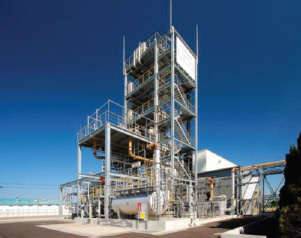
In this study, as part of the project by Ministry of the Environment (Japan), Mizuho Information & Research Institute, Inc. (MHIR) and Toshiba Corporation drafted the guidelines presenting the basic principles (methods, basic points) of environmental risk assessment with regard to exhaust gas and other parameters involved in the CO2 capture process. Based on Toshiba's emission data from 10 ton-CO2/day scale pilot plant using MEA solution at Mikawa coal-fired thermal power plant run by Sigma Power Ariake Co. Ltd. (Figure 1), MHIR conducted a trial of environmental risk assessment for the CO2 capture process, examined the risk assessment procedure, and drafted technical guidelines. The guidelines are expected to enable plant owners to make reasonable judgement on "how far emission should be reduced", and thus to decide "to what extent they should employ emission reduction technologies". And, the guidelines include "whole-mixture approach", which not only helps to overcome the issues typical of the CO2 capture process but also is easy to understand and thus familiar to local residents and public.
2. Drafting guidelines on assessing environmental risk for the CO2 capture process
2.1. Purpose
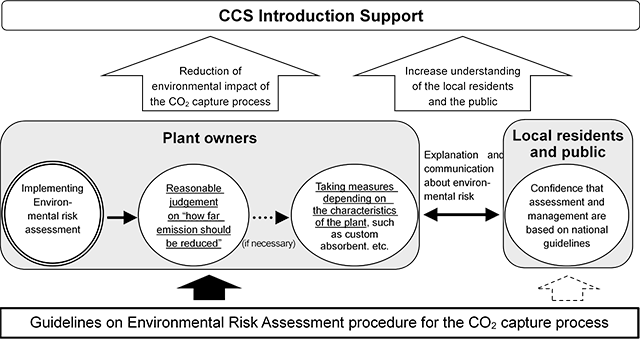
The drafted guidelines present the basic principles (methods, basic points) of environmental risk assessment with regard to exhaust gas and other parameters involved in the CO2 capture process, to reduce the environmental impact of the process and increase local residents and public understanding, and to promote the introduction of CCS. Companies gradually introducing CCS (development, demonstration, initial phase of commercialization, etc.) can instill confidence in the public and local residents especially when they can ensure safety by conducting risk assessment of the CO2 capture process based on the guidelines the government established and, if required, by undertaking emission reduction measures for harmful chemical substances. Furthermore, on the basis of results of the risk assessment, the guidelines support "rational management" ensuring environmental safety (Figure 2).
2.2. Scope of application of the Guidelines
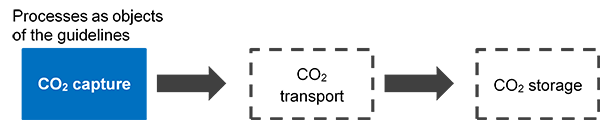
The guidelines are addressed to companies planning to implement the CO2 capture process in coal-fired power plants (Figure 3). We generally assume normal operating conditions. Thus, risks pertaining to accidents or disasters are outside the scope of the guidelines. In addition, we emphasize ensuring the safety of the general environment and not the working environment.
2.3. Contents of the Guidelines
The provisional contents of the guidelines are shown in Figure 4. For "Procedure of environmental risk assessment and management in the CO2 capture process", see Section 4. The guidelines include the test result of environmental risk assessment using Toshiba's emission data from 10 ton-CO2/day scale pilot plant at Mikawa coal-fired thermal power plant (not shown in this paper). Emission reduction technology and proper disposal treatment are also included as reference materials (not shown in this paper).
1.Introduction
1.1.Purpose
1.2.Scope of application of the Guidelines
1.3.The benefit of conducting voluntary environmental risk assessment
1.4.The basic concepts of environmental risk assessment
2.Procedure of environmental risk assessment and management in the CO2 capture process
2.1.Substances requiring risk assessment and management
2.2.Estimated emission and exposure scenario in the CO2 capture process
2.3.Identification and quantitative determination of substances emitted from the absorber
2.4.Toxicity assessment
2.5.Exposure assessment
2.6.Risk characterization
2.7.About the future application of bioassay
3.Implementation examples of environmental risk assessment
(CO2 capture process using MEA solution)
3.1.Emission and exposure scenario
3.2.About emission experiments and emission reduction tests in Mikawa Post Combustion Capture Pilot Plant
3.3.Identification and quantitative determination of materials emitted from the absorber
3.4.Toxicity assessment
3.5.Exposure assessment
3.6.Risk characterization
3.7.(Reference) emission reduction test
4.Reference materials
4.1.Emission reduction technology
4.2.About proper disposal treatment
2.4. The benefit of conducting voluntary environmental risk assessment
Reduction of the environmental impact of the CO2 capture process will obviously promote the introduction of CCS. In addition, the implementation of environmental risk assessment will enable a reasonable judgement on "how far emission should be reduced". Thus, the development of CO2 absorbents based on environmental considerations could be expected. Furthermore, through publication of Environmental Reports by companies, their commitment to protecting the environment will highlight their corporate values.
3. The characteristics of the CO2 capture process using amine solvents
Acid gas separation and recovery using amine solvents based on the chemical absorption method is conventionally used in natural gas purification, the hydrogen–ammonia industry, and the likes. On the other hand, the CO2 separation and recovery process intended for the combustion exhaust gas of fossil fuels mainly differs from the existing processes in the following points:
- Because the exhaust gas from thermal power plants includes oxygen, oxidative decomposition of the amines is likely to occur in the CO2 capture system.
- In addition to oxygen, impurities contained in the exhaust gas from thermal power plants exert an impact on the degree of degradation of the amines (and thus on the amount of emission) and the type of degradation products.
- With the future commercial development, the scale of the CO2 capture system will increase.
The degree of degradation of the amines (and thus the amount of emission to the environment) or the type of the degradation products formed depends on the type of amine utilized as the main agent of the CO2 absorbent and on the operating conditions of the CO2 capture process, such as amine concentration in the CO2 absorbent, CO2 loading (ratio of amine molecules bonded to CO2),reaction temperature in the absorber, temperature of the stripper, amount of oxygen, SOx, NOx, and particulate matter in the gas emitted from the power plant, composition of the particulate matter (iron, nickel, vanadium, phosphorus, chromium, cobalt, etc.), and catalytic effect owing to the material constituting the CO2 capture system [21-23].
Since the types of degradation products generated in the CO2 capture process are extremely diverse, identification of "all" degradation products (component-based approach; see Section 4.2) is economically and technically inefficient. From the perspective of environmental risk assessment, there are concerns that highly toxic substances with very small amount of emissions might be emitted into environment. For this reason, the use of the whole-mixture approach is considered complementary, as described in Section 4.3.
There are also differences between the CO2 capture process and existing process, for example, in the case of natural gas purification, the product is a treated gas free from oxygen, after passing through the absorber (thus not discharged into the environment).
4. The framework of environmental risk assessment and management for the CO2 capture process
Environmental risk assessment involves, in general, various steps such as determining the chemicals substances emitted into the environment and the amount of emissions, toxicity assessment, exposure assessment, and risk characterization [24].
In the CO2 capture process, numerous substances are generated secondarily and it is economically and technically not feasible to identify "all" these degradation products, as described in Section 3. Thus, conventional methods of risk assessment and management may not sufficiently ensure safety. For example, highly toxic substances (e.g. nitrosamines) with very small amount of emissions might be emitted into environment without identification. In addition, it may not be possible to publicize the components of the CO2 absorbent owing to intellectual property rights.
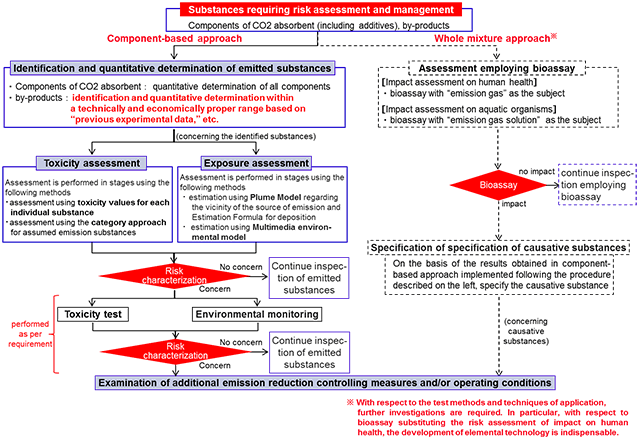
We consider the procedure shown in Figure 5 to conduct environmental risk assessment and management for the CO2 capture process. Here, we combine the conventional "component-based approach" with the "whole-mixture approach" to deal with the challenges for environmental risk assessment for the CO2 capture process. The following cases are given as examples, some substances are unidentified due to the detection limit, substances without toxicity information are included, and the components of CO2 absorbent solutions cannot be disclosed owing to intellectual property protection. It should be noted that the whole-mixture approach requires further testing and application (for the elemental technology; see Section 5.3 and Section 5.4). In the guidelines, the description is focused on the conventional component-based approach and outlined the perspective for the use of a bioassay among the techniques of the whole-mixture approach.
4.1. Substances requiring risk assessment and management
With regard to the components of the CO2 absorbent (all purposely used substances including the main agent) and the degradation products generated in the CO2 capture process, appropriate management based on risk assessment is necessary. Furthermore, it is necessary to identify the degradation products within technically and economically appropriate limits and measure their amount of emission to the environment.
4.2. Component-based approach
A general risk assessment is conducted through the component-based approach [24]. In addition to the component(s) of the CO2 absorbent (all purposely used substances including the main agent), every chemical substance generated as degradation products in the CO2 capture process is identified one-by-one and individually subjected to toxicity assessment (collection of toxicity data, implementation of toxicity tests), exposure assessment (collection of data concerning physicochemical properties, estimation of environmental concentrations using a mathematical model, and if necessary, conducting environmental monitoring), and risk characterization.
In general, risk assessment involves certain uncertainties. Therefore, ideas and methods with regard to safety should be viewed from a conservative scope within reasonable ranges. And, environmental risk assessment could be discussed thoroughly in detail, or implemented in a cost-efficient manner within scientifically reasonable range. For example, in the guidelines, in toxicity assessment, regarding the assessment of substances with missing toxicity data, toxicity tests should be performed as a general rule. However, before the toxicity tests are complete, risk characterization may be conducted using the toxicity levels of the most harmful substances among those assumed in the emissions as a reference. In addition, when the safety is not ensured because of the various uncertainties, an assessment through "category approach" could be implemented [25,26]. Furthermore, in the guidelines, in exposure assessment, the concentration in the environment is estimated using a mathematical model such as the Plume Model near the emission source. When the safety is not ensured because of the various uncertainties, safety can be confirmed by implementation of environmental monitoring.
4.3. Whole mixture approach
Although a general risk assessment is conducted through the component-based approach, such as in the case of the CO2 capture process using amine solvents, when some substances are unidentified due to the detection limit, or substances without toxicity information are included, complementation with the whole-mixture approach is effective (Table 1).
In the whole-mixture approach [27,28], inspection is based on the bioassay (biological response test), which is conducted "directly" on wastewater. In the United States, this test is known as Whole Effluent Toxicity (WET) test [29]. With this approach, the risk assessment can be conducted even if the unidentified substances are included. This method is therefore efficient to evaluate the impact of small amounts of degradation products as well as their additive effect and/or synergistic effect.
This approach is already introduced in the United States and other countries as a wastewater management technique. In the guidelines formulated for the implementation of "the International Convention for the Control and Management of Ship's Ballast Water and Sediments", adopted by the International Maritime Organization (IMO), in addition to the identification and toxicity testing of all active substances and by-products used in the processing of ballast water, a WET test is prescribed on the ballast wastewater itself: that is, the component-based approach and the whole-mixture approach are combined [30].
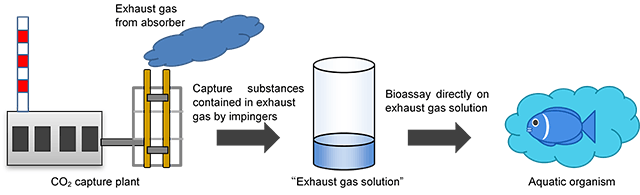
Also in the context of environmental risk assessment (and management) for the CO2 capture process, whole-mixture approach is effective. In the future, bioassays targeting "exhaust gases" (risk assessment of human health effects) and bioassays targeting "exhaust gas solutions" (risk assessment of the effect to an aquatic organism) are expected to be implemented (see Section 5.3, Section 5.4 and Figure 6). Since the whole-mixture approach enables assessment even when the presence of unidentified substances, it is suitable not only when substances without toxicity information are present, but also when the components of the CO2 absorbent solution cannot be disclosed owing to intellectual property protection. In addition, in performing a toxicity assessment using the exhaust gas or exhaust gas solution itself, the method is easy to understand and persuasive. Furthermore, by utilizing whole-mixture approach, the development of next-generation CO2 absorbents based on environmental considerations could be expected. On the other hand, if impacts are detected as a result of bioassays, it is needed to be supplemented by the component-based approach to employ emissions reduction measures targeting specific causative substances. In the same way as they are used in combination in the management of ballast water, these two approaches are complementary also in the context of environmental risk assessment for the CO2 capture process (Table 1).
4.4. About cases with possibility of risk concerns
When performing a step-wise evaluation, in the case of possibility of risk concerns despite reduction in uncertainty associated with the evaluation, additional emission control measures and/or analysis of the operating conditions such as reaction temperature of the absorber are performed, so as to reduce the environmental burden to a sufficiently safe level. It should be noted that the investigations are conducted in view of the characteristics of each CO2 capture plant, such as CO2 absorbent or operating conditions, and economic rationality. In the guidelines, in order to assist companies to select the optimal emission reduction technology in accordance with the characteristics of each plant, as reference information, various emission reduction technologies are introduced (not shown in this paper; see [31-33]).
5. Prospects of environmental risk assessment and management method for the CO2 capture process
5.1. Toxicity assessment for substances without toxicity information
An issue is that there is poor hazard information for substances emitted from the CO2 capture process. For example, in the test result of environmental risk assessment using Toshiba's emission data from 10 ton-CO2/day scale pilot plant using MEA solution at Mikawa coal-fired thermal power plant (Figure 1), 13 substances were identified as emitted substances. Of the 13 substances, there are hazard information for only 6 substances on human health and only 3 substances on aquatic organisms, respectively (Table 2).
To conduct a toxicity assessment for such substances without toxicity information, "category approach" is effective. However, the category approach requires further examination and application [25,26]. In such a situation, whole-mixture approach is also effective (see Section 5.3, Section 5.4 and Figure 6).
5.2. Mathematical model used for estimation of environmental concentration
The detailed mechanism of dynamics of treated flue gas composition, which would be driven by deviation of various operational conditions, is still unknown. Thus, it is difficult to determine the sufficiently representative numerical values which are treated as input data for mathematical models for estimating the environmental concentration. And, considering the increase of the scale of the CO2 capture system along with the future commercial development, it would be preferable to reduce the uncertainties derived from mathematical models by implementation of environmental monitoring, comparing the data with the estimated environmental concentrations, and improving mathematical model.
5.3. Bioassay targeting "exhaust gas" (assessment of impact on human health)
In future, to conduct a risk assessment of the impact on human health from the viewpoint of the whole-mixture approach, it is necessary to develop a method for comprehensive assessment of the toxicity of the exhaust gas (long-term inhalation exposure toxicity test). However, there are also issues relating to the technique of introducing the sample into the toxicity test equipment, while preserving its composition, as a first step. Therefore, genotoxicity tests, such as in vitro tests (ames test, and chromosomal aberration test) or comparatively simple in vivo tests with the use of exhaust gas (or exhaust gas solution) are necessary to evaluate the methods to be implemented. In addition, it is also necessary to consider a correlation between genotoxicity and carcinogenicity in risk assessment.
5.4. Bioassay targeting "exhaust gas solution" (assessment of the effect to an aquatic organism)
In future, to perform a risk assessment of the effect to an aquatic organism from the viewpoint of the whole-mixture approach (Figure 6), it is necessary to correlate the minimum dilution level of an exhaust gas solution, which is required to eliminate its adverse effects on aquatic organisms, with the substances' dilution rates in the environment. In particular, estimations of environmental concentrations using mathematical models, and environment measurements of concentration in the waters and deposition velocity are considered to be effective.
6. Conclusion
We drafted guidelines on environmental risk assessment method for the CO2 capture process, which enable plant owners to reduce the environmental impact of the process, to increase understanding of local residents (near CO2 capture plants) and public, and to promote the introduction of CCS. Now, in order to complete the framework of environmental risk assessment and management (Figure 5), we are trying to overcome the issues as described in Section 5, through the demonstration using post-combustion CO2 capture pilot plant and etc.
From the perspective of "environmental justice (especially procedural justice)", it is preferable that the risk assessment method is easy to understand [19,20]. Whole-mixture approach seems to not only overcome the issues typical of the CO2 capture process but also to be easy to understand and thus familiar to local residents and public.
Acknowledgements
This study was carried out as a part of the project "Feasibility study for the introduction of sustainable CCS technology" funded by Ministry of the Environment, Government of Japan. The authors would like to acknowledge the subcommittee for environmental impact of CO2 separation and capture absorbent.
References
[1]Hendriks C. Carbon Dioxide Removal from Coal-Fired Power Plants. Netherlands: Kluwer Academic Publishers; 1994.
[2]Gjernes E, Helgesen LI, Maree Y. Health and environmental impact of amine based post combustion CO2 capture. Energy Procedia 2013;37 :735 – 742.
[3]Shao R, Stangeland A. Amines Used in CO2 Capture: Health and Environmental Impacts. The Bellona Foundation (Norway). 2009.
[4]Knudsen S, Karl M, Randall S. Summary Report: Amine Emissions to Air During Carbon Capture. Norwegian Institute for Air Research (NILU). 2009.
[5]Brooks S. The toxicity of selected primary amines and secondary products to aquatic organisms: A review. Norwegian Institute for Water Research (NIVA). 2008.
[6]Låg M, Andreassen Å, Instanes C, Lindeman B. Health effects of different amines relevant for CO2 capture. Norwegian Institute of Public Health (FHI). 2009.
[7]Låg M, Instanes C, Lindeman B, Andreassen Å. Health effects of possible degradation products of different amines relevant for the CO2 capture. Norwegian Institute of Public Health (FHI). 2009.
[8]Karl M, Brooks S, Wright R, Knudsen S. Amines Worst Case Studies - Worst Case Studies on Amine Emissions from CO2 Capture Plants (Task 6). Norwegian Institute for Air Research (NILU). 2009.
[9]Azzi M., Tibbett A, Halliburton B, Element A, Artanto Y, Meuleman E, Feron P. Assessing Atmospheric Emissions from Amine-based CO2 Post-combustion Capture Processes and their Impacts on the Environment – A Case Study. Global Carbon Capture and Storage Institute (Global CCS Institute). 2014
[10]Lag M, Lindemann B, Instanes C, Brunborg G, Schwarze P. Health effects of amines and derivatives associated with CO2 capture. Norwegian Institute of Public Health (FHI). 2011.
[11]Selin NE. Environmental Guidelines and Regulations for Nitramines: A Policy Summary. Prepared for CO2 Technology Centre Mongstad. Final Report, 10 July 2011.
[12]World Resources Institute (WRI). CCS Guidelines: Guidelines for Carbon Dioxide Capture, Transport, and Storage.Washington, DC: WRI. 2008.
[13]Det Norske Veritas (DNV). QUALIFICATION PROCEDURES FOR CO2 CAPTURE TECHNOLOGY (RECOMMENDED PRACTICE DET NORSKE VERITAS DNV-RP-J201). 2010.
[14]Det Norske Veritas (DNV). Guideline for Selection and Qualification of Sites and Projects for Geological Storage of CO2 (DNV Report No.: 2009-1425). 2009.
[15]Det Norske Veritas (DNV). Guideline for the risk management of existing wells at CO2 geological storage sites (DNV Report No.: 2011-0448). 2011
[16]Forbes SM, Almendra F, ZieglerWorld MS. Guidelines for Community Engagement in Carbon Dioxide Capture, Transport, and Storage Projects. World Resources Institute (WRI).
[17]OECD. OECD Guidance Document on Risk Communication for Chemical Risk Management. 2002.
[18]European Chemicals Agency (ECHA). Guidance on the communication of information on the risks and safe use of chemicals. 2010.
[19]Walker G, Environmental Justice: Concepts, evidence and politics. New York: Routledge; 2012.
[20]Picou JS, Marshall BK. Contemporary Conceptions of Environmental Risk: Implications for Resource Management and Policy. Sociological Practice 2002;4:293-313.
[21]Thong D, Dave N, Feron P, Azzi M. Environmental Impacts of Amine-based CO2 Post Combustion Capture (PCC) Process Activity 3: Process Modelling for Amine-based Post Combustion Capture Plant. Commonwealth Scientific and Industrial Research Organisation (CSIRO). 2012.
[22]Thong D, Dave N, Feron P, Azzi M. Environmental Impacts of Amine-based CO2 Post Combustion Capture (PCC) Process Activity 3: Estimated emissions to the atmosphere from amine based PCC processes for a black coal fired power station based on literature and modelling. Commonwealth Scientific and Industrial Research Organisation (CSIRO). 2012.
[23]SINTEF. Evaluation of Solvents – Process and Atmospheric Chemistry. 2010.
[24]National Research Council. Risk assessment in the federal government: Managing the process. Washington, DC: National Academy Press; 1983.
[25]Buist HE, Devito S, Goldbohm RA, Stierum RH, Venhorst J, Kroese ED. Hazard assessment of nitrosamine and nitramine by-products of amine-based CCS: Alternative approaches. Regulatory Toxicology and Pharmacology 2015;71-3:601-623.
[26]Harju M, Ravnum S, Pran ER, Grossberndt S, Fjellsbø LM, Dusinska M, Heimstad ES. Alternative approaches to standard toxicity testing. Norwegian Institute for Air Research (NILU). 2011.
[27]Backhaus T, Blanck H, Faust M. Hazard and Risk Assessment of Chemical Mixtures under REACH State of the Art, Gaps and Options for Improvement. Swedish Chemicals Agency. 2010.
[28]Hartmanns A. A Comparative Assessment of the Environmental and Human Health - Related Legislation on Mixture Toxicity, in the USA and the EU. University of Gothenburg. 2014.
[29]United States Environmental Protection Agency (US EPA). Method Guidance and Recommendations for Whole Effluent Toxicity (WET) Testing (40 CFR Part 136). 2000.
[30]International Maritime Organization (IMO). PROCEDURE FOR APPROVAL OF BALLAST WATER MANAGEMENT SYSTEMS THAT MAKE USE OF ACTIVE SUBSTANCES (G9). 2008.
[31]Herman K, Falck DSE, Thor M, Andrew TF, Geir H, Anders HK, Domaas JK, Strøm T, Furuseth O, Hanssen KF, Wirsching H, Myhrvold T, Johnsen K. Emission Reducing Technologies H&ETQP Amine. SINTEF. 2011.
[32]Spietz T, Stec M, Tatarczuk A, Więcław L. Reduction of amines emission and their volatile degradation products. CHEMIK 2015;69-10: 625–634.
[33]Moser P, Schmidt S, Stahl K, Vorberg G, Lozano GA, Stoffregen T, Rösler F. Demonstrating Emission Reduction – Results from the Post - combustion Capture Pilot Plant at Niederaussem. Energy Procedia 2014; 63: 902 – 910.
Book
Business books explaining both domestic and overseas technologies and industry trends have been published. Books to answer the wide variety of needs such as instruction manuals for IT related technology and practical purpose books relating to environmental businesses have been published as well, and we have received high reviews from various fields.
Post-2020 Climate Action: Global and Asian Perspectives

Post-2020 Climate Action: Global and Asian Perspectives
This book summarizes assessments of the Paris Agreement to provide an excellent introduction to this research field. The AIM/CGE (Asia-Pacific Integrated Modeling /Computable General Equilibrium) model, which is the core of AIM modeling framework, is used for the assessment.
The first part focuses on global issues, presenting both short-term (a few decades) and long-term (century scale) assessments in the context of the Agreement’s ultimate climate goal. It also discusses policy implementation and climate risk.
Part 2 is a collection of assessments of individual Asian countries, providing insights into the national situations and detailed analyses. It includes contributions from Asian countries as well as NIES (National Institute for Environmental Studies, Japan) members. The main conclusion is that many countries require changes to their energy systems change and societal transformation in order to meet emissions targets.
Part 3 describes in detail the AIM/CGE model, which is used to evaluate the climate and energy policies by simulating the future economic and energy and environmental situation in the Asia-Pacific region. This section can be used as a standard text on CGE modelling in climate change mitigation.
Contents
Preface
Chapter 1
Introduction:Overview and Key Messages
Chapter 2
Implications of the Paris Agreement in the Context of Long-Term Climate Mitigation Goals
Chapter 3
Risks from Global Climate Change and the Paris Agreement
Chapter 4
Temporal and Spatial Distribution of Global Mitigation Cost: INDCs and Equity
Chapter 5
The Effectiveness of the International Emissions Trading under the Paris Agreement
Chapter 6
Achieving Carbon Emissions Peak in China by 2030: The Key Options and Economic Impacts
Chapter 7
India INDC Assessment: Emission Gap Between Pledged Target and 2℃ Target
Chapter 8
An Assessment of Indonesia's Intended Nationally Determined Contributions
Chapter 9
Quantitative Analysis of Japan's 2030 Target Based on AIM/CGE and AIM/Enduse
Chapter 10
Asian INDC Assessments: The Case of Thailand
Chapter 11
Realizing the Intended Nationally Determined
Chapter 12
AIM/CGE V2.0 Model Formula
Chapter 13
AIM/CGE V2.0: Basic Feature of the Model
Economic Reports
Mizuho Economic Outlook & Analysis
Mizuho Economic Outlook & Analysis provides Outlooks on the Japanese economy every quarter and in-depth analyses on economic issues on a timely basis.
Latest Reports
- Structural factors behind sluggish private consumption―Prolonged food inflation weighs on consumption―(PDF/301KB)Aug 27, 2025Aug 27, 2025
- FY2025 - FY2026 Economic Outlook―Global Economy in a Transition Phase amid Adjustments to Trump 2.0―(PDF/1,607KB)Jul 15, 2025Jul 15, 2025
- FY2025 - FY2026 Economic Outlook―The Global Economy in a Transition Phase toward the Readjustment of Globalization―(PDF/2,147KB)May 21, 2025May 21, 2025
- Tariff risks hit Japan as its competitiveness declines―Trump auto tariffs estimated to lower GDP by 0.3%―(PDF/355KB)May 2, 2025May 2, 2025
- FY2025 - FY2026 Economic Outlook―Structural changes and widening growth gaps on the back of Trump 2.0―(PDF/2,008KB)Mar 12, 2025Mar 12, 2025
- How should we evaluate the effects of economic measures?―Estimated impact on GDP and CPI and reduction in household spending burden―(PDF/586KB)Jan 21, 2025Jan 21, 2025
- Ecoomic Outlook 2025―Trump 2.0 Policy Assumptions and Impact on the Global Economy―(PDF/1,304KB)Jan 17, 2025Jan 17, 2025
- Changes in the Competitive Environment of the ASEAN Manufacturing Business(PDF/801KB)Nov 11, 2024Nov 11, 2024
- How will the Japanese economy be affected by rising interest rates?―The impact of a "0.5% rate hike" on the economy―(PDF/419KB)Sep 13, 2024Sep 13, 2024
- FY2024 - FY2025 Economic Outlook (July 2, 2024)―Economies return to growth at varying speeds, facing polarization and widening gaps―(PDF/913KB)Aug 30, 2024Aug 30, 2024
- 3 Scenarios of the Bank of Japan's Monetary Policy(PDF/582KB)Jun 25, 2024Jun 25, 2024
- Varying impact of high crude oil prices on Japan, the US, and Europe―Disruptors of inflation, the economy, and monetary policy―(PDF/268KB)Jun 18, 2024Jun 18, 2024
- FY2024 - FY2025 Economic Outlook (February 27, 2024)―The global economy is heading for a soft landing, but the moderate pace of recovery with lingering risks―(PDF/2,092KB)Apr 10, 2024Apr 10, 2024
- FY2024 New Year Economic Outlook―Dilemmas lurking in the last mile―(PDF/463KB)Feb 2, 2024Feb 2, 2024
- The Japanese Economy's Adaptability to"A World with Interest Rates"(PDF/442KB)December 11, 2023December 11, 2023
- FY2023 - FY2024 Economic Outlook (September 25, 2023)―The global economy is polarizing between the US and China. A sense of stagnation is gradually intensifying.―(PDF/1,356KB)October 24, 2023October 24, 2023
- Will "savings to investment" advance? - Keys to success of the Doubling Asset-based Income Plan and a simulation of the future―(PDF/295KB)October 16, 2023October 16, 2023
- The silicon cycle will soon bottom out - The “recovery” to positive y-o-y growth will probably take place from next spring―(PDF/1,002KB)September 4, 2023September 4, 2023
- FY2023 - FY2024 Economic Outlook―Economic slowdown due to rise of inflation and interest rates―(PDF/1,192KB)June 22, 2023June 22, 2023
- Evaluating India’s Growth Potential―Investment-led stable growth of 6%, with tailwinds for the IT/electronics sector―(PDF/2,863KB)May 30, 2023May 30, 2023
- 7 million labor shortage is expected in 2030―Japan needs to raise productivity through investment in labor saving and human capital―(PDF/1,356KB)Apr 28, 2023Apr 28, 2023
- Is supply chain restructuring good news for ASEAN?―Import dependence on Chinese parts growing behind rising ASEAN exports―(PDF/872KB)Apr 7, 2023Apr 7, 2023
- FY2023 - FY2024 Economic Outlook―Persistent inflationary pressures are lingering. Financial and monetary policy tightening serve as a drag on the global economy.―(PDF/1,224KB)Feb 21, 2023Feb 21, 2023
- China aims for economic normalization in 2023―Economic policy agenda was determined at an important conference based on the “live with the virus” policy―(PDF/679KB)Feb 15, 2023Feb 15, 2023
- FY2023 New Year Economic Outlook(PDF/679KB)Feb 15, 2023Feb 15, 2023
- Growing importance of stable energy supply―Policy support required for a stable procurement of fuels―(PDF/319KB)Jan 23, 2023Jan 23, 2023
- FY2022 - FY2023 Economic Outlook: October 24, 2022―Uncertainties intensified by government policies; rising risk of recession under inflation―(PDF/678KB)December 23, 2022December 23, 2022
- US Economy struggles with persistent inflation―Further tightening could lead to a recession in 2023―(PDF/413KB)December 6, 2022December 6, 2022
- Emerging Asian countries suffer from high inflation―Economic slowdown is expected in 2023 due to rising prices and interest rates―(PDF/329KB)October 7, 2022October 7, 2022
- FY2022 - FY2023 Economic Outlook: July 26, 2022―The future of global inflation and the world economy―(PDF/1,443KB)September 14, 2022September 14, 2022
- The COVID-hit Chinese Economy―The economy will return to cruise speed only in 2023, with a V-shaped recovery unlikely―(PDF/1,400KB)September 2, 2022September 2, 2022
- Japan's "New Form of Capitalism" and Human Capital Investment―Achieving a virtuous cycle of growth and distribution with JPY 4 trillion in annual human capital investment―(PDF/246KB)July 5, 2022July 5, 2022
- FY2022-FY2023 Economic Outlook: April 26, 2022―The global economy will slow down, given the surge of commodity prices accompanying Russia’s invasion of Ukraine―(PDF/1,118KB)June 14, 2022June 14, 2022
- FY2022-FY2023 Economic Outlook: February 18, 2022―Despite prolonged US inflation, the global economy should remain on a steady recovery path.―(PDF/555KB)Apr 12, 2022Apr 12, 2022
- Slowdown in the Chinese economy and its impact on the world―Sluggish property investment will dampen Japan’s growth rate―(PDF/447KB)Apr 7, 2022Apr 7, 2022
- FY2021-FY2022 Economic Outlook: December 17, 2021―Despite the recovery of the global economy, it will be necessary to keep a close eye upon Covid-19, the Chinese economy, and inflation risks―(PDF/1,049KB)Feb 21, 2022Feb 21, 2022
- Impact of the commodity market price hike on the Japanese economy―Deterioration in the terms of trade will place a 10 trillion-yen burden on companies and households―(PDF/483KB)Feb 14, 2022Feb 14, 2022
- Production-linked incentive (PLI) schemes in industrial policy boosts manufacturing investment in India―Highly likely to drive medium-term economic growth―(PDF/811KB)Feb 8, 2022Feb 8, 2022
- Emerging countries pressed to tackle inflation―The expected US monetary policy change and stagflation risk―(PDF/351KB)Jan 14, 2022Jan 14, 2022
- After COVID-19 pandemic, emerging Asian economies expecting downward pressure due to fiscal reform commitments(PDF/1.34MB)Dec 6, 2021Dec 6, 2021
- FY2021-FY2022 Economic Outlook: October 22, 2021―Despite prospects of global economic recovery, the resurgence of Covid-19 infections and supply constraints serve as a drag―(PDF/3.77MB)Dec 2, 2021Dec 2, 2021
- Automotive industry suffers from parts procurement―Japanese firms should prepare for long-term supply chain disruptions―(PDF/400KB)Nov 5, 2021Nov 5, 2021
- FY2021-FY2022 Economic Outlook: August 17, 2021―The pace of recovery has been polarized among regions. Polarized goods and services are expected to swing back.―(PDF/3.20MB)Oct 11, 2021Oct 11, 2021
- Economic effect of accelerated vaccinations―One million shots per day will boost Japan's FY2021 GDP by 1%―(PDF/755KB)Aug 24, 2021Aug 24, 2021
- FY2021-FY2022 Economic Outlook: May 20, 2021―The global economy is driven by the US and China. Disparities in capabilities to address the Covid-19 pandemic intensify.―(PDF/781KB)Jul 5, 2021Jul 5, 2021
- 2021 Summer Bonus Forecast―Year-on-year decline continues from last winter; bipolarization becomes even clearer―(PDF/392KB)Jun 28, 2021Jun 28, 2021
- Impact of the third declaration of a state of emergency―What actions are needed to prevent a resurgence of infections in the second half of the year?―(PDF/1.16MB)Jun 8, 2021Jun 8, 2021
- The ASEAN Export Industry Is Evolving―Production transfer from China has promoted the industry’s qualitative growth―(PDF/843KB)May 14, 2021May 14, 2021
- Corporate bankruptcies declined even amid the Covid-19 pandemic―“Exit strategies” for cashflow assistance measures will be the key for the future―(PDF/492KB)May 6, 2021May 6, 2021
- FY2020 - FY2022 Economic Outlook -Acceleration of investment for digitalization and the environment ("green investments") with a view to the world after Covid-19- (February 16, 2021)(PDF/260KB)Feb 22, 2021Feb 22, 2021
- Sustainability of the US dollar weakness against the Japanese yen -Future yen strengthening pressures are limited based upon current fundamentals- (December 29, 2020)(PDF/541KB)Feb 10, 2021Feb 10, 2021
- RCEP as a starting point for evolution -A mega EPA less than TPP but more than WTO- (November 30, 2020)(PDF/516KB)Jan 28, 2021Jan 28, 2021
MHRT Brief
MHRT Brief is a short report on the Japanese/global economies and financial markets.
Latest Reports
- The growing labor shortage in Japan―Two types of labor market mismatches are contributing factors―(PDF/354KB)Jun 24, 2025Jun 24, 2025
- The impact of the Bank of Japan's additional rate hike on households―Positive for households as a whole, but significant negative impact for debt-holding households―(PDF/344KB)Feb 27, 2025Feb 27, 2025
- Alternative for Germany gaining wider support―Concerns about political and economic stagnation and the rightward shift of the younger generation―(PDF/476KB)Nov 19, 2024Nov 19, 2024
- Background of the Working Hour Decline in Europe(February 28, 2024)―People are increasingly looking for ways to reduce working hours centered on educated groups―(PDF/1,107KB)May 15, 2024May 15, 2024
- New NISA expected to have a limited impact on the USD/JPY exchange rate (January 30, 2024)(PDF/331KB)Feb 26, 2024Feb 26, 2024
- Looking back at the Japanese economy's "2% interest rate era"―The biggest difference between then and now is the BOJ's JGB holdings―(PDF/307KB)Decembe 8, 2023Decembe 8, 2023
- China's Economy Continues to Face Challenges―Double-dip decline of the economy averted, but real estate remains sluggish―(PDF/454KB)November 7, 2023November 7, 2023
- Will high wage growth continue in 2024?―Wage increase momentum is expected to recede next year as inflation slows―(PDF/516KB)July 31, 2023July 31, 2023
- A JGB downgrade may be triggered by Bank of Japan’s policy change ―Worry that a slowdown in long-term government bond purchases may prompt a downgrade―(PDF/302KB)May 8, 2023May 8, 2023
- How long will Japan's high inflation last?―Combined factors slow the CPI to the 1% range year-on-year in the second half of FY2023―(PDF/776KB)Mar 13, 2023Mar 13, 2023
- Relaxation of border control accelerates Japan’s inbound recovery―Boosts GDP by 0.2% in FY2022. Limited effect to restrain the yen’s decline―(PDF/411KB)November 4, 2022November 4, 2022
- Is household tolerance of rising prices really improving? -“Price increase tolerance DI” is declining, which suggests Japan’s households are still price-sensitive- (June 10, 2022)(PDF/367KB)August 9, 2022August 9, 2022
- Japan’s economy under pressure of yen depreciation and commodity price hikes -A wide range of firms and households will be directly hit by the demerits of yen depreciation- (April 22, 2022)(PDF/396KB)June 13, 2022June 13, 2022
- Tokyo sees a dramatic decline in population inflow and a sharp rise in outflow -The pandemic brought change to unipolar concentration in Tokyo- (March 31, 2022)(PDF/337KB)May 12, 2022May 12, 2022
- Grain inflation shakes emerging countries -Watch out for a "multicrisis" of inflation, foreign currency shortage, and political instability- (April 8, 2022)(PDF/0.97MB)May 12, 2022May 12, 2022
- Price hike strikes a heavier blow to low–income households -Slashed education expenses may widen the education gap even further- (January 24, 2022)(PDF/335KB)Mar 11, 2022Mar 11, 2022
- Price hike of daily necessities generates a regressive financial burden on households -Financial impact on low-income households is equivalent to a more than 2% consumption tax increase- (January 27, 2022)(PDF/356KB)Mar 10, 2022Mar 10, 2022
- Japan's industrial production growing firmly even under the Declaration of a State of Emergency -Information-related goods and capital goods are the drivers of growth- (March 1, 2021)(PDF/315KB)Mar 16, 2021Mar 16, 2021
- 2021 Economic Outlook (December 18, 2020)(PDF/360KB)Dec 28, 2020Dec 28, 2020
Monthly Economic Report
Fixed-point analysis of the Japanese economy and financial markets on a monthly basis.
Latest Reports
- Monthly Economic Report: March 23, 2022(PDF/642KB)Apr 25, 2022Apr 25, 2022
- Monthly Economic Report: February 22, 2022(PDF/988KB)Mar 25, 2022Mar 25, 2022
- Monthly Economic Report: January 25, 2022(PDF/0.95MB)Feb 28, 2022Feb 28, 2022
- Monthly Economic Report: December 21, 2021(PDF/1.26MB)Jan 27, 2022Jan 27, 2022
- Monthly Economic Report: November 19, 2021(PDF/785KB)Dec 17, 2021Dec 17, 2021
- Monthly Economic Report: October 21, 2021(PDF/1.39MB)Nov 18, 2021Nov 18, 2021
- Monthly Economic Report: September 22, 2021(PDF/1.03MB)Oct 21, 2021Oct 21, 2021
- Monthly Economic Report: August 24, 2021(PDF/1.04MB)Sep 28, 2021Sep 28, 2021
- Monthly Economic Report: July 21, 2021(PDF/967KB)Aug 25, 2021Aug 25, 2021
- Monthly Economic Report: June 23, 2021(PDF/1.19MB)Jul 21, 2021Jul 21, 2021
- Monthly Economic Report: May 26, 2021(PDF/1.18MB)Jun 28, 2021Jun 28, 2021
- Monthly Economic Report: April 26, 2021(PDF/0.99MB)Jun 9, 2021Jun 9, 2021
- Monthly Economic Report: March 29, 2021(PDF/990KB)Apr 30, 2021Apr 30, 2021
- Monthly Economic Report: February 25, 2021(PDF/1.15MB)Mar 31, 2021Mar 31, 2021
- Monthly Economic Report: January 28, 2021(PDF/545KB)Mar 5, 2021Mar 5, 2021
- Monthly Economic Report: December 24, 2020(PDF/631KB)Feb 1, 2021Feb 1, 2021
- Monthly Economic Report: November 30, 2020(PDF/418KB)Jan 12, 2021Jan 12, 2021
Mizuho Research Paper
In-depth analysis on economy and finance of Japan and Asia.
Latest Reports
Mizuho Economic Outlook & Analysis Back Number(2020)
Mizuho Economic Outlook & Analysis provides Outlooks on the Japanese economy every quarter and in-depth analyses on economic issues on a timely basis.
- Determinants of households' risk assets holding -The causal structure estimation through machine learning- (October 20, 2020)(PDF/524KB)Dec 18, 2020Dec 18, 2020
- FY2020 - FY2021 Economic Outlook -Even though the global economy should recover, the pace of recovery will be varied among countries due to differences in household and corporate behavior- [Summary] (December 10, 2020)(PDF/135KB)Dec 15, 2020Dec 15, 2020
- Impact of a prolonged "Covid-19 shock" -Impact of sluggish consumption of face-to-face services- (September 25, 2020)(PDF/406KB)Nov 17, 2020Nov 17, 2020
- The Chinese economy continuing its moderate recovery -The focus is on expanding domestic demand and enhancing innovation capability- (October 1, 2020)(PDF/426KB)Nov 16, 2020Nov 16, 2020
- "Corona special demand" offset by import hike -High dependence on China supply chains reconfirmed- (September 3, 2020)(PDF/336KB)Oct 20, 2020Oct 20, 2020
- The "corona shock" and the Japanese economy -Substantial contraction of the economy expected in FY2020. Future recovery will be slow- (August 18, 2020)(PDF/389KB)Oct 7, 2020Oct 7, 2020
- FY2020 - FY2021 Economic Outlook -Forecast of a slow recovery of the Japanese economy due to concerns regarding a resurgence of Covid-19 infections- REVISED to reflect the 2nd QE for the Apr-Jun Qtr of 2020 (September 8, 2020)(PDF/160KB)Sep 18, 2020Sep 18, 2020
- Whose income is slashed due to the COVID-19 crisis? -About one-third of households expect to see their income fall even after receiving the special cash payments- (July 21, 2020)(PDF/373KB)Sep 14, 2020Sep 14, 2020
- FY2020 - FY2021 Economic Outlook -The recovery of mobility will be slow. Level of GDP among developed countries will fall short of a rebound to pre-Covid levels- (August 18, 2020)(PDF/844MB)Sep 11, 2020Sep 11, 2020
- The current state and outlook on the gold market -We expect that the gold market will follow firm footing reflecting high uncertainties and persisting low interest rate environment- (August 3, 2020)(PDF/356KB)Sep 4, 2020Sep 4, 2020
- Economic Impact of the Second Supplementary Budget -Early execution and recovery of trust in government are the keys- (June 22, 2020)(PDF/410KB)Aug 27, 2020Aug 27, 2020
- FY2020 - FY2021 Economic Outlook -The recovery of mobility will be slow. Level of GDP among developed countries will fall short of a rebound to pre-Covid levels- [Summary] (August 18, 2020)(PDF/135KB)Aug 20, 2020Aug 20, 2020
- Impacts and Issues of Japan's Pension System Reform -Reform of the pension system to enhance the financial base of seniors- (June 11, 2020)(PDF/242KB)Aug 7, 2020Aug 7, 2020
- The potential for home-based work in Japan -Around 30% of workers can work from home- (May 22, 2020)(PDF/352KB)Jul 7, 2020Jul 7, 2020
- First-year landscape of the new "Specified Skilled Worker" residence status system -Accumulated challenges keep the number of accepted foreign workers much smaller than expected- (April 1, 2020)(PDF/123KB)Jun 8, 2020Jun 8, 2020
- Transformation of China's outward direct investment -Investments to the US and Europe fell sharply, but investments to Asia remain robust- (March 4, 2020)(PDF/381KB)Apr 6, 2020Apr 6, 2020
- Semiconductor market "before the dawn" -Semiconductor demand in 2020 is expected to pick up- (January 15, 2020)(PDF/373KB)Mar 25, 2020Mar 25, 2020
- Expected measures for local governments to promote the SDGs -Coordination and incentives required to encourage SDG businesses- (January 16, 2020)(PDF/397KB)Mar 19, 2020Mar 19, 2020
- FY2019 - FY2021 Economic Outlook -Dark clouds gather over the global economic recovery scenario due to the spread of novel coronavirus (COVID-19)- (February 20, 2020)(PDF/508MB)Mar 16, 2020Mar 16, 2020
- FY2019 - FY2021 Economic Outlook -Dark clouds gather over the global economic recovery scenario due to the spread of coronavirus (COVID-19)- [Summary] (February 20, 2020)(PDF/135KB)Feb 26, 2020Feb 26, 2020
- Expanding the 20% medical fee copayment to include seniors aged 75 or over -Review of an interim report of the planning meeting on a social security system oriented to all generations- (December 20, 2019)(PDF/262KB)Feb 7, 2020Feb 7, 2020
- China's infrastructure investment coming out of sluggishness -Expected to continue a moderate recovery to shore up the economy in 2020- (December 25, 2019)(PDF/279KB)Feb 7, 2020Feb 7, 2020
Back Number
Mizuho Economic Outlook & Analysis Back Number(2019)
Mizuho Economic Outlook & Analysis provides Outlooks on the Japanese economy every quarter and in-depth analyses on economic issues on a timely basis.
- RCEP comes to a crossroads -Even though an agreement in principle is reached among 15 nations, India suggests that it may withdraw- (November 18, 2019)(PDF/258KB)Dec 23, 2019Dec 23, 2019
- Analysis of Household Consumption Dynamics -Considerations for the Consumption Stimulus- (October 30, 2019)(PDF/332KB)Dec 17, 2019Dec 17, 2019
- FY2019, FY2020 Economic Outlook -The Japanese economy will remain on weak footing due to the slowdown of capital investment and tepid recovery of consumer spending- REVISED to reflect the 2nd QE for the Jul-Sep Qtr of 2019 (December 9, 2019)(PDF/328KB)Dec 12, 2019Dec 12, 2019
- Deciphering China's "Fourth Plenum" Communique -The principles and ideals of governance based on party guidance were reaffirmed- (November 7, 2019)(PDF/274KB)Dec 2, 2019Dec 2, 2019
- Second round of the regional revitalization initiative starts from FY2020 -Promoting central cities of regional economies is a key challenge- (November 1, 2019)(PDF/233KB)Nov 27, 2019Nov 27, 2019
- FY2019, FY2020 Economic Outlook -Even though the global economy should bottom out through 2020, uncertainties will linger- (November 15, 2019)(PDF/442KB)Nov 21, 2019Nov 21, 2019
- Dependence on trade with China growing globally -Transitions in the past 20 years and the future under US-China rivalry- (October 16, 2019)(PDF/352KB)Nov 18, 2019Nov 18, 2019
- Only a partial agreement reached on the Japan-US Trade Agreement -"Initial Agreement" in line with the US wish for an early conclusion- (October 8, 2019)(PDF/307KB)Nov 8, 2019Nov 8, 2019
- Slowing exports dampening China's manufacturing investment -Impact of US-China trade tensions on capital spending by listed firms- (September 27, 2019)(PDF/328KB)Oct 31, 2019Oct 31, 2019
- Pension reform from the viewpoint of financial verification -It is important to expand the Employees' Pension Insurance coverage and promote labor participation- (September 9, 2019)(PDF/319KB)Oct 17, 2019Oct 17, 2019
- When will Japan’s capital goods exports begin to pick up? -The timing of recovery may be delayed to the latter half of 2020- (September 2, 2019)(PDF/377KB)Oct 10, 2019Oct 10, 2019
- FY2019, FY2020 Economic Outlook -The global economy will continue to slow down due to the escalation of US-China trade tensions- (August 13, 2019)(PDF/1.51MB)Oct 7, 2019Oct 7, 2019
- Emerging market currency depreciation and debt problems -Latent risk in the expansion of foreign currency debt in China's private sector- (September 4, 2019)(PDF/434KB)Sep 30, 2019Sep 30, 2019
- Status of the private lodging market one year after the new law enactment -The market dwindled due to new restrictions, but its presence is growing in central Tokyo and some regional areas- (August 16, 2019)(PDF/426KB)Sep 30, 2019Sep 30, 2019
- China's interest rate marketization takes a step forward -Interest rates cut substantively, albeit marginally, following reform measur- (August 22, 2019)(PDF/446KB)Sep 19, 2019Sep 19, 2019
- Revision of the Companies Act aimed at improving corporate governance -The revised law is expected to be enacted next year at the earliest, its effectiveness is being required- (July 24, 2019)(PDF/225KB)Sep 12, 2019Sep 12, 2019
- FY2019, FY2020 Economic Outlook -The Japanese economy should remain on weak footing given the stagnation of exports and slowdown of domestic demand- REVISED to reflect the 2nd QE for the Apr-Jun Qtr of 2019 (September 9, 2019)(PDF/848KB)Sep 11, 2019Sep 11, 2019
- Developments in interest rate benchmark reform -Responses to the discontinuation of LIBOR are urgently needed- (July 24, 2019)(PDF/455KB)Sep 5, 2019Sep 5, 2019
- FY2019, FY2020 Economic Outlook -The global economy will continue to slow down due to the escalation of US-China trade tensions- [Summary] (August 13, 2019)(PDF/135KB)Aug 15, 2019Aug 15, 2019
- Reforms to social security system for all generations -Both benefits and burdens should target people of all generations- (July 22, 2019)(PDF/188KB)Aug 9, 2019Aug 9, 2019
- The number of foreign visitors to Japan in 2020 -The yellow light is flashing for the attainment of the 40 million inbound target- (July 8, 2019)(PDF/459KB)Aug 6, 2019Aug 6, 2019
- Policy response to the increasing importance of population decline -Employment promotion and regional revitalization under the Basic Policy 2019- (July 8, 2019)(PDF/463KB)Jul 30, 2019Jul 30, 2019
- Launch of "Osaka Track" on Digital Rules -Many difficulties lie ahead for WTO e-commerce negotiations- (July 2, 2019)(PDF/287KB)Jul 26, 2019Jul 26, 2019
- Building momentum for measures against climate change -Risks and investment opportunities cited by central banks and regulatory authorities- (June 5, 2019)(PDF/451KB)Jul 22, 2019Jul 22, 2019
- Dark clouds loom over the semiconductor market -Bottoming out will likely drag on with the trade war escalating between the US and China- (June 4, 2019)(PDF/270KB)Jul 9, 2019Jul 9, 2019
- Impact of US-China Trade Tensions on Asia (II) -A simulation of the risks in the event the US and China invoke punitive tariffs upon all US-China trade- (June 4, 2019)(PDF/332KB)Jun 25, 2019Jun 25, 2019
- The Impact of US-China Tensions on China's Exports -Substitution of China's exports has expanded to over 30% of tariff items- (May 27, 2019)(PDF/1.31MB)Jun 19, 2019Jun 19, 2019
- US automobile import restriction measures will shift to negotiations -Concerns over additional tariffs and import quotas remain- (May 20, 2019)(PDF/266KB)Jun 18, 2019Jun 18, 2019
- FY2019, FY2020 Economic Outlook -The Japanese economy will continue to lack strength- REVISED to reflect the 2nd QE for the Jan-Mar Qtr of 2019 (June 10, 2019)(PDF/156KB)Jun 12, 2019Jun 12, 2019
- The 19th Questionaire Survey of Japanese Corporate Enterprises Regarding Business in Asia (February 2019) -Japanese Firms Concerned over China's Economic Slowdown and U.S.-China Trade Tensions- (May 17, 2019)(PDF/381KB)Jun 6, 2019Jun 6, 2019
- Will Japan fall into economic recession? -Detailed analysis of the Tankan survey and consideration based on a historical DI estimate- (April 15, 2019)(PDF/176KB)Jun 3, 2019Jun 3, 2019
- FY2019, FY2020 Economic Outlook -The global economy is gradually slowing down, and a further downshift may ensue if trade tensions escalate- (May 21, 2019)(PDF/1.06MB)Jun 3, 2019Jun 3, 2019
- FY2019, FY2020 Economic Outlook -The global economy is gradually slowing down, and a further downshift may ensue if trade tensions escalate- [Summary] (May 21, 2019)(PDF/131KB)May 27, 2019May 27, 2019
- Will the effects of China's economic stimulus measures materialize? -Evaluation of Jan-Mar quarter real GDP and analysis of policy effects- (April 23, 2019)(PDF/266KB)May 24, 2019May 24, 2019
- India, Indonesia and the Philippines: Will their current account balances continue to deteriorate? (April 1, 2019)(PDF/184KB)May 8, 2019May 8, 2019
- FY2018, FY2019 and FY2020 Economic Outlook -The global economy is headed for a slowdown in 2020, and uncertainty remains high- (February 15, 2019)(PDF/1.36MB)Apr 8, 2019Apr 8, 2019
- BOJ ETF Purchases After Flexibility -Delaying aggravating side effects still leaves an element of risk- (February 27, 2019)(PDF/274KB)Apr 3, 2019Apr 3, 2019
- FY2018, FY2019, FY2020 Economic Outlook -The Japanese economy will continue to lack strength due to the slowdown of exports- REVISED to reflect the 2nd QE for the Oct-Dec Qtr of 2018 (March 8, 2019)(PDF/156KB)Mar 11, 2019Mar 11, 2019
- Economic impact of building national resilience and the supplementary budget -Expectations and risks of mitigating the reactionary downturn- (January 28, 2019)(PDF/131KB)Mar 7, 2019Mar 7, 2019
- Will condominium prices in the Tokyo metropolitan area fall sharply? (February 8, 2019)(PDF/233KB)Mar 4, 2019Mar 4, 2019
- Land prices in regional areas recover thanks to expanding inbound demand (January 16, 2019)(PDF/274KB)Feb 25, 2019Feb 25, 2019
- FY2018, FY2019, FY2020 Economic Outlook -The global economy is headed for a slowdown in 2020, and uncertainties remain high- [Summary] (February 15, 2019)(PDF/131KB)Feb 18, 2019Feb 18, 2019
- Impact of trade friction on capital investment -Uncertainty restrains capital investment growth by around 1%Pt- (December 14, 2018)(PDF/303KB)Feb 6, 2019Feb 6, 2019
- Japan's trade policy challenges in 2019 -The focus of attention is on mega FTAs, WTO reform, and the Japan-US trade talks- (December 21, 2018)(PDF/705KB)Feb 6, 2019Feb 6, 2019
- Effects and challenges of measures to deal with the consumption tax hike -Economic impact of spending stimulus measures totaling roughly 150 billion yen- (November 30, 2018)(PDF/139KB)Jan 24, 2019Jan 24, 2019
Back Number
Mizuho Economic Outlook & Analysis Back Number(2018)
Mizuho Economic Outlook & Analysis provides Outlooks on the Japanese economy every quarter and in-depth analyses on economic issues on a timely basis.
- Asia's Debt Risks -The risk of financial crises is limited, but attention should be paid to slowing domestic demand- (November 15, 2018)(PDF/160KB)Dec 21, 2018Dec 21, 2018
- 2019 Economic Outlook for Major Emerging Market (EM) Countries (December 13, 2018)(PDF/504KB)Dec 21, 2018Dec 21, 2018
- Japan's foreign direct investment trends in Asia -Investment growth in the field of next-generation automobiles- (November 2, 2018)(PDF/156KB)Dec 18, 2018Dec 18, 2018
- FY2018, FY2019 Economic Outlook -Japan's economic recovery will moderate due to the slowdown of exports- REVISED to reflect the 2nd QE for the Jul-Sep Qtr of 2018 (December 10, 2018)(PDF/147KB)Dec 18, 2018Dec 18, 2018
- FY2018, FY2019 Economic Outlook -Despite slower growth in 2019, the economy should remain firm. Keep a close eye upon the rise of uncertainties- (November 15, 2018)(PDF/893KB)Dec 17, 2018Dec 17, 2018
- How a rise in crude oil prices may affect Asian countries -The key factor is whether these countries can absorb the negative impact from a decline in terms of trade- (October 4, 2018)(PDF/131KB)Dec 3, 2018Dec 3, 2018
- FY2018, FY2019 Economic Outlook -Desite slower growth in 2019, the economy should remain firm. Keep a close eye upon the rise of uncertainties- [Summary] (November 15, 2018)(PDF/131KB)Nov 19, 2018Nov 19, 2018
- Policy Issues facing the Abe Administration in the final stage of Abenomics -Looking beyond to "post-Abenomics"- (October 10, 2018)(PDF/303KB)Nov 19, 2018Nov 19, 2018
- China's "explosive buying" fuels Japan's industrial robot exports (September 26, 2018)(PDF/360KB)Nov 1, 2018Nov 1, 2018
- Will the consumption tax hike dampen consumer spending once again? -Households' familiar prices and thrift-consciousness hold the key- (September 7, 2018)(PDF/582KB)Oct 15, 2018Oct 15, 2018
- Contagion risk of Turkey's currency shock -Similarities and differences with past currency crises- (September 10, 2018)(PDF/745KB)Sep 26, 2018Sep 26, 2018
- FY2018, FY2019 Economic Outlook -Despite ongoing expansion, the global economy is maturing. Keep a close eye upon the escalation of trade friction- (August 13, 2018)(PDF/1.13MB)Sep 19, 2018Sep 19, 2018
- FY2018, FY2019 Economic Outlook -The Japanese economy is continuing to follow a recovery track- REVISED to reflect the 2nd QE for the Apr-Jun Qtr of 2018 (September 10, 2018)(PDF/156KB)Sep 13, 2018Sep 13, 2018
- Japan's foreign population hitting a record high -The government announces the acceptance of more foreign workers- (July 25, 2018)(PDF/360KB)Sep 13, 2018Sep 13, 2018
- The light and shadow of the e-commerce market -The expansion of e-commerce is weighing down prices.Boosting the elderly's consumption is the key- (July 12, 2018)(PDF/156KB)Aug 20, 2018Aug 20, 2018
- FY2018, FY2019 Economic Outlook -Despite ongoing expansion, the global economy is maturing. Keep a close eye upon the escalation of trade friction- [Summary] (August 13, 2018)(PDF/131KB)Aug 14, 2018Aug 14, 2018
- Japan's fiscal consolidation plan revised -Need to strengthen expenditure reform to achieve a primary balance surplus in FY2025- (June 27, 2018)(PDF/213KB)Jul 31, 2018Jul 31, 2018
- Looking at the future potential labor supply through the first release of labor underutilization indicators (June 21, 2018)(PDF/360KB)Jul 30, 2018Jul 30, 2018
- Medium-term Economic Outlook on the Japanese Economy -The Japanese Economy will sustain 1% growth in the 2020s in the course of 3 mega-trends and by overcoming 3 major challenges- (June 28, 2018)(PDF/1.05MB)Jul 26, 2018Jul 26, 2018
- FY2018, FY2019 Economic Outlook -Despite the ongoing expansion of the global economy, keep a close eye upon protectionism and risks of higher interest rates- (May 17, 2018)(PDF/1.67MB)Jul 5, 2018Jul 5, 2018
- Is there any sign of change in the price trend? -Some industries including restaurants have started transferring costs onto service prices- (June 1, 2018)(PDF/242KB)Jul 2, 2018Jul 2, 2018
- Impact of the yen appreciation on corporate earnings -10% rise in the yen slashes corporate earnings by 0.2 trillion yen and GDP by 0.2%- (May 11, 2018)(PDF/328KB)Jun 18, 2018Jun 18, 2018
- FY2018, FY2019 Economic Outlook -The Japanese economy will return to a gradual recovoery track- REVISED to reflect the 2nd QE for the Jan-Mar Qtr of 2018 (June 8, 2018)(PDF/156KB)Jun 11, 2018Jun 11, 2018
- Japan-US leaders agreed to start new trade talks -A prelude to negotiating a Japan-US FTA?- (April 20, 2018)(PDF/119KB)Jun 4, 2018Jun 4, 2018
- The 18th Questionnaire Survey of Japanese Corporate Enterprises Regarding Business in Asia (February 2018) -Japanese Firms Reevaluate China as a Destination for Business Expansion- (May 2, 2018)(PDF/332KB)May 23, 2018May 23, 2018
- FY2018, FY2019 Economic Outlook -Despite the ongoing expansion of the global economy, keep a close eye upon protectionism and risks of higher interest rates- [Summary] (May 17, 2018)(PDF/131KB)May 21, 2018May 21, 2018
- Outlook and comments on the review of Japan's fiscal consolidation plan -Some proposals for achieving a primary balance surplus- (April 6, 2018)(PDF/135KB)May 9, 2018May 9, 2018
- The rise of "familiar prices" is pushing down consumer spending -Households are sensitive to rising food and energy prices and practical price increases- (March 8, 2018)(PDF/201KB)Apr 10, 2018Apr 10, 2018
- FY2017, FY2018, FY2019 Economic Outlook -While the global economy will continue to expand, keep a close eye upon shifts in the financial market- (February 15, 2018)(PDF/2.00MB)Apr 3, 2018Apr 3, 2018
- Bank of Japan’s new leadership nomination underscores intention to maintain current monetary policy stance -Vice Governor Wakatabe emphasizes quantity but no change in policy direction- (February 20, 2018)(PDF/205KB)Mar 27, 2018Mar 27, 2018
- FY2017, FY2018, FY2019 Economic Outlook -Firm outlook on both domestic and overseas economic growth remains unchanged- REVISED to reflect the 2nd QE for the Oct-Dec Qtr of 2017 (March 8, 2018)(PDF/250KB)Mar 13, 2018Mar 13, 2018
- New focus on inbound tourism and updates on estimated hotel shortages (January 26, 2018)(PDF/221KB)Feb 27, 2018Feb 27, 2018
- FY2017, FY2018, FY2019 Economic Outlook -While the global economy will continue to expand, keep a close eye upon shifts in the financial market- [Summary] (February 15, 2018)(PDF/152KB)Feb 19, 2018Feb 19, 2018
- Will the BOJ shift its monetary policy? -We need to watch how the Bank of Japan responds when interest rates start rising- (December 27, 2017)(PDF/106KB)Feb 5, 2018Feb 5, 2018
- Five years of Abenomics and policy issues going forward -Japan's economic revival remains the Abe administration's focus as it takes a step toward a long-term administration- (December 21, 2017)(PDF/1.82MB)Jan 30, 2018Jan 30, 2018
Back Number
Mizuho Economic Outlook & Analysis Back Number(2017)
Mizuho Economic Outlook & Analysis provides Outlooks on the Japanese economy every quarter and in-depth analyses on economic issues on a timely basis.
- FY2017, FY2018 Economic Outlook -The global economy will continue to grow throughout 2018- (November 16, 2017)(PDF/1.14MB)Dec 27, 2017Dec 27, 2017
- 2018 Economic Outlook for Major Emerging Market (EM) Contries (December 18, 2017)(PDF/3.04MB)Dec 25, 2017Dec 25, 2017
- Trends in Japan's Foreign Direct Investment (FDI) toward Asia -Since the second half of 2016, FDI toward China has been rising, driven by the manufacturing industry- (November 16, 2017)(PDF/238KB)Dec 21, 2017Dec 21, 2017
- FY2017, FY2018 Economic Outlook -Outlook on Japan's economic growth in FY2017 revised up, to a strong pace of growth reaching almost +2%- REVISED to reflect the 2nd QE for the Jul-Sep Qtr of 2017 (December 8, 2017)(PDF/193KB)Dec 18, 2017Dec 18, 2017
- Corporate behaviors shown in cash flows -Signs of change in broadly-defined investment (M&A, etc.) and funding in Japan- (October 20, 2017)(PDF/512KB)Dec 4, 2017Dec 4, 2017
- FY2017, FY2018 Economic Outlook -The global economy will continue to expand in 2018- [Summary] (November 16, 2017)(PDF/131KB)Nov 24, 2017Nov 24, 2017
- Regional characteristics of Japanese agriculture as revealed by the data -Agricultural policies responsive to local conditions will be crucial- (September 4, 2017)(PDF/246KB)Oct 16, 2017Oct 16, 2017
- FY2017, FY2018 Economic Outlook -Even though the global economy is continuing to grow, the "new normal" is a world of low inflation and low interest rates- (August 15, 2017)(PDF/1.92MB)Oct 10, 2017Oct 10, 2017
- FY2017, FY2018 Economic Outlook -The Japanese economy is still following firm footing despite a downward revision of growth reflecting the Second Preliminary Quarterly Estimates of GDP- REVISED to reflect the 2nd QE for the Apr-Jun Qtr of 2017 (September 8, 2017)(PDF/164KB)Sep 13, 2017Sep 13, 2017
- Real estate market trends in Japan -The impact of the increase in office supply and a re-evaluation of the "market polarization"- (July 19, 2017)(PDF/602KB)Sep 6, 2017Sep 6, 2017
- E-Commerce creating new business opportunities and challenges in the Chinese economy (July 12, 2017)(PDF/197KB)Sep 1, 2017Sep 1, 2017
- Will AI take away our jobs? -Our concern should not be the loss of jobs but the mismatch- (July 18, 2017)(PDF/242KB)Aug 28, 2017Aug 28, 2017
- FY2017, FY2018 Economic Outlook -Even though the global economy is continuing to grow, the "new normal" is a world of low inflation and low interest rates- [Summary] (August 15, 2017)(PDF/131KB)Aug 17, 2017Aug 17, 2017
- Significance of the Japan-EU EPA - The Agreement in Principle -Restart of Japan’s trade strategy- (July 12, 2017)(PDF/127KB)Aug 14, 2017Aug 14, 2017
- The declining birthrate and population aging will reduce the labor force by 40.1% -Work-style reform holds the key to a higher labor force participation rate- (May 31, 2017)(PDF/152KB)Jul 4, 2017Jul 4, 2017
- FY2017, FY2018 Economic Outlook -While the global economy is following a gradual expansion, keep a close eye upon US policy agenda and geopolitical risks- (May 19, 2017)(PDF/770KB)Jun 23, 2017Jun 23, 2017
- "Three inconvenient truths" and "three proposals" concerning Japan’s exit policy -How can Japan escape the "eternal zero?"- (May 19, 2017)(PDF/377KB)Jun 20, 2017Jun 20, 2017
- FY2017, FY2018 Economic Outlook -The Japanese economy is enjoying the recovery of both domestic and external demand- REVISED to reflect the 2nd QE for the Jan-Mar Qtr of 2017 (June 8, 2017)(PDF/147KB)Jun 12, 2017Jun 12, 2017
- The Bank of Japan continues playing the endurance game -Hurdles for the exit policy and issues facing the BOJ's Governor Kuroda- (April 28, 2017)(PDF/197KB)Jun 5, 2017Jun 5, 2017
- Reasons why condominium prices do not fall -Prices are expected to remain high due to three factors- (April 24, 2017)(PDF/172KB)May 26, 2017May 26, 2017
- FY2017, FY2018 Economic Outlook -While the global economy is following a gradual expansion, keep a close eye upon US policy agenda and geopolitical risks- [Summary] (May 19, 2017)(PDF/131KB)May 23, 2017May 23, 2017
- The 17th Questionnaire Survey of Japanese Corporate Enterprises Regarding Business in Asia (February 2017) -Japanese Manufacturers Reviving Interest in Asian Investment, But Wary of Trade with the U.S.- (May 2, 2017)(PDF/324KB)May 15, 2017May 15, 2017
- How will US-China trade friction affect the Japanese economy? (April 6, 2017)(PDF/262KB)May 10, 2017May 10, 2017
- Measures to address Japan’s falling birthrate should target those in the 20s -Despite a slight rise of the birthrate in the 30s+ age bracket, it is not enough- (February 14, 2017)(PDF/238KB)Apr 12, 2017Apr 12, 2017
- FY2016, FY2017, FY2018 Economic Outlook -While the global economy is on growth track, US policy agenda and European political developments are risk factors- (February 14, 2017)(PDF/881KB)Mar 28, 2017Mar 28, 2017
- Japan’s potential growth rate was revised upward to nearly 1% reflecting the new GDP standard (January 27, 2017)(PDF/147KB)Mar 21, 2017Mar 21, 2017
- FY2016, FY2017, FY2018 Economic Outlook -While the global economy is on growth track, US policy agenda and European political developments are risk factors- (March 2017)(PDF/254KB)Mar 13, 2017Mar 13, 2017
- FY2016, FY2017, FY2018 Economic Outlook -The 2nd QE indicates a clearer recovery of the Japanese economy driven by the corporate sector- REVISED to reflect the 2nd QE for the Oct-Dec Qtr of 2016 (March 8, 2017)(PDF/147KB)Mar 13, 2017Mar 13, 2017
- Premium Friday should push up personal consumption by approximately ¥200 billion to ¥300 billion (February 6, 2017)(PDF/98KB)Feb 27, 2017Feb 27, 2017
- FY2016, FY2017, FY2018 Economic Outlook -While the global economy is on growth track, US policy agenda and European political developments are risk factors- [Summary] (February 14, 2017)(PDF/131KB)Feb 16, 2017Feb 16, 2017
- Recording of R&D set to bring greater strength to capital investment as a component of GDP (December 20, 2016)(PDF/147KB)Feb 14, 2017Feb 14, 2017
- The BOJ after the Comprehensive Assessment will shift to a managed float system with the US adoption of Trumponomics -The BOJ may tolerate a gradual rise without fixing long-term interest rates- (November 24, 2016)(PDF/872KB)Jan 18, 2017Jan 18, 2017
- FY2016, FY2017 Economic Outlook -The global economy will gradually pick up. Will Trump change the world?- (November 15, 2016)(PDF/541KB)Jan 16, 2017Jan 16, 2017
Back Number
Mizuho Economic Outlook & Analysis Back Number(2016)
Mizuho Economic Outlook & Analysis provides Outlooks on the Japanese economy every quarter and in-depth analyses on economic issues on a timely basis.
- 2017 Economic Outlook for Major Emerging Market Economies (December 20, 2016)(PDF/483KB)Dec 22, 2016Dec 22, 2016
- FY2016, FY2017 Economic Outlook -Considering the coming Trump administration's policy agenda, forecasts have been revised upward mainly on the US economy- REVISED to reflect the 2nd QE for the Jul-Sep Qtr of 2016 (December 8, 2016)(PDF/311KB)Dec 20, 2016Dec 20, 2016
- Rise in the population not in the labour force is prominent among men -Measures for people who do not prioritize employment are necessary- (October 12, 2016)(PDF/254KB)Dec 12, 2016Dec 12, 2016
- FY2016, FY2017 Economic Outlook -The global economy will gradually pick up. Will Trump change the world?- (December 2016)(PDF/123KB)Dec 7, 2017Dec 7, 2017
- Corporate behaviors shown in cash flows -Signs of change in broadly-defined investment (M&A, etc.) and funding in Japan- (October 20, 2017)(PDF/512KB)Dec 7, 2016Dec 7, 2016
- FY2016, FY2017 Economic Outlook -The global economy will gradually pick up. Will Trump change the world?- [Summary] (November 15, 2016)(PDF/131KB)Nov 16, 2016Nov 16, 2016
- Rising private debt in the emerging market countries -may weigh on the recovery of private demand and restrain the implementation of economic stimulus measures- (September 29, 2016)(PDF/160KB)Nov 14, 2016Nov 14, 2016
- Issues left unresolved in the BOJ's "Comprehensive Assessment" -Monetary policy has limits in overcoming the malfunction of the monetary transmission mechanism- (October 3, 2016)(PDF/160KB)Nov 9, 2016Nov 9, 2016
- Upcoming agricultural policies in the autumn of 2016 -The key agendas are further promotion of feed rice production and the introduction of income insurance system- (October 31, 2016)(PDF/119KB)Oct 31, 2016Oct 31, 2016
- What are the factors behind China's sharp investment slowdown? -The rise of uncertainty over economic policy may have affected investment in China- (September 2, 2016)(PDF/225KB)Oct 24, 2016Oct 24, 2016
- FY2016, FY2017 Economic Outlook -"New normal" under prolonged 3Ls (Low growth, Low inflation, Low interest rates), swirling uncertainties in the world- (August 16, 2016)(PDF/758KB)Oct 4, 2016Oct 4, 2016
- The BOJ’s Comprehensive Assessment will be a de facto game changer of its monetary policy framework -"Five Proposals" for the extension of monetary easing toward the year 2020- (September 8, 2016)(PDF/303KB)Sep 15, 2016Sep 15, 2016
- FY2016, FY2017 Economic Outlook -The Japanese economy will continue to follow a public demand-dependent recovery (no material chgange from our outlook released in August)- REVISED to reflect the 2nd QE for the Apr-Jun Qtr of 2016 (September 8, 2016)(PDF/139KB)Sep 12, 2016Sep 12, 2016
- Brexit and its impact on the global economy (August 31, 2016)(PDF/332KB)Sep 8, 2016Sep 8, 2016
- FY2016, FY2017 Economic Outlook -The global economy faces mounting uncertainties- (September 2016)(PDF/123KB)Sep 5, 2016Sep 5, 2016
- Commitment to 2% price stability target to be tested with BOJ "September Comprehensive Assessment" (August 12, 2016)(PDF/94KB)Aug 29, 2016Aug 29, 2016
- FY2016, FY2017 Economic Outlook -"New normal" under prolonged 3Ls (Low growth, Low inflation, Low interest rates), swirling uncertainties in the world- [Summary] (August 16, 2016)(PDF/131KB)Aug 17, 2016Aug 17, 2016
- Policy issues facing the Abe administration after the Upper House election -The ruling coalition has secured a stable policy foundation- (July 27, 2016)(PDF/225KB)Aug 15, 2016Aug 15, 2016
- Background of the slowdown in inbound tourism consumption per person and its future outlook (June 23, 2016)(PDF/188KB)Aug 8, 2016Aug 8, 2016
- How should we view the fall of real estate prices in Hong Kong and Singapore? (June 2, 2016)(PDF/324KB)Jul 19, 2016Jul 19, 2016
- The impact of the fall of interest rates upon retirement benefit obligations of Japanese corporate enterprises -While the impact on a macro basis will likely be minimal, some corporations may suffer an unexpected blow- (May 2, 2016)(PDF/254KB)Jul 11, 2016Jul 11, 2016
- FY2016, FY2017 Economic Outlook -Amid persisting concerns of a global economic downturn, fiscal stimulus will underpin the economy- (May 20, 2016)(PDF/586KB)Jun 28, 2016Jun 28, 2016
- Challenges for Japanese companies to grow in the expanding "global technology frontier" (May 10, 2016)(PDF/496KB)Jun 21, 2016Jun 21, 2016
- FY2016, FY2017 Economic Outlook -Even though the postponement of the consumption tax hike has eased uncertainties, the slowdown of the overseas economies will serve as a drag upon the Japanese economy- REVISED to reflect the 2nd QE for the Jan-Mar Qtr of 2016 (June 8, 2016)(PDF/160KB)Jun 14, 2016Jun 14, 2016
- FY2016, FY2017 Economic Outlook -Amid persisting concerns of a global economic downturn, fiscal stimulus will underpin the economy- (June 2016)(PDF/123KB)Jun 6, 2016Jun 6, 2016
- Japan's population has started to shrink and polarize geographically -The census reveals the concentration of people in large cities and city centers- (April 5, 2016)(PDF/266KB)May 30, 2016May 30, 2016
- Equilibrium real interest rates in the US are negative 2% -Estimates based on the modified LW model and its implications- (April 4, 2016)(PDF/336KB)May 25, 2016May 25, 2016
- FY2016, FY2017 Economic Outlook -Amid persisting concerns of a global economic downturn, fiscal stimulus will underpin the economy- [Summary] (May 20, 2016)(PDF/131KB)May 24, 2016May 24, 2016
- The 16th Questionnaire Survey of Japanese Corporate Enterprises Regarding Business in Asia (February 2016)(PDF/377KB)May 17, 2016May 17, 2016
- The depreciation of the renminbi may have a negative impact on the Asian economies (February 12, 2016)(PDF/332KB)Apr 25, 2016Apr 25, 2016
- Determining factors of inbound travel to Japan -A stronger yen matters more for the NIEs than China- (February 19, 2016)(PDF/344KB)Apr 11, 2016Apr 11, 2016
- Inbound tourism props up Japan's employment growth -"Employment generation" of approximately 270,000 jobs expected- (February 17, 2016)(PDF/123KB)Mar 22, 2016Mar 22, 2016
- FY2015, FY2016, FY2017 Economic Outlook -Note the risk of the EM slowdown setting off a global contagion- (February 16, 2016)(PDF/745KB)Mar 17, 2016Mar 17, 2016
- FY2015, FY2016, FY2017 Economic Outlook -The Japanese economy is forecast to remain in a soft patch in the Jan-Mar quarter of 2016- REVISED to reflect the 2nd QE for the Oct-Dec Qtr of 2015 (March 8, 2016)(PDF/143KB)Mar 11, 2016Mar 11, 2016
- Factors behind Japan's sluggish capital investment growth -Capital investment targets have shifted to areas not yet captured by current GDP statistics- (January 22, 2016)(PDF/418KB)Mar 8, 2016Mar 8, 2016
- Note the risk of the EM slowdown setting off a global contagion -Even though the Japanese economy avoided a recession, its pace of recovery will be slow- (March 2016)(PDF/143KB)Mar 8, 2016Mar 8, 2016
- Quality is the key to the future of Japan's exports -amid China's rising presence in the capital goods markets of the US and the EU- (January 8, 2016)(PDF/238KB)Feb 18, 2016Feb 18, 2016
- FY2015, FY2016, FY2017 Economic Outlook -Note the risk of the EM slowdown setting off a global contagion- [Summary] (February 16, 2016)(PDF/131KB)Feb 18, 2016Feb 18, 2016
- The supplementary budget should push up GDP growth by 0.3% -Method to allocate welfare benefits to low-income pensioners remains an issue- (January 12, 2016)(PDF/274KB)Feb 9, 2016Feb 9, 2016
- Durable goods hamper personal consumption growth -A full-scale stock adjustment has been triggered by the front-loading of future demand- (January 5, 2016)(PDF/332KB)Jan 29, 2016Jan 29, 2016
- The Risks of the Materialization of Concerns over the EM Economies -keep a close eye upon the "Risky Four"- (December 2, 2015)(PDF/340KB)Jan 21, 2016Jan 21, 2016
Back Number
Mizuho Economic Outlook & Analysis Back Number(2015)
Mizuho Economic Outlook & Analysis provides Outlooks on the Japanese economy every quarter and in-depth analyses on economic issues on a timely basis.
- 2016 Economic Outlook A restart of Japan's virtuous cycle (January 1, 2016)(PDF/217KB)Dec 25, 2015Dec 25, 2015
- Impact of the global economic slowdown on corporate earnings -Even though the impact on ordinary profits should be limited, watch out for a dampening of business sentiment- (October 28, 2015)(PDF/156KB)Dec 14, 2015Dec 14, 2015
- FY2015, FY2016 Economic Outlook -A slight upward revision on Japan's growth, given the upturn of Japan's real GDP growth into positive territory in the Jul-Sep quarter of 2015- REVISED to reflect the 2nd QE for the Jul-Sep Qtr of 2015 (December 8, 2015)(PDF/221KB)Dec 10, 2015Dec 10, 2015
- Will Japan's investment in Asia stay firm? -ASEAN continues to be the top key destination while China bottoms out, but the outlook remains uncertain-(PDF/270KB)Dec 7, 2015Dec 7, 2015
- FY2015, FY2016 Economic Outlook -Keep a close eye upon EM downside risks amid the sluggish recovery of the global economy- (November 17, 2015)(PDF/1.21MB)Dec 3, 2015Dec 3, 2015
- Abenomics' Second Stage: "Dynamic Engagement of All Citizens"(PDF/180KB)Nov 19, 2015Nov 19, 2015
- Provisional Evaluation of the Agreement on the Trans-Pacific Partnership (TPP) -Based on the summary of the TPP agreement by the government of Japan released on October 5, 2015- (October 19, 2015)(PDF/311KB)Nov 5, 2015Nov 5, 2015
- Verification of the risk of recession driven by external demand -Despite the risk of a small setback, a serious adjustment will likely be avoided- (October 1, 2015)(PDF/209KB)Nov 2, 2015Nov 2, 2015
- Japan's Inequality Today and Policy Issues (September 30, 2015)(PDF/852KB)Oct 7, 2015Oct 7, 2015
- Mid- to Long-term Economic Outlook -Forecast on the global economy up to 2020 based on a long-term perspective- (July 24, 2015)(PDF/950KB)Oct 2, 2015Oct 2, 2015
- FY2015, FY2016 Economic Outlook -Another downward revision due to negative spillover of China risks- REVISED to reflect the 2nd QE for the Apr-Jun Qtr of 2015 (September 8, 2015)(PDF/926KB)Sep 18, 2015Sep 18, 2015
- FY2015, FY2016 Economic Outlook -The slowdown is temporary. Even though the global economy will follow a gradual recovery, watch the rise of risks regarding China- (August 18, 2015)(PDF/1.26MB)Sep 9, 2015Sep 9, 2015
- An analysis of factors behind the post-tax hike consumer spending slump -Note a change in buying appetite in the high income bracket-(PDF/250KB)Aug 11, 2015Aug 11, 2015
- FY2015, FY2016 Economic Outlook -Despite a downward revision of US growth, our outlook on a recovery from the Apr-Jun quarter remains unchanged- REVISED to reflect the 2nd QE for the Jan-Mar Qtr of 2015 (June 8, 2015)(PDF/393KB)Jun 22, 2015Jun 22, 2015
- FY2015, FY2016 Economic Outlook -Despite uncertainties, the global economy will grow, driven mainly by the developed economies- (May 21, 2015)(PDF/1.11MB)Jun 12, 2015Jun 12, 2015
- Recent Trends in the Real Estate Market -Despite signs of market overheating, investors remain calm and selective-(PDF/356KB)Jun 4, 2015Jun 4, 2015
- The 15th Questionnaire Survey of Japanese Corporate Enterprises Regarding Business in Asia (February 2015)(PDF/778KB)May 25, 2015May 25, 2015
- Sustainability of Quantitative and Qualitative Monetary Easing(PDF/111KB)Mar 31, 2015Mar 31, 2015
- FY2014, FY2015, FY2016 Economic Outlook -The Japanese and US economies should gather pace despite the slow recovery of the global economy- REVISED to reflect the 2nd QE for the Oct-Dec Qtr of 2014 (March 9, 2015)(PDF/147KB)Mar 20, 2015Mar 20, 2015
- FY2014, FY2015, FY2016 Economic Outlook -The Japanese and US economies should gather pace despite the slow recovery of the global economy- (February 17, 2015)(PDF/713KB)Mar 10, 2015Mar 10, 2015
- Ongoing Agricultural Reforms Led by the Abe Administration(PDF/225KB)Feb 10, 2015Feb 10, 2015
- Effect of the Formation of the Customs Union by Russia, Belarus, and Kazakhstan(PDF/193KB)Jan 13, 2015Jan 13, 2015
- FY2014, FY2015 Economic Outlook -While the sharp fall of crude oil prices will serve as underpinnings of the global economy, watch closely for its impact upon finance- (December 18, 2014)(PDF/328KB)Jan 7, 2015Jan 7, 2015
Back Number
Mizuho Economic Outlook & Analysis Back Number(2014)
Mizuho Economic Outlook & Analysis provides Outlooks on the Japanese economy every quarter and in-depth analyses on economic issues on a timely basis.
- Medium-term Economic Outlook and Japan's Demographic and Regional Issues -The World in 2020 as Projected by Mizuho Research Institute- (October 2014)(PDF/446KB)Dec 26, 2014Dec 26, 2014
- FY2014, FY2015 Economic Outlook -The "Triple Merits" will boost the Japanese economy- REVISED to reflect the 2nd QE for the Jul-Sep Qtr of 2014 (December 9, 2014)(PDF/156KB)Dec 12, 2014Dec 12, 2014
- FY2014, FY2015 Economic Outlook -The "Triple Merits" will boost the Japanese economy- (November 18, 2014)(PDF/561KB)Dec 8, 2014Dec 8, 2014
- The Economic Impact of the 2020 Tokyo Olympic Games(PDF/340KB)Oct 17, 2014Oct 17, 2014
- FY2014, FY2015 Economic Outlook REVISED to reflect the 2nd QE for the Apr-Jun Qtr of 2014 (September 9, 2014)(PDF/168KB)Sep 24, 2014Sep 24, 2014
- FY2014, FY2015 Economic Outlook (August 15, 2014)(PDF/418KB)Sep 3, 2014Sep 3, 2014
- Japanese companies see ASEAN with a mixture of anticipation and concern -Results of Questionnaire Survey of Japanese Corporate Enterprises Regarding Business in Asia as of February 2014-(PDF/430KB)Jul 24, 2014Jul 24, 2014
- FY2014, FY2015 Economic Outlook REVISED to reflect the 2nd QE for the Jan-Mar Qtr of 2014 (June 9, 2014)(PDF/168KB)Jun 12, 2014Jun 12, 2014
- FY2014, FY2015 Economic Outlook (May 16, 2014)(PDF/262KB)Jun 2, 2014Jun 2, 2014
- Cambodia seen as a location for new production bases -Better investment environment puts Cambodia ahead of Myanmar-(PDF/705KB)Apr 30, 2014Apr 30, 2014
- China's Economic Outlook Based on the Presentation at the NPC -Taking measures to tackle a potential economic slowdown while pushing through reform-(PDF/184KB)Apr 24, 2014Apr 24, 2014
- FY2013, FY2014, FY2015 Economic Outlook REVISED to reflect the 2nd QE for the Oct-Dec Qtr of 2013 (March 10, 2014)(PDF/168KB)Mar 17, 2014Mar 17, 2014
- FY2013, FY2014, FY2015 Economic Outlook (February 18, 2014)(PDF/303KB)Mar 6, 2014Mar 6, 2014
- Situation Surrounding the Indonesian Presidential Election -The odds are high that a reformist candidate will be elected and move to improve the country's investment environment-(PDF/422KB)Feb 7, 2014Feb 7, 2014
Back Number
Mizuho Economic Outlook & Analysis Back Number(2013)
Mizuho Economic Outlook & Analysis provides Outlooks on the Japanese economy every quarter and in-depth analyses on economic issues on a timely basis.
- Japanese investments in China and ASEAN countries since the second half of 2012 -More Japanese companies opting for the China-Plus-One strategy-(PDF/221KB)Dec 17, 2013Dec 17, 2013
- FY2013 and FY2014 Economic Outlook REVISED to reflect the 2nd QE for the Jul-Sep Qtr of 2013 (December 10, 2013)(PDF/164KB)Dec 13, 2013Dec 13, 2013
- FY2013 and FY2014 Economic Outlook (November 15, 2013)(PDF/205KB)Dec 2, 2013Dec 2, 2013
- FY2013 and FY2014 Economic Outlook REVISED to reflect the 2nd QE for the Apr-Jun Qtr of 2013 (September 9, 2013)(PDF/160KB)Sep 18, 2013Sep 18, 2013
- FY2013 and FY2014 Economic Outlook (August 14, 2013)(PDF/216KB)Sep 4, 2013Sep 4, 2013
- How Far Will the Yen Fall? -What the industry average equilibrium rate tells us-(PDF/148KB)Jul 3, 2013Jul 3, 2013
- FY2013 and FY2014 Economic Outlook REVISED to reflect the 2nd QE for the Jan-Mar Qtr of 2013 (June 10, 2013)(PDF/148KB)Jun 14, 2013Jun 14, 2013
- FY2013 and FY2014 Economic Outlook (May 17, 2013)(PDF/264KB)May 30, 2013May 30, 2013
- FY2012, FY2013 and FY2014 Economic Outlook REVISED to reflect the 2nd QE for the Oct-Dec Qtr of 2012 (March 8, 2013)(PDF/152KB)Mar 14, 2013Mar 14, 2013
- FY2012, FY2013 and FY2014 Economic Outlook (February 15, 2013)(PDF/192KB)Mar 4, 2013Mar 4, 2013
Back Number
Mizuho Economic Outlook & Analysis Back Number(2012)
Mizuho Economic Outlook & Analysis provides Outlooks on the Japanese economy every quarter and in-depth analyses on economic issues on a timely basis.
- FY2012 and FY2013 Economic Outlook REVISED to reflect the 2nd QE for the Jul-Sep Qtr of 2012 (December 11, 2012)(PDF/148KB)Dec 18, 2012Dec 18, 2012
- FY2012 and FY2013 Economic Outlook (November 2012)(PDF/128KB)Nov 28, 2012Nov 28, 2012
- Farm Land Policy and Agriculture Recovery after the Great East Japan Earthquake(PDF/204KB)Nov 1, 2012Nov 1, 2012
- FY2012 and FY2013 Economic Outlook REVISED to reflect the 2nd QE for the Apr-Jun Qtr of 2012 (September 2012)(PDF/164KB)Sep 20, 2012Sep 20, 2012
- FY2012 and FY2013 Economic Outlook (August 2012)(PDF/200KB)Aug 27, 2012Aug 27, 2012
- FY2012 and FY2013 Economic Outlook (June 2012)(PDF/144KB)Jun 14, 2012Jun 14, 2012
- FY2012 and FY2013 Economic Outlook (May 2012)(PDF/228KB)May 24, 2012May 24, 2012
- FY2011, FY2012 and FY2013 Economic Outlook (REVISED to reflect the 2nd QE for the Oct-Dec Qtr of 2011)(PDF/88KB)Mar 13, 2012Mar 13, 2012
- FY2011, FY2012 and FY2013 Economic Outlook (February 2012)(PDF/204KB)Feb 24, 2012Feb 24, 2012
Back Number
Mizuho Economic Outlook & Analysis Back Number(2011)
Mizuho Economic Outlook & Analysis provides Outlooks on the Japanese economy every quarter and in-depth analyses on economic issues on a timely basis.
- Economic Outlook for FY2011 and FY2012 (revised to reflect the Second Preliminary Quarterly Estimates of GDP for the Jul-Sep quarter of 2011)(PDF/111KB)Dec 16, 2011Dec 16, 2011
- Economic Outlook for FY2011 and FY2012 (November 2011)(PDF/192KB)Nov 24, 2011Nov 24, 2011
- Economic Outlook for FY2011 and FY2012(revised to reflect the Second Preliminary Quarterly Estimates of GDP for the Apr-Jun quarter of 2011)(PDF/119KB)Sep 16, 2011Sep 16, 2011
- Economic Outlook for FY2011 and FY2012 (August 2011)(PDF/243KB)Sep 01, 2011Sep 01, 2011
- Economic Outlook for FY2011 and FY2012(revised to reflect the Second Preliminary Quarterly Estimates of GDP for the Jan-Mar quarter of 2011)(PDF/174KB)Jun 14, 2011Jun 14, 2011
- Economic Outlook for FY2011 and FY2012(May 2011)(PDF/197KB)Jun 01, 2011Jun 01, 2011
- Economic Outlook for FY2010, FY2011 and FY2012 (revised after the Great East Japan Earthquake)(PDF/132KB)Apr 08, 2011Apr 08, 2011
- Economic Outlook for FY2010, FY2011 and FY2012 (February 2011)(PDF/190KB)Feb 28, 2011Feb 28, 2011
Back Number
Mizuho Economic Outlook & Analysis Back Number(2010)
Mizuho Economic Outlook & Analysis provides Outlooks on the Japanese economy every quarter and in-depth analyses on economic issues on a timely basis.
- Economic Outlook for FY2010 and FY2011(revised to reflect the Second Preliminary Quarterly Estimates of GDP for the Jul-Sep quarter of 2010)(PDF/106KB)Dec 14, 2010Dec 14, 2010
- Economic Outlook for FY2010 and FY2011 (November 2010)(PDF/144KB)Nov 29, 2010Nov 29, 2010
- Economic Outlook for FY2010 and FY2011(revised to reflect the Second Preliminary Quarterly Estimates of GDP for the Apr-Jun quarter of 2010)(PDF/115KB)Sep 16, 2010Sep 16, 2010
- Economic Outlook for FY2010 and FY2011 (August 2010)(PDF/136KB)Aug 30, 2010Aug 30, 2010
- Economic Outlook for FY2010 and FY2011(revised to reflect the Second Preliminary Quarterly Estimates of GDP for the Jan-Mar quarter of 2010)(PDF/107KB)Jun 17, 2010Jun 17, 2010
- Economic Outlook for FY2010 and FY2011 (May 2010)(PDF/149KB)Jun 02, 2010Jun 02, 2010
- Fiscal Management by the Hatoyama Administration: an assessment of the FY2010 budget(PDF/366KB)Mar 23, 2010Mar 23, 2010
- Economic Outlook for FY2009, FY2010 and FY2011(revised to reflect the Second Preliminary Quarterly Estimates of GDP for the Oct-Dec quarter of 2009)(PDF/195KB)Mar 17, 2010Mar 17, 2010
- Economic Outlook for FY2009, FY2010 and FY2011 (February 2010)(PDF/242KB)Mar 01, 2010Mar 01, 2010
Back Number
Mizuho Economic Outlook & Analysis Back Number(2009)
Mizuho Economic Outlook & Analysis provides Outlooks on the Japanese economy every quarter and in-depth analyses on economic issues on a timely basis.
- Economic Outlook for FY2009 and FY2010 (revised to reflect the Second Preliminary Quarterly Estimates of GDP for the Jul-Sep quarter of 2009)(PDF/111KB)Dec 17, 2009Dec 17, 2009
- Economic Outlook for FY2009 and FY2010 (November 2009)(PDF/174KB)Dec 03, 2009Dec 03, 2009
- Economic Outlook for FY2009 and FY2010(revised to reflect the Second Preliminary Quarterly Estimates of GDP for the Apr-Jun quarter of 2009)(PDF/103KB)Sep 17, 2009Sep 17, 2009
- Economic Outlook for FY2009 and FY2010 (August 2009)(PDF/180KB)Sep 02, 2009Sep 02, 2009
- Will the Chinese Economy Drive Japan's Export Recovery?(PDF/154KB)Aug 07, 2009Aug 07, 2009
- Economic Outlook for FY2009 and FY2010(revised to reflect the Second Preliminary Quarterly Estimates of GDP for the Jan-Mar quarter of 2009)(PDF/139KB)Jun 19, 2009Jun 19, 2009
- Economic Outlook for FY2009 and FY2010 (May 2009)(PDF/205KB)Jun 03, 2009Jun 03, 2009
- An Overview and Impact of the Expanded Tax Cut on Residential Mortgages(PDF/252KB)May 18, 2009May 18, 2009
- Economic Outlook for FY2008, FY2009 and FY2010(revised to reflect the Second Preliminary Quarterly Estimates of GDP for the Oct-Dec quarter of 2008)(PDF/189KB)Mar 17, 2009Mar 17, 2009
- Economic Outlook for FY2008, FY2009 and FY2010 (February 2008)(PDF/201KB)Feb 27, 2009Feb 27, 2009
- The Sharp Fall of the South Korean Won in 2008: the background and prospects(PDF/168KB)Feb 13, 2009Feb 13, 2009
Back Number
- Back Number(2020)
- Back Number(2019)
- Back Number(2018)
- Back Number(2017)
- Back Number(2016)
- Back Number(2015)
- Back Number(2014)
- Back Number(2013)
- Back Number(2012)
- Back Number(2011)
- Back Number(2010)
- Back Number(2008)
- Back Number(2007)
- Back Number(2006)
- Back Number(2005)
- Back Number(2004)
- Back Number(2003)
Mizuho Economic Outlook & Analysis Back Number(2008)
Mizuho Economic Outlook & Analysis provides Outlooks on the Japanese economy every quarter and in-depth analyses on economic issues on a timely basis.
- The Impact of the Unprecedented Financial Turmoil on Corporate Earnings and Financial Conditions-estimates based upon stock prices and foreign exchange rates as of the end of October 2008-(PDF/278KB)Dec 22, 2008Dec 22, 2008
- Economic Outlook for FY2008 and FY2009 (revised to reflect the Second Preliminary Quarterly Estimates of GDP for the Jul-Sep quarter of 2008)(PDF/155KB)Dec 17, 2008Dec 17, 2008
- Economic Outlook for FY2008 and FY2009 (December 2008)(PDF/205KB)Dec 03, 2008Dec 03, 2008
- Recent trends in Japan's real estate market: signs of shifting sands(PDF/154KB)Nov 10, 2008Nov 10, 2008
- Economic Outlook for FY2008 and FY2009(revised to reflect the Second Preliminary Quarterly Estimates of GDP for the Apr-Jun quarter of 2008)(PDF/126KB)Sep 18, 2008Sep 18, 2008
- The Tokyo metropolitan government takes a step ahead to fight global warming: introducing a domestic emissions trading scheme for large, high-emission buildings and factories.(PDF/103KB)Sep 04, 2008Sep 04, 2008
- Economic Outlook for FY2008 and FY2009 (August 2008)(PDF/253KB)Aug 27, 2008Aug 27, 2008
- Economic Outlook for FY2008 and FY2009(revised to reflect the Second Preliminary Quarterly Estimates of GDP for the Jan-Mar quarter of 2008)(PDF/130KB)Jun 17, 2008Jun 17, 2008
- Economic Outlook for FY2008 and FY2009(May 2008)(PDF/312KB)May 26, 2008May 26, 2008
- Japanese Companies Venturing into the Indian Market: India requires different marketing strategies from ASEAN and China(PDF/255KB)May 13, 2008May 13, 2008
- Economic Outlook for FY2008 and FY2009(revised to reflect the Second Preliminary Quarterly Estimates of GDP for the Oct-Dec quarter of 2007)(PDF/141KB)Mar 19, 2008Mar 19, 2008
- Economic Outlook for FY2008 and FY2009(February 2008)(PDF/377KB)Feb 26, 2008Feb 26, 2008
- Price Negotiation Power of Small and Medium-Sized Enterprises (SMEs)(PDF/230KB)Jan 16, 2008Jan 16, 2008
Back Number
Mizuho Economic Outlook & Analysis Back Number(2007)
Mizuho Economic Outlook & Analysis provides Outlooks on the Japanese economy every quarter and in-depth analyses on economic issues on a timely basis.
- Economic Outlook for FY2007 and FY2008(revised to reflect the Second Preliminary Quarterly Estimates of GDP for the Jul-Sep quarter of 2007)(PDF/232KB)Dec 17, 2007Dec 17, 2007
- Japan considers raising its pension eligibility age further-the conditions necessary to raise the age to 67-(PDF/309KB)Dec 12, 2007Dec 12, 2007
- Economic Outlook for FY2007 and FY2008(November 2007)(PDF/339KB)Nov 26, 2007Nov 26, 2007
- Population Growth In the Tokyo Metropolitan Area in Recent Years and its Background-Women of Reproductive Age Increasing in the Tokyo Metropolitan Area-(PDF/199KB)Oct 24, 2007Oct 24, 2007
- Recent trends in the real estate market-concerns regarding a bubble in certain parts of central Tokyo-(PDF/307KB)Sep 19, 2007Sep 19, 2007
- Economic Outlook for FY2007 and FY2008(PDF/156KB)Sep 19, 2007Sep 19, 2007
- Economic Outlook for FY2007 and FY2008(PDF/279KB)Aug 28, 2007Aug 28, 2007
- Tax and fiscal reform in the "Basic Policies 2007"(Revised to reflect 2nd QE, December 2003)(PDF/306KB)Aug 02, 2007Aug 02, 2007
- Economic Outlook for FY2007 and FY2008(revised to reflect the Second Preliminary Quarterly Estimates of GDP for the Jan-Mar quarter of 2007)(PDF/150KB)Jun 19, 2007Jun 19, 2007
- Economic Outlook for FY2007 and FY2008(PDF/238KB)May 31, 2007May 31, 2007
- Economic Outlook for FY2007 and FY2008(revised to reflect the Second Preliminary Quarterly Estimates of GDP for the Oct-Dec quarter of 2006)(PDF/151KB)Mar 20, 2007Mar 20, 2007
- How should the BOJ communicate with the public?-Comparison of transparency among major central banks-(PDF/449KB)Mar 14, 2007Mar 14, 2007
- Economic Outlook for FY2007 and FY2008 (February 2007)(PDF/193KB)Feb 27, 2007Feb 27, 2007
- A primary surplus is possible without a tax hike(PDF/341KB)Feb 09, 2007Feb 09, 2007
Mizuho Economic Outlook & Analysis Back Number(2006)
Mizuho Economic Outlook & Analysis provides Outlooks on the Japanese economy every quarter and in-depth analyses on economic issues on a timely basis.
- Economic Outlook for FY2006 and FY2007(revised to reflect the Second Preliminary Quarterly Estimates of GDP For the Jul-Sep quarter of 2006)(PDF/205KB)Dec 19, 2006Dec 19, 2006
- Economic Outlook for FY2006 and FY2007(November 2006)(PDF/189KB)Nov 29, 2006Nov 29, 2006
- Economic Outlook for FY2006 and FY2007(Revised to reflect the Second Preliminary Quarterly Estimates of GDP for the Apr-Jun quarter of 2006)(PDF/108KB)Sep 19, 2006Sep 19, 2006
- Economic Outlook for FY2006 and FY2007(August 2006)(PDF/197KB)Aug 23, 2006Aug 23, 2006
- How can the Japanese government change primary budget estimates in the future?(PDF/250KB)Jul 31, 2006Jul 31, 2006
- Economic Outlook for FY2006 and FY2007(Revised to reflect the Second Preliminary Quarterly Estimates of GDP for the Jan-Mar quarter of 2006)(PDF/104KB)Jun 15, 2006Jun 15, 2006
- Economic Outlook for FY2006 and FY2007(May 2006)(PDF/234KB)Jun 01, 2006Jun 01, 2006
- What are the conditions for a primary surplus in Japan?(PDF/258KB)Apr 10, 2006Apr 10, 2006
- Economic Outlook for FY2006 and FY2007(Revised to reflect the Second Preliminary Quarterly Estimates of GDP for the Oct-Dec quarter of 2005)(PDF/106KB)Mar 17, 2006Mar 17, 2006
- Economic Outlook for FY2006(February 2006)(PDF/199KB)Mar 02, 2006Mar 02, 2006
Back Number
Mizuho Economic Outlook & Analysis Back Number(2005)
Mizuho Economic Outlook & Analysis provides Outlooks on the Japanese economy every quarter and in-depth analyses on economic issues on a timely basis.
- Economic Outlook for FY2005 and FY2006(Revised to reflect the Second Preliminary Quarterly Estimates of GDP for the Jul-Sep quarter of 2005)(PDF/135KB)Dec 16, 2005Dec 16, 2005
- Economic Outlook for FY2005 and FY2006(November 2005)(PDF/214KB)Nov 22, 2005Nov 22, 2005
- Economic Outlook for FY2005 and FY2006(Revised to reflect the Second Preliminary Quarterly Estimates of GDP for the Apr-Jun quarter of 2005)(PDF/128KB)Sep 20, 2005Sep 20, 2005
- Economic Outlook for FY2005 and FY2006(August 2005)(PDF/222KB)Aug 25, 2005Aug 25, 2005
- Economic Outlook for FY2005 and FY2006(Revised to reflect the Second Preliminary Quarterly Estimates of GDP for the Jan-Mar quarter of 2005)(PDF/157KB)Jun 22, 2005Jun 22, 2005
- Economic Outlook for FY2005 and FY2006(May 2005)(PDF/206KB)May 30, 2005May 30, 2005
- Economic Outlook for FY2004, FY2005 and FY2006(Revised to reflect the Second Preliminary Quarterly Estimates of GDP for the Oct-Dec quarter of 2004)(PDF/135KB)Mar 29, 2005Mar 29, 2005
- Economic Outlook for FY2004, FY2005 and FY2006(February 2005)(PDF/245KBMar 03, 2005Mar 03, 2005
Back Number
Mizuho Economic Outlook & Analysis Back Number(2004)
Mizuho Economic Outlook & Analysis provides Outlooks on the Japanese economy every quarter and in-depth analyses on economic issues on a timely basis.
- Economic Outlook for FY2004 and FY2005(Revised to reflect the Second Preliminary Quarterly Estimates of GDP for the Jul-Sep quarter of 2004)(PDF/162KB)Dec 22, 2004Dec 22, 2004
- Economic Outlook for FY2004 and FY2005(November 2004)(PDF/453KB)Dec 06, 2004Dec 06, 2004
- Forecast on the Preliminary Quarterly Estimates of GDP for the Jul-Sep Quarter of 2004(PDF/74KB)Oct 29, 2004Oct 29, 2004
- Economic Outlook for FY2004 and FY2005(Revised to reflect the Second Preliminary Quarterly Estimates of GDP for the Apr-Jun quarter of 2004)(PDF/163KB)Sep 22, 2004Sep 22, 2004
- Economic Outlook for FY2004 and FY2005(September 2004)(PDF/352KB)Sep 08, 2004Sep 08, 2004
- Forecast on the Preliminary Quarterly Estimates of GDP for the Apr-Jun Quarter of 2004(PDF/74KB)Jul 30, 2004Jul 30, 2004
- Economic Outlook for FY2004 and FY2005(Revised to reflect the Second Preliminary Quarterly Estimates of GDP for the Jan-Mar quarter of 2004)(PDF/372KB)Jun 14, 2004Jun 14, 2004
- Economic Outlook for FY2004 and FY2005(Summary Translation)(PDF/78KB)May 27, 2004May 27, 2004
- Forecast on the Preliminary Quarterly Estimates of GDP for the Jan-Mar Quarter of 2004(PDF/79KB)Apr 30, 2004Apr 30, 2004
- Economic Outlook for FY2004 and FY2005(Revised to reflect 2nd QE for the Oct-Dec quarter of 2003)(PDF/210KB)Mar 16, 2004Mar 16, 2004
- Economic Outlook for FY2004 and FY2005(Summary Translation)(PDF/327KB)Feb 27, 2004Feb 27, 2004
- Forecast on the Preliminary Quarterly Estimates of GDP for the Oct-Dec Quarter of 2003(PDF/63KB)Jan 30, 2004Jan 30, 2004
Back Number
Mizuho Economic Outlook & Analysis Back Number(2003)
Mizuho Economic Outlook & Analysis provides Outlooks on the Japanese economy every quarter and in-depth analyses on economic issues on a timely basis.
- Economic Outlook for FY2003 and FY2004(Revised to reflect 2nd QE, December 2003)(PDF/115KB)Dec 15, 2003Dec 15, 2003
- Economic Outlook for FY2003 and FY2004(November 2003)(PDF/236KB)Dec 08, 2003Dec 08, 2003
- Economic Outlook for FY2003 and FY2004 (Revised)(PDF/52KB)Oct 10, 2003Oct 10, 2003
- Economic Outlook for FY2003 and FY2004 (August 2003)(PDF/195KB)Sep 02, 2003Sep 02, 2003
- Economic Outlook for FY2003 and FY2004 (May 2003)(PDF/137KB)May 21, 2003May 21, 2003
- Economic Outlook for FY2002 and FY2003 (February 2003)(PDF/246KB)Feb 21, 2003Feb 21, 2003
Back Number
- Back Number(2020)
- Back Number(2019)
- Back Number(2018)
- Back Number(2017)
- Back Number(2016)
- Back Number(2015)
- Back Number(2014)
- Back Number(2013)
- Back Number(2012)
- Back Number(2011)
- Back Number(2010)
- Back Number(2009)
- Back Number(2008)
- Back Number(2007)
- Back Number(2006)
- Back Number(2005)
- Back Number(2004)
- Back Number(2003)
MHRI Brief Back Number(2019)
MHRI Brief is a short report on the Japanese/global economies and financial markets.
- 2020 Economic Outlook (December 18, 2019)(PDF/516KB)Dec 23, 2019Dec 23, 2019
- The Japanese economy: topic of the month -The positive effect and challenges of Japan's work style reform- (March 18, 2019)(PDF/299KB)Mar 18, 2019Mar 18, 2019
- The Japanese economy: topic of the month -Change in risk perception among Japanese corporate enterprises- (February 18, 2019)(PDF/229KB)Feb 26, 2019Feb 26, 2019
- The Japanese economy: topic of the month -The impact of trade frictions upon capital investment- (January 21, 2019)(PDF/160KB)Jan 23, 2019Jan 23, 2019
MHRI Brief Back Number(2018)
MHRI Brief is a short report on the Japanese/global economies and financial markets.
- 2019 Economic Outlook -The greatest risk to the global economy in 2019 - a return to 2016?- (January 1, 2019)(PDF/201KB)Dec 26, 2018Dec 26, 2018
- The Japanese economy: topic of the month -Do not overrate the economic impact of events surrounding Japan's transition into a new era accompanying the Imperial accession- (December 26, 2018)(PDF/188KB)Dec 26, 2018Dec 26, 2018
- The Japanese economy: topic of the month -Forecast on private-sector bonus payments in the winter of 2018- (November 16, 2018)(PDF/233KB)Nov 19, 2018Nov 19, 2018
- The Japanese economy: topic of the month -An examination of fixed investment forecasts in the BOJ Tankan- (October 15, 2018)(PDF/242KB)Oct 18, 2018Oct 18, 2018
- The Japanese economy: topic of the month -Trends in household thrift consciousness and pass-on of costs to prices by corporate enterprises- (September 14, 2018)(PDF/188KB)Sep 18, 2018Sep 18, 2018
- The Japanese economy: topic of the month -Tasks over the medium-term for Japan to attract more foeign workers- (July 13, 2018)(PDF/152KB)Jul 19, 2018Jul 19, 2018
- The Japanese economy: topic of the month -Japan starts to release indicators on labour underutilization- (June 15, 2018)(PDF/197KB)Jun 25, 2018Jun 25, 2018
- The Japanese economy: topic of the month -Will female employees' shift to regular employee status lead to the rise of wage levels in Japan?- (May 18, 2018)(PDF/119KB)May 21, 2018May 21, 2018
- The Japanese economy: topic of the month -Are we seeing signs of an end to the Global Trade Slowdown?- (April 17, 2018)(PDF/242KB)Apr 17, 2018Apr 17, 2018
- FY2017 - FY2019 Economic Outlook -While the global economy will continue to expand, keep a close eye upon shifts in the financial market- (February 28, 2018)(PDF/193KB)Mar 19, 2018Mar 19, 2018
- The Japanese economy: topic of the month -The necessary condition for further wage hikes- (March 15, 2018)(PDF/221KB)Mar 19, 2018Mar 19, 2018
- The Japanese economy: topic of the month -Beware of uncertainty shocks- (February 16, 2018)(PDF/188KB)Feb 21, 2018Feb 21, 2018
- The Japanese economy: topic of the month -Wages and disposable income- (January 18, 2018)(PDF/225KB)Jan 22, 2018Jan 22, 2018
- Is the stock market rise boosting consumer spending and confidence in Japan? (December 26, 2017)(PDF/311KB)Jan 11, 2018Jan 11, 2018
MHRI Brief Back Number(2017)
MHRI Brief is a short report on the Japanese/global economies and financial markets.
- The Japanese economy: topic of the month -Upwardly-revised capital investment and lackluster personal consumption- (December 14, 2017)(PDF/160KB)Dec 22, 2017Dec 22, 2017
- 2018 Economic Outlook -The global economy will remain on firm footing - Will Japan draw closer to a "true dawn"?- (January 1, 2018)(PDF/160KB)Dec 21, 2017Dec 21, 2017
- FY2017, FY2018 Economic Outlook -The global economy will continue to grow throughout 2018- (November 30, 2017)(PDF/139KB)Dec 18, 2017Dec 18, 2017
- "Human resources development revolution" as a priority issue (September 26, 2017)(PDF/143KB)Nov 30, 2017Nov 30, 2017
- The Japanese economy: topic of the month -The impact of the stock market rise upon consumer confidence- (November 17, 2017)(PDF/143KB)Nov 22, 2017Nov 22, 2017
- Growing interest in anime pilgrimage sites -Collaboration between pilgrimage sites and fans vital to sustaining the tourism effect- (November 1, 2017)(PDF/156KB)Nov 13, 2017Nov 13, 2017
- The Japanese economy: topic of the month -Rising quality of imported goods - it’s not only about exports- (October 16, 2017)(PDF/168KB)Oct 24, 2017Oct 24, 2017
- The US economy: topic of the month -Asset reduction begins, mystery of inflation remains- (September 26, 2017)(PDF/102KB)Oct 19, 2017Oct 19, 2017
- Concern over hotel lodging supply and demand receding significantly (September 26, 2017)(PDF/115KB)Oct 16, 2017Oct 16, 2017
- The European economy: topic of the month -The plan to create "a European IMF"- (September 29, 2017)(PDF/184KB)Oct 16, 2017Oct 16, 2017
- Structural factors inhibiting earnest wage growth (October 1, 2017)(PDF/131KB)Oct 4, 2017Oct 4, 2017
- The Japanese economy: topic of the month -Japan marks the second longest postwar economic recovery- (September 15, 2017)(PDF/258KB)Sep 25, 2017Sep 25, 2017
- Japan deploys cultural assets for economic revitalization (September 19, 2017)(PDF/102KB)Sep 19, 2017Sep 19, 2017
- FY2017, FY2018 Economic Outlook -Even though the global economy is continuing to grow, the "new normal" is a world of low inflation and low interest rates- (August 31, 2017)(PDF/127KB)Sep 11, 2017Sep 11, 2017
- Forecasting the direction of the semiconductor boom (August 28, 2017)(PDF/229KB)Sep 11, 2017Sep 11, 2017
- Post-Olympics construction demand and the labor shortage issue -The shortage of workers in the construction industry is of greater concern- (September 1, 2017)(PDF/160KB)Sep 1, 2017Sep 1, 2017
- Is replacement demand for construction investment feasible under the condition of labor shortages? (July 28, 2017)(PDF/205KB)Aug 21, 2017Aug 21, 2017
- The Japanese economy: topic of the month -Examination of the IT cycle- (August 16, 2017)(PDF/131KB)Aug 21, 2017Aug 21, 2017
- The European economy: topic of the month -Considering the ECB's exit strategy- (July 28, 2017)(PDF/193KB)Aug 10, 2017Aug 10, 2017
- The US economy: topic of the month -What does the slowdown in C&I loan growth in U.S. tell us?- (July 27, 2017)(PDF/201KB)Aug 4, 2017Aug 4, 2017
- The positive impact of foreign visitors upon Japan's export of consumer goods -Are confectioneries the next boom?- (August 1, 2017)(PDF/160KB)Aug 4, 2017Aug 4, 2017
- The Japanese economy: topic of the month -The stable rise of the Services Producer Price Index (SPPI)- (July 14, 2017)(PDF/172KB)Jul 19, 2017Jul 19, 2017
- Recent trends in financial risks in China (June 29, 2017)(PDF/115KB)Jul 12, 2017Jul 12, 2017
- The European economy: topic of the month -A retrospective on the first half and the prospects for the second half of 2017 for the elections in European countries- (June 29, 2017)(PDF/188KB)Jul 12, 2017Jul 12, 2017
- A closer look at the latest Basic Policy on Economic and Fiscal Management and Reform (June 29, 2017)(PDF/135KB)Jul 11, 2017Jul 11, 2017
- Is corporate cost pass-through actually pushing up consumer prices? (May 31, 2017)(PDF/172KB)Jun 21, 2017Jun 21, 2017
- Reform opportunity in light of the new population projections for Japan (May 31, 2017)(PDF/242KB)Jun 19, 2017Jun 19, 2017
- The Japanese economy: topic of the month -Is Japan’s wage recovery really tepid?- (June 14, 2017)(PDF/172KB)Jun 16, 2017Jun 16, 2017
- The US economy: topic of the month -The FOMC's "Cruise Control" approach for reinvestment policy- (May 31, 2017)(PDF/254KB)Jun 8, 2017Jun 8, 2017
- FY2017, FY2018 Economic Outlook -While the global economy is expanding, keep a close eye upon developments in the US and China- (June 1, 2017)(PDF/135KB)Jun 8, 2017Jun 8, 2017
- How are Spring Price Revisions Going to Affect Our Livings? -They Are Likely to Spill Over to Consumer Prices from Mid-Year, but the Margin of Increase Should Be Limited- (June 1, 2017)(PDF/197KB)Jun 1, 2017Jun 1, 2017
- The Japanese economy: topic of the month -Slow improvement of consumer confidence among pension households- (May 19, 2017)(PDF/172KB)May 22, 2017May 22, 2017
- Strong Showing of Small Businesses Noticeable in 2017 "Shunto" -Initiatives also increasing for work-style reforms- (May 1, 2017)(PDF/225KB)May 11, 2017May 11, 2017
- The Possibility of Expanding Consumer Markets in Promising ASEAN Countries -Vietnam currently poised to take advantage of its demographic dividend- (March 31, 2017)(PDF/94KB)May 9, 2017May 9, 2017
- The US economy: topic of the month -Review of the Trump administration’s First 100 Days- (April 24, 2017)(PDF/197KB)Apr 27, 2017Apr 27, 2017
- The Japanese economy: topic of the month -The decline in the share of part-time workers: a change in trend?- (April 14, 2017)(PDF/131KB)Apr 18, 2017Apr 18, 2017
- Impact of Inward-Looking U.S. Policy on Japan (March 30, 2017)(PDF/238KB)Apr 17, 2017Apr 17, 2017
- High Hopes Pinned on "Golden Week" Domestic Travel Demand Expansion -Favorable alignment of holiday dates and new hotel openings may prove helpful- (April 3, 2017)(PDF/119KB)Apr 4, 2017Apr 4, 2017
- A Letter to President Trump -Policies needed to make America "Great"- (March 9, 2017)(PDF/102KB)Mar 9, 2017Mar 9, 2017
- Trends in Japan's Foreign Direct Investment (FDI) toward Asia since the first half of 2015 -FDI toward China declines again while FDI to the ASEAN remains steady- (January 1, 2017)(PDF/127KB)Jan 31, 2017Jan 31, 2017
MHRI Brief Back Number(2016)
MHRI Brief is a short report on the Japanese/global economies and financial markets.
- 2017 Economic Outlook -Will Trump change the world? Tailwinds for the Japanese economy- (January 1, 2017)(PDF/238KB)Dec 27, 2016Dec 27, 2016
- Small and Medium-Sized Manufacturers are Actually Showing Robust Growth (December 6, 2016)(PDF/172KB)Dec 6, 2016Dec 6, 2016
- Japan's hotel accommodations demand in 2020 -Can an increase in inbound travelers counterbalace the impact of Japan's aging population?- (September 1, 2016)(PDF/180KB)Oct 14, 2016Oct 14, 2016
Mizuho Research Paper Back Number(2013)
In-depth analysis on economy and finance of Japan and Asia.
- Mizuho Research Paper [33] December, 2013(Japanese companies shift away from China to the ASEAN -Questionnaire Survey of Japanese Corporate Enterprises Regarding Business in Asia (February 2013)-)(PDF/1.23MB)Dec 13, 2013Dec 13, 2013
- Mizuho Research Paper [32] February, 2013(Japan's strategy on the regional economic integration of the Asia-Pacific region: its role as a bridge between the "Asia-Pacific" and "East Asia")(PDF/824KB)Feb 28, 2013Feb 28, 2013
Mizuho Research Paper Back Number(2012)
In-depth analysis on economy and finance of Japan and Asia.
- Mizuho Research Paper [31] June, 2012(Globalization of Japanisation Japanisation is not a uniquely Japanese phenomenon What does it mean for the world?)(PDF/748KB)Jun 29, 2012Jun 29, 2012
- Mizuho Research Paper [30] April, 2012(Why Economic Slumps Following Economic Crises Turn Out to be Long and Arduous: Japan's experience of the "Lost Decades")(PDF/816KB)Apr 27, 2012Apr 27, 2012
Mizuho Research Paper Back Number(2011)
In-depth analysis on economy and finance of Japan and Asia.
- Mizuho Research Paper [29] September, 2011(The Great East Japan Earthquake: lessons on reconstruction from Japan's past earthquakes)(PDF/822KB)Sep 28, 2011Sep 28, 2011
- Mizuho Research Paper [28] May, 2011(Searching for clues to the low profitability and competitiveness of Japanese SMEs: an analysis based upon international comparisons)(PDF/876KB)May 31, 2011May 31, 2011
- Mizuho Research Paper [27] February, 2011(Searching for the factors dragging down the competitiveness of Japanese firms : problems and challenges from the perspective of R&D)(PDF/918KB)Feb 28, 2011Feb 28, 2011
Mizuho Research Paper Back Number(2010)
In-depth analysis on economy and finance of Japan and Asia.
- Mizuho Research Paper [26] December, 2010(Japan's historical political power shift and efforts toward economic revitalization: the DPJ's New Growth Strategy and MHRI's proposal for domestic demand stimulation)(PDF/905KB)Dec 20, 2010Dec 20, 2010
- Mizuho Research Paper [25] July, 2010(How serious are the risks of deflation in Japan? A vicious cycle of prolonged price falls and wage decline)(PDF/978KB)Jul 21, 2010Jul 21, 2010
- Mizuho Research Paper [24] March, 2010(Japan's Trade Policy at the Crossroads: the Hatoyama Administration's Agenda)(PDF/329KB)Mar 30, 2010Mar 30, 2010
Mizuho Research Paper Back Number(2009)
In-depth analysis on economy and finance of Japan and Asia.
- Mizuho Research Paper [23] December, 2009(The Hatoyama Administration's Economic Policy Measures: its impact and challenges)(PDF/608KB)Dec 10, 2009Dec 10, 2009
- Mizuho Research Paper [22] September, 2009(The “Trilemma of the International Financial System” in India)(PDF/849KB)Sep 08, 2009Sep 08, 2009
- Mizuho Research Paper [21] June, 2009(The Key to Success of Family Businesses: an empirical analysis based upon survey results)(PDF/961KB)Jun 03, 2009Jun 03, 2009
- Mizuho Research Paper [20] March, 2009(Demographic Ageing in East Asia and the Challenges Involved in the Formulation of Policy Initiatives)(PDF/816KB)Mar 03, 2009Mar 03, 2009
Mizuho Research Paper Back Number(2008)
In-depth analysis on economy and finance of Japan and Asia.
- Mizuho Research Paper [19] December, 2008(Japan's Widening Income Gap Among the Elderly: necessary measures for the reconstruction of an income safety net)(PDF/917KB)Dec 16, 2008Dec 16, 2008
- Mizuho Research Paper [18] August, 2008 (Japan's worsening terms of trade: its impact upon prices, income distribution and demand)(PDF/927KB)Aug 15, 2008Aug 15, 2008
- Mizuho Research Paper [17] May, 2008(The Economy, Corporate Management and Public Policy in a Society with an Aging Population)-Joint research by Brookings Institution and Mizuho Research Institute-(PDF/52KB)May 15, 2008May 15, 2008
- Mizuho Research Paper [16] January,2008(The launch of China's sovereign wealth fund -long-term implications upon the global monetary regime and economic order-)(PDF/33KB)Jan 28, 2008Jan 28, 2008
Mizuho Research Paper Back Number(2007)
In-depth analysis on economy and finance of Japan and Asia.
- Mizuho Research Paper [15] October,2007(Long-term Estimates of Japan's Potential GDP -the impact of economic stimulus measures and the implications of the estimates upon the current economy-)(PDF/251KB)Oct 24, 2007Oct 24, 2007
- Mizuho Research Paper [14] July,2007(Determinants of Transaction-based Lending to SMEs in Japan: Borrower Characteristic Evidences from the MHRI Survey)(PDF/94KB)Jul 19, 2007Jul 19, 2007
- Mizuho Research Paper [13] April,2007(When will Japan's saving rate stop falling? -exploring the impact of the aging population upon the saving rate-)(PDF/39KB)Apr 20, 2007Apr 20, 2007
- Mizuho Research Paper [12] February, 2007(The FTAAP and Economic Integration in East Asia: Japan's approach to regionalism and US engagement in East Asia)(PDF/74KB)Feb 21, 2007Feb 21, 2007
Mizuho Research Paper Back Number(2006)
In-depth analysis on economy and finance of Japan and Asia.
- Mizuho Research Paper [11] Octber, 2006(The state of China's institutions to underpin sustainable economic growth -China's institutional flaws and the prescription set forth in the Eleventh Five-Year Plan-)(PDF/34KB)Oct 27, 2006Oct 27, 2006
- Mizuho Research Paper [10] June, 2006(The Indonesian Economy under the Yudhoyono Administration -a crucial stage in its efforts to improve the investment climate)(PDF/33KB)Jun 05, 2006Jun 05, 2006
- Mizuho Research Paper [9] April, 2006(South China's labor shortage -will the current worker shortage escalate?)(PDF/62KB)Mar 30, 2006Mar 30, 2006
- Mizuho Research Paper [8] February, 2006(The New Keynesian Phillips Curve [Sticky Price-Wage Model] in the U.S. and Japan)(PDF/33KB)Feb 28, 2006Feb 28, 2006
Mizuho Research Paper Back Number(2005)
In-depth analysis on economy and finance of Japan and Asia.
- Mizuho Research Paper [7] November, 2005(Japan's Real Property Market: another bubble in the making?)(PDF/73KB)Nov 25, 2005Nov 25, 2005
- Mizuho Research Paper [6] August, 2005(The Current Status of Small Business Credit Scoring in Japan: based upon survey evidence on its use by Japanese banks)(PDF/34KB)Aug 24, 2005Aug 24, 2005
- Mizuho Research Paper [5] June, 2005(International Comparison of Local Revenue Structures and Japan's Local Tax and Finance Reform)(PDF/36KB)Jun 22, 2005Jun 22, 2005
- Mizuho Research Paper [4] February, 2005(The Surge of Japanese Investments in China Utilizing Taiwanese Managerial Resources -a viable business model?-)(PDF/42KB)Feb 07, 2005Feb 07, 2005
Mizuho Research Paper Back Number(2004)
In-depth analysis on economy and finance of Japan and Asia.
- Mizuho Research Paper [3] November, 2004(Rethinking the Digital Boom -the key to survival-)(PDF/254KB)Nov 11, 2004Nov 11, 2004
- Mizuho Research Paper [2] September, 2004(Changes in Japan's Business Strategy in Asia(PDF/56KB)Sep 22, 2004Sep 22, 2004
- Mizuho Research Paper [1] June, 2004(The Economic Consequences of Japan's Dwindling Birthrate and Aging Population)(PDF/35KB)Jun 29, 2004Jun 29, 2004