

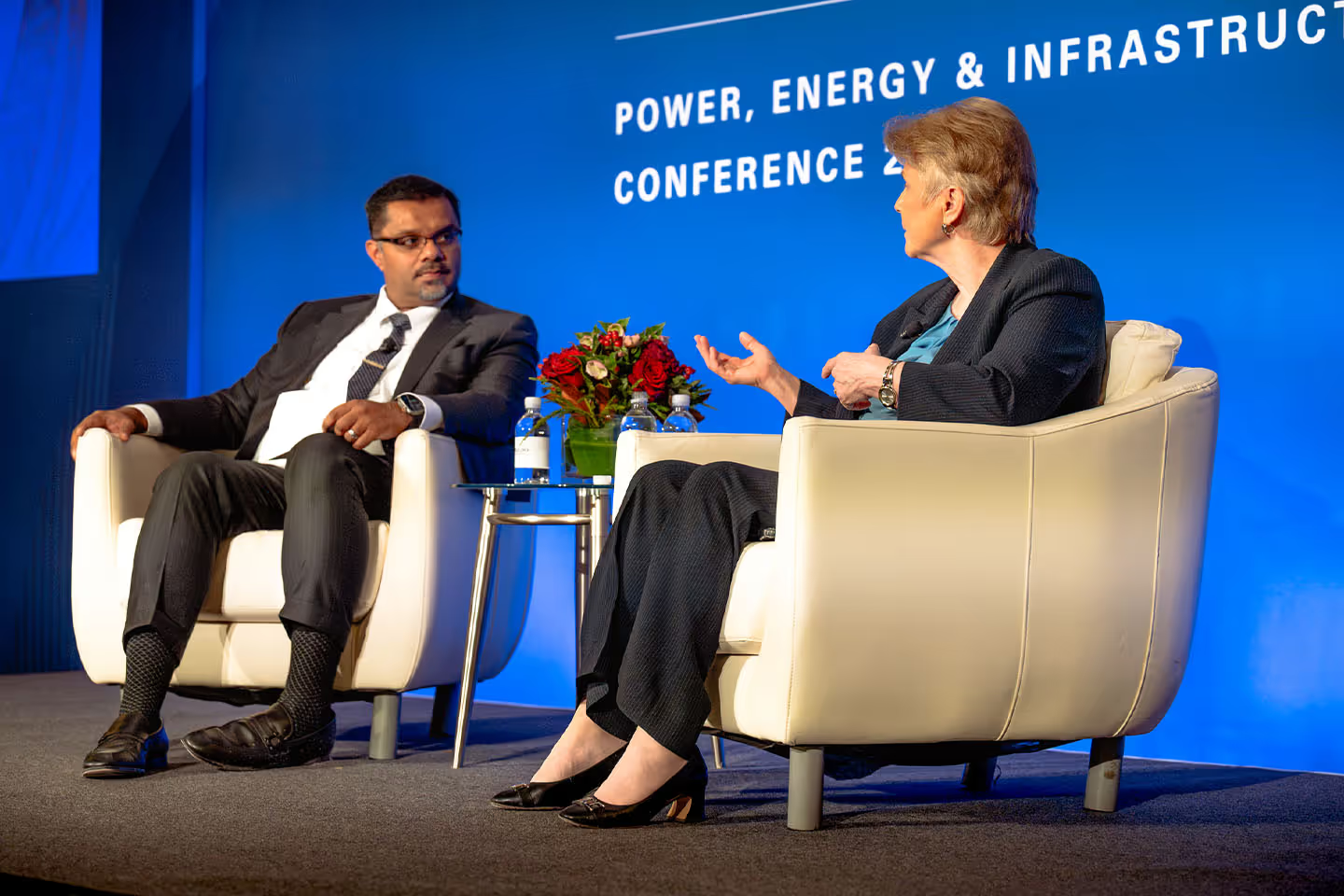
Transcript
Maheep Mandloi:
If I were to give a slogan for the power energy energysector looking into 2026, it's AI's world and we're just trying to power it.
Anthony Crowdell:
Recently at the Power Energy and InfrastructureConference, I think we continued to harp on the affordability tone and just howare customers going to pay for all this infrastructure that's required to bringthe grid up to today's standards of this twenty four seven electric or digitaleconomy. Every meeting, I think affordability was the biggest driver of concernfor investors.
Gabe Moreen:
So we had a terrific conference at the PEI event. We gotgreat feedback on the part from investors and companies. Everyone seemed to bereally engaged in the conference. I think a couple of themes emerged for sure.One is that even with the crude oil backdrop that we're facing, the view isthat natural gas production is going to increase in the US, not only in thelong term, but even in the near term. So companies and investors are reallypositioning themselves accordingly for that to happen. The other thing I wouldsay is that continued consolidation in the sector is a theme. We've seenseveral of the integrated midstream energy companies continue to grow theirfootprint inorganically through acquisitions. I think that's very topical onthe minds of investors as sector basically looks to continue to consolidate andgrow both organically and through M&A.
Maheep Mandloi:
At our power energy infrastructure conference, one of theother takeaways was around some M&A aspects next year. We've seen a lot ofturbulence in the renewable industry because of the tax credit exploration thattax rates expired by the end of 2030 instead of being available for the nextdecade. So that's caused a lot of developers to sell their early stage projectpipelines. So we might see early stage or infrastructure pipeline solar orbattery or renewable projects exchanging hands in the US.
Transcript
Maheep Mandloi:
If I were to give a slogan for the power energy energysector looking into 2026, it's AI's world and we're just trying to power it.
Anthony Crowdell:
Recently at the Power Energy and InfrastructureConference, I think we continued to harp on the affordability tone and just howare customers going to pay for all this infrastructure that's required to bringthe grid up to today's standards of this twenty four seven electric or digitaleconomy. Every meeting, I think affordability was the biggest driver of concernfor investors.
Gabe Moreen:
So we had a terrific conference at the PEI event. We gotgreat feedback on the part from investors and companies. Everyone seemed to bereally engaged in the conference. I think a couple of themes emerged for sure.One is that even with the crude oil backdrop that we're facing, the view isthat natural gas production is going to increase in the US, not only in thelong term, but even in the near term. So companies and investors are reallypositioning themselves accordingly for that to happen. The other thing I wouldsay is that continued consolidation in the sector is a theme. We've seenseveral of the integrated midstream energy companies continue to grow theirfootprint inorganically through acquisitions. I think that's very topical onthe minds of investors as sector basically looks to continue to consolidate andgrow both organically and through M&A.
Maheep Mandloi:
At our power energy infrastructure conference, one of theother takeaways was around some M&A aspects next year. We've seen a lot ofturbulence in the renewable industry because of the tax credit exploration thattax rates expired by the end of 2030 instead of being available for the nextdecade. So that's caused a lot of developers to sell their early stage projectpipelines. So we might see early stage or infrastructure pipeline solar orbattery or renewable projects exchanging hands in the US.
It may be the most exciting time in the power sector in a generation. For nearly two decades, US power demand growth was stagnant – around 0–1% annually – as population and economic growth were offset by efficiency improvements and structural changes in the economy. Today, the outlook is dramatically different. Driven largely by AI and data center expansion, demand is accelerating at an unprecedented pace, and forecasts show data centers could account for 11–12% of national power demand by 2030, requiring an additional 50 gigawatts of capacity – equivalent to approximately 25 Hoover Dams.
Against this backdrop, Mizuho hosted its 2025 Power, Energy and Infrastructure (PE&I) Conference, bringing together Mizuho markets and research experts, institutional investors, and top corporates in the energy space for one-on-one meetings and keynote sessions featuring leaders from across energy spectrum, from solar and geothermal to nuclear, oil, and gas. Keynote panelists and speakers included:
• Vicki Hollub, CEO of Occidental Petroleum
• Takajiro Ishikawa, President & CEO of Mitsubishi Heavy Industries America
• Tim Latimer, Co-Founder and CEO of FervoEnergy
• Mesut Uzman, Chief Nuclear Construction Officer at Fermi America and President & CEO of Fermi Nuclear
While not every subsector is experiencing radical demand growth or comparable exposure to the AI theme, we find ourselves at a pivotal moment across the power, energy, and infrastructure landscape. The resulting transformations present challenges, and opportunities, for industry players. Conference speakers explored the complex dynamics impacting the PE&I markets, unearthing key themes for investors to watch in 2026.
Key Conference Themes:
• It’s AI’s World: Data centers are driving unprecedented power demand growth and reshaping energy and infrastructure markets, even as consumers and policy makers accept the role of natural gas in meeting growth aspirations. Physical infrastructure may be a bottleneck, and reliable power supply could struggle to keep pace with demand growth.
• Clean Still Matters: Whether from a brand perspective or for companies operating in states with Renewable Portfolio Standards (RPS), there’s no shortage of customers where a clean energy portfolio still matters.
• Consolidation Across Subsectors: Renewables tax credits are set to expire at the end of 2030, leading developers to begin selling their early-stage infrastructure project pipelines. This is likely to continue in 2026. Meanwhile, in oil & gas, industry consolidation has continued as operators seek scale and market relevance.
• For Renewables Suppliers, Diversification is Key: Interconnection challenges, long lead times for new projects, and the looming cessation of tax credits are causing suppliers, such as solar OEMs, to diversify their product mix and look for new customers in adjacent industries.
• Natural Gas Utilities as Safe-Haven? With consumers dealing with rising electricity costs and the associated political crosshairs, natural gas utilities are flying under the radar, offering less exposure to the AI undercurrents.
• Continued Capital Discipline: The importance of capital discipline amidst an uncertain macro outlook, depleting reserves, and investor apathy was a recurring theme, with E&Ps reinforcing commitments to efficiency gains and shareholder returns.
• Shale Resource Expansion: Advances in technology are helping shale operators improve recovery of reserves in place, addressing concerns about inventory quality and reserve depletion. Even as the outlook for long-term (2040+) oil demand improves, US companies are investing to make sure they are relevant on the global stage for longer.
• Affordability is the Word: A great deal of new infrastructure, and upgrades to existing infrastructure, are needed to modernize the grid and power our 24/7 data-centric economy. One of the biggest concerns for investors going into 2026 is how customers are going to pay for these costly requirements.
The evolving PE&I landscape presents a mix of uncertainty and promise as we move into 2026. Corporates and investors alike have lots to navigate as the sector adapts to significant technological, market, and policy shifts in the year ahead.