Our Initiatives to Reduce Environmental Impact
Addressing climate change
Mizuho is moving ahead with efforts to address climate change by periodically assessing the energy consumption of the entire Group, setting GHG emissions reduction targets and devising energy consumption reduction strategies centered on electric power consumption.
GHG Emissions Reduction Initiatives
Regarding our own GHG emissions (Scope 1 and 2), Mizuho has set a target of becoming carbon neutral by FY2030 and pursues various initiatives to achieve this target. In view of addressing legally mandated disclosures, we expanded the scope of measurements in FY2023 to include all domestic and overseas consolidated subsidiaries, and in FY2024 we obtained third-party assurance of our measurements on a consolidated basis. In March 2025, we expanded the scope of our targets to all consolidated subsidiaries.
Target for GHG emissions (Scope 1 *and 2*)
Target for GHG emissions (Scope 1* and 2*):
Carbon neutral by FY2030* (Carbon neutrality to be maintained thereafter)
Scope 1 and 2 GHG emission results* and progress on reduction initiatives
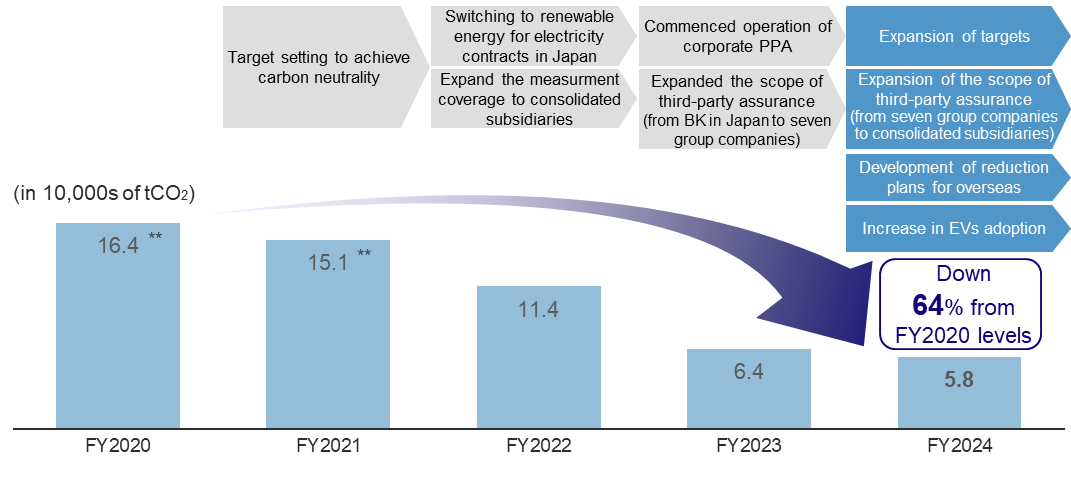
*Target / scope of datacollections: All domestic and overseas consolidated subsidiaries.
**Previous scope: Seven groupcompanies (Mizuho Financial Group, Mizuho Bank, Mizuho Trust & Banking,Mizuho Securities, Mizuho Research & Technologies***, Asset Management One,and Mizuho Americas)
***Mizuho Research & Technologies merged with Mizuho Bank in April 2026.
Sustainability Report "Data section" (PDF/5,811KB)
Strategy for achieving Scope 1 and 2 targets
• Expansion of the scope of carbon neutrality target to the consolidated group (previously limited to seven group companies)
• Expansion of the scope of third-party assurance to consolidated companies and globally
• Introduction of EVs at sales offices (approximately 100 vehicles across 10 branches).Further rollouts are planned
• Development of reduction plans for high-emitting overseas sites
• Purchasing high-quality credits with a view towards FY2030 and beyond
Reduce CO2 emissions by installing and properly utilizing energy-saving equipment
To attain its CO2 emission volume reduction target, Mizuho will introduce energy–conserving facilities and take thorough measures to appropriately operate and manage those facilities and implement other energy conservation measures while also working to increase its employees' consciousness of environmental issues as a means of promoting CO2 emission reductions going forward.
In addition, based on the "Mizuho Environmental Standards" instituted with respect to the environmental friendliness of Mizuho Bank branches, Mizuho Bank has adopted solar cell power generation systems and LED lighting fixtures.
Principal Energy Conservation Measures
Promoting the adoption and operation of environment–friendly vehicles
Group companies centered on Mizuho Bank have reevaluated their low–usage–level motor vehicles, completely eliminating the use of marketing–use motorcycles and progressively reducing the number of automobiles while concurrently moving ahead with the introduction of hybrid vehicles and other low–pollution vehicles and shifting to the use of electric bicycles.
Going forward, plans call for moving further ahead with the introduction of electric vehicles, hybrid vehicles, and other low–pollution vehicles, while also encouraging drivers to reduce engine idling time periods, adopt other "eco–driving" techniques, and implement other measures to further reduce CO2 emission volume.
Initiatives Taken in Response to National and Local Laws, Ordinances, and Requirements
In Japan, the national government has passed the Act on the Rational Use of Energy (Energy Conservation Law), and local environmental ordinances require that business facilities emitting more than a certain level of greenhouse gases submit and disclose plans for fighting global warming. Mizuho is submitting reports for each of its facilities covered by the ordinances and is striving to reduce energy usage and the volume of CO2 emissions associated with each facility. Specifically, in line with the requirements of the Energy Conservation Law, Mizuho is working to cut back annual energy consumption per unit by 1% or more on average, and is endeavoring to attain the targets set by local governments.
Tokyo Metropolitan Environmental Security Ordinance
Based on "the Tokyo Cap–and–Trade Program" (for large facilities) and "the Tokyo Carbon Reduction Reporting Program" (for small and medium scale facilities) promoted by The Tokyo Metropolitan Government, relevant Mizuho Group companies have formulated policies for responding to global warming (climate change) and have submitted the reports shown below to the Tokyo Metropolitan Government. In addition, facilities subject to "the Tokyo Cap–and–Trade Program" have undergone third–party audits. In addition for properties managed in trust, the Mizuho Group collects information and submits reports to the Tokyo metropolitan government on energy usage and greenhouse gas emissions.
Tokyo Metropolitan Government, "The Tokyo Cap-and-Trade Program"
Tokyo Metropolitan Government, "The Tokyo Carbon Reduction Reporting Program"
Required Entity
Tokyo Carbon Reduction Report (Japanese Text Only)
MHBK
MHTB
Mizuho submits reports on its global warming countermeasure to the government of Minato City, Tokyo, in accordance with the ordinance on the promotion of low-carbon buildings for the protection of the living environment for Minato City residents.
City of Yokohama, Kanagawa Prefecture, "The CO2 Emission Reduction Program"
Based on the "CO2 Emissions Reduction Program" specified in the "Ordinance to Preserve the Living Environment", business facilities emitting more than a certain level of greenhouse gases are required to submit and disclose plans for preventing global warming.
Mizuho submitted the CO2 Emissions Reduction Plan and Report on required facilities in the city of Yokohama as follows:
Required Entity
CO2 Emissions Reduction Plan (Japanese Text Only)
CO2 Emissions Reduction Report (Japanese Text Only)
Carbon Accounting Based on PCAF
Carbon accounting is the evaluation of business activity by calculating and tallying how much Greenhouse Gas (GHG) they produce, as well as the degree to which business activities contribute to reducing GHG emissions. We disclose the further reliable and transparent information by utilizing the concept of PCAF, one of international initiatives. We are utilizing these results as information for future management to support the movement toward a decarbonized society.
Carbon accounting overview
What is PCAF?
It means Partnership for Carbon Accounting Financials, a framework for financial institutions to calculate consistently GHG emissions derived by businesses that they invest and/or finance.
(https://carbonaccountingfinancials.com/)
We have applied our own carbon accounting to new large–scale power generation projects for which financial agreements were signed in the respective fiscal year since fiscal 2006. We disclose the information against project finance for power generation projects based on PCAF concept since fiscal 2019.
CO2 Emissions
We calculate the CO2 emissions based on the below formula described under PCAF Standard.
Financed Emissions of Power Sector Portfolio = Σ (Annual Power Generation × Sectorial Emission Factor × Mizuho Attribution Factor)

CO2 Avoided Emissions
The term "avoided emissions" refers to the quantified contribution of a company to the reduction of total GHG emissions from the whole of society through the use of its products and services. While it is important for a company to work toward reducing GHG emissions including from its value chain, any increase in economic or business activities invariably leads to a rise in GHG emissions. It is thus more crucial than ever to measure avoided emissions accurately and to financially support decarbonizing solutions in order to reconcile economic growth with reduction in GHG emissions.
Mizuho adopts the concept of Avoided Emissions under the PCAF Standard for the purpose of measuring the reduction in emissions from our project finance portfolio. This calculation is based on the emission factor of the fossil fuel that has the largest impact on the power generation mix in the project region and CO2 emission reductions contributed by the renewable power projects that Mizuho finance. The above Mizuho Attribution Factor is used for calculating CO2 avoided emissions in line with PCAF Standard.
Conceptual Diagram of Avoided Emissions
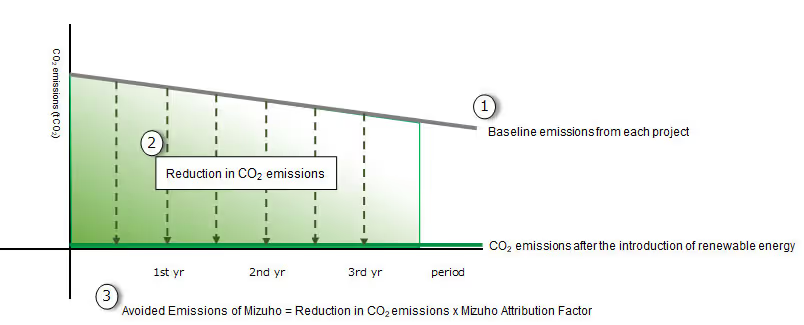
- Baseline emissions from each project: Theoretical CO2 emissions calculated using the emission factor of fossil fuel that has the largest impact on the power generation mix in the project region, serving as the base scenario of reference for the project concerned.
- Reduction in CO2 emissions: Calculated for each project as the difference between the CO2 emissions after the introduction of renewable energy and the baseline emissions.
- Avoided emissions of Mizuho: Calculated by multiplying each project’s reduction in CO2 emissions by Mizuho Attribution Factor.
* The above diagram simply illustrates the concept and does not necessarily represent the situation of a specific project.
Results of Evaluations
Results based on PCAF
Mizuho believes that an orderly transition needs to consider national and local realities, because the pathway to the decarbonization of electricity varies depending on energy security considerations and geographical/social factors specific to the country or locality. It is for this reason that financed emissions from Mizuho's power sector portfolio may increase due to specific conditions of the country or locality concerned. Nevertheless, this does not change Mizuho's commitment to the decarbonization of the whole of society through continued support for the promotion of renewable energy going forward.
Promoting a Recycling–based Society
As part of its efforts to conserve resources and energy as a means of helping create a recycling–based society, Mizuho is giving particular emphasis to paper–the resource that it uses the greatest quantity of–as it promotes resource conservation efforts at each stage, from purchasing through to usage, disposal, and recycling.
Promoting Green Purchasing
At Mizuho, in line with our Environmental Policy and Procurement Policy, we are committed to purchasing environmentally friendly goods and services, and we are promoting "green" purchasing of products centered on such consumables as paper and stationery goods. When procuring such items, Mizuho requests the understanding of suppliers, and, especially for paper, Mizuho is actively working to use recycled paper and paper products made from pulp obtained from forests that are managed properly.
In addition, MHFG and its core group companies have established green purchasing ratio targets for their domestic business facilities.
Initiatives for purchasing environmentally friendly goods and services (PDF/127KB)
Targeted Green Purchasing Ratio for Paper
Green purchasing ratio (for paper) of 85% or more at core group companies
Sustainability Report "Data section - KPIs related to environmental impact reductions" (PDF/5,811KB)
Environmentally Friendly Gifts
Promotional gifts given to customers at branch counters are created while considering environmental friendliness.
The paper used to produce calendars distributed by MHFG and paper bags distributed by MHBK, MHTB, and MHSC are made from wood harvested in forestland certified by the Forest Stewardship Council (FSC). MHSC uses environmentally friendly materials in its calendars. In addition, the Mizuho IC Cash Card is made from an environmentally friendly material, PET–G, a non–halogen plastic that has a low environmental impact at disposal.
Initiatives for Waste Reduction and Recycling
Through efforts to reduce its paper usage and other measures, in addition to working to decrease the amount of waste it generates, Mizuho is promoting setting of objectives for separating and recycling waste and is working to reduce waste in general and promote recycling.
Reduction of Paper Use
Targeted Reduction of Paper Use
Reduce 6 group companies'* paper usage in Japan by 1% compared to the previous fiscal year
* Mizuho Financial Group, Mizuho Bank, Mizuho Trust & Banking, Mizuho Securities, Mizuho Research & Technologies**, and Asset Management One
**Mizuho Research & Technologies merged with Mizuho Bank in April 2026.
Sustainability Report "Data section - KPIs related to environmental impact reductions" (PDF/5,811KB)
Principal Measures to Reduce Paper Usage
- Ensuring the use of two–sided printing and reduced–magnification printing
- Reappraising requirements for paper forms and shifting to electronic documents
- Promoting paperless operations through the introduction of electronic application form systems
- Expanding the range of paperless meetings through the introduction of tablet computers
- Reducing unnecessary copying by shifting multifunction machines (printing, copying, scanning, facsimiles) from joint use within sections to joint use on floors
- Shift reports on entrusted assets and other reports to electronic formats
Sustainability Report "Data section - Waste" (PDF/5,811KB)
Promoting Paper Recycling
Mizuho has put in place recycling systems to thoroughly separate paper waste into office automation paper, newsprint, magazines, cardboard, and other categories. In fiscal 2015, Mizuho expanded the scope of recycling management, and set objectives and target recycling ratios.
Reducing Non–combustible Waste and Recycling
Mizuho is working to reduce and recycle non–combustible waste by carefully sorting out cans, glass bottles, and plastic bottles.
With regard to waste disposed of by offices, we will conduct management and disposal according to an industrial waste manifest in line with the Wastes Disposal and Public Cleansing Act and remain in compliance with the law.
Sustainability Report "Data section - Waste" (PDF/5,811KB)
Principal Measures for Reducing/Recycling Waste Products
Each company in the Mizuho Group is moving ahead with measures to reduce the volume of waste products it generates and to ensure that those waste products are recycled.
Water Conservation
Mizuho is introducing water–saving devices and taking other initiatives that have led to a sustained decrease in water usage.
The MHBK Otemachi Head Office, the Tama Information Center, and the Koto Center use reused wastewater (recycled water), including the cooling tower blow–treated water and rainwater–treated water, used for the cooling tower water supply, the flushing of toilets, etc.