About CANADE
Mizuho has published the Human Capital Report since 2024 to comprehensively explain how we create value together with our customers, the economy and society through "Enhancing Human Capital" and "Transforming Corporate Culture." Since 2026, the report has been incorporated into the Sustainability Report "Human capital section". For details on our various human capital initiatives, please refer to the above section in the Sustainability Report.
Please note that the names and terms used on this page and in the report reflect those in use at the time of publication and may differ from current names and terms.
Sustainability Report "Human capital section"
Breaking away from traditional HR management
At Mizuho, we regard human capital as the source of value creation, and CANADE is the foundation for the continuous enhancement and enrichment of our personnel. CANADE, which was created in partnership with employees, is a shared HR framework across the five core Group1 companies and encompasses two aspects: a commitment to strategic HR and an emphasis on employee narratives.
The first aspect —strategic HR —involves aligning business strategies with HR strategies. Specifically, it enables individual business divisions to take the lead in HR management and promotes strategic talent acquisition and development across business areas.
The second aspect —employee narratives —is the cornerstone for achieving strategic HR. It involves initiatives that encourage our employees to take greater initiative in designing their own individual careers and directing their personal growth.
We believe that engaging in human capital management, guided by the CANADE framework, will connect the growth of employees with business advancement, drive Mizuho’s capability to create value, and ultimately lead to the realization of our corporate identity.
- Mizuho Financial Group, Mizuho Bank, Mizuho Trust & Banking, Mizuho Securities, and Mizuho Research & Technologies2
- Mizuho Research & Technologies has been integrated into Mizuho Bank, effective April 1, 2026.
Breaking away from traditional HR management
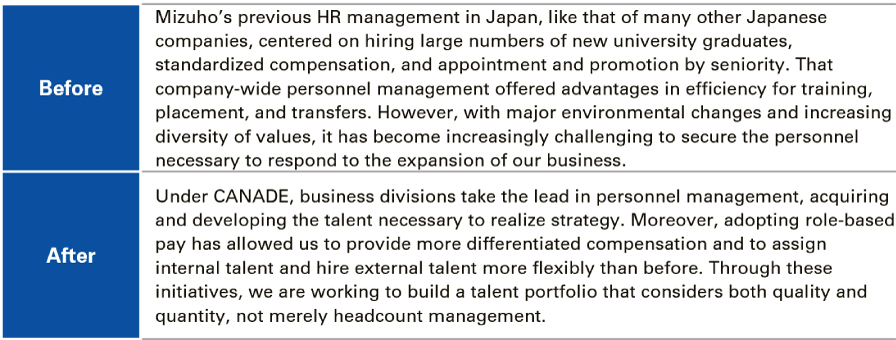
CANADE introduces new systems and operations that break with traditional practices such as seniority-based HR management and company-led HR operations. Efforts are still ongoing to disseminate the idea of breaking with the previous seniority system, to instill role-based and performance-based compensation, and to encourage employee independence through the presentation and provision of career paths. Nevertheless, the aim, as we take steps to improve in these areas, is to enable all employees to maximize their potential through CANADE and to create a virtuous cycle between the growth of individual employees and increased corporate value.

Mizuho's perspectives on changes brought on by the transition to CANADE
Employees perspectives on changes brought on by the transition to CANADE

Developing management candidates
Mizuho has published the Human Capital Report since 2024 to comprehensively explain how we create value together with our customers, the economy and society through "Enhancing Human Capital" and "Transforming Corporate Culture." Since 2026, the report has been incorporated into the Sustainability Report "Human capital section". For details on our various human capital initiatives, please refer to the above section in the Sustainability Report.
Please note that the names and terms used on this page and in the report reflect those in use at the time of publication and may differ from current names and terms.
Sustainability Report "Human capital section"
The AOI Program bolsters the quality and quantity of management candidates
AOI Juku enhances the conceptual and execution capabilities that management talent needs
To increase our corporate value, Mizuho needs management talent who can set a clear direction for the entire company, identify pressing issues, and lead the organization toward solutions. At the same time, we recognize the difficulty of spontaneously producing such management talent in a rapidly changing business landscape.
To this end, Mizuho has been running the AOI Program, a leadership development initiative under the ownership of the Group CEO, since FY2023. The program is designed to foster leaders who have both the conceptual ability to envision the future of the entire business and the execution ability to drive the organization as a whole. The consistent operation of this program has started to yield tangible results in the steady turnout of management talent.

- Executive Officers refers to officers defined under the Companies Act and executive officers with special titles.
The AOI Program bolsters the quality and quantity of management candidates
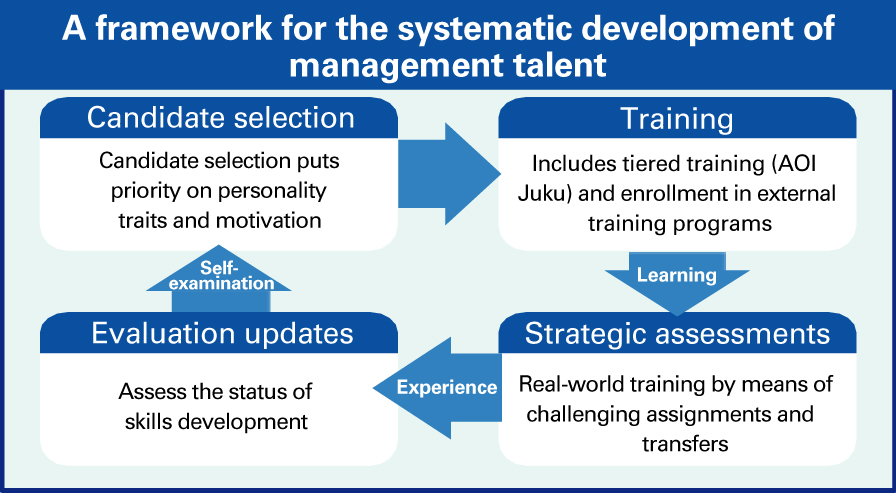
The AOI Program encourages the growth of management candidates with a systematic training cycle. The AOI in the program’s name stands for the Aspiration to be a future member of our management team; the Optimism to see that negativity is an emotion, while positivity is a choice; and the recognition of Ignorance, because the more you learn, the more you realize how little you know.
The program is progressing steadily, but we will continue to strengthen our talent pool from the perspective of whole Group optimization, including, for instance, strategic placements to ensure a balance of candidates across all business areas.
AOI Juku enhances the conceptual and execution capabilities that management talent needs
The AOI Juku in-house training program facilitates the acquisition of the mindset (self-awareness and preparedness) and skills that management talent needs, aiming to strengthen their conceptual and execution capabilities. The program is designed around five learning themes (learning strategies, learning organizations, exploring knowledge, exploring oneself, and communication skills) and is tailored to the individual characteristics of participants. AOI Juku provides opportunities for direct dialogue with the Group CEO and other members of the management team and for self-examination so participants can better understand themselves. It also has an alumni program that encourages participants to continually improve themselves through friendly competition as well as a mentoring aspect, in which program graduates nurture the next-generation of business leaders. The aim of all these programs is to encourage continuous and multifaceted growth among the participants.
The program is yielding tangible results, such as the appointment of program graduates to executive positions.
Building a talent portfolio to implement the growth strategy
Mizuho has published the Human Capital Report since 2024 to comprehensively explain how we create value together with our customers, the economy and society through "Enhancing Human Capital" and "Transforming Corporate Culture." Since 2026, the report has been incorporated into the Sustainability Report "Human capital section". For details on our various human capital initiatives, please refer to the above section in the Sustainability Report.
Please note that the names and terms used on this page and in the report reflect those in use at the time of publication and may differ from current names and terms.
Sustainability Report "Human capital section"
Toward an HR management system led by business divisions
Stable recruitment of talent to support business areas
Mizuho business divisions, to achieve their strategies, are taking the lead in operating their own flexible HR recruiting, from both internal and external talent pools. We believe that allowing individual divisions to accelerate their own strategic HR initiatives leads to optimal personnel allocations, which helps achieve business strategies and ultimately increases the corporate value of Mizuho as a whole.
We are making further operational improvements to the construction of our talent portfolio, such as spelling out the personnel requirements of each business area and the career paths that meet those requirements, as well as improving HR training and recruiting practices through employee career development and other programs.
Toward an HR management system led by business divisions
Our HR management system led by business divisions is still in its early stages, and there is room for improvement in terms of operational knowledge and optimal personnel allocations across the entire company. Accordingly, we are continuing with measures to enhance operations in order to bolster human capital for the Group. These measures include organizing useful HR data (using Tableau) for business divisions, forming consensus on overall optimization through the Human Resources Strategy Council, and developing and securing talent with experience and perspectives that translate across multiple business areas.

Stable recruitment of talent to support business areas
We have set priority-focus areas within our business portfolio in line with our target business models and have set KPIs for the talent who will drive the realization of growth strategies in these areas. Thanks to independent HR management by business divisions, we are making steady progress in securing talent in each area and reaching the KPIs. In FY 2026, we will continue efforts to enhance in-house training systems and mid-career recruiting in order to secure the necessary talent to realize our business strategies.
Retail business in Japan
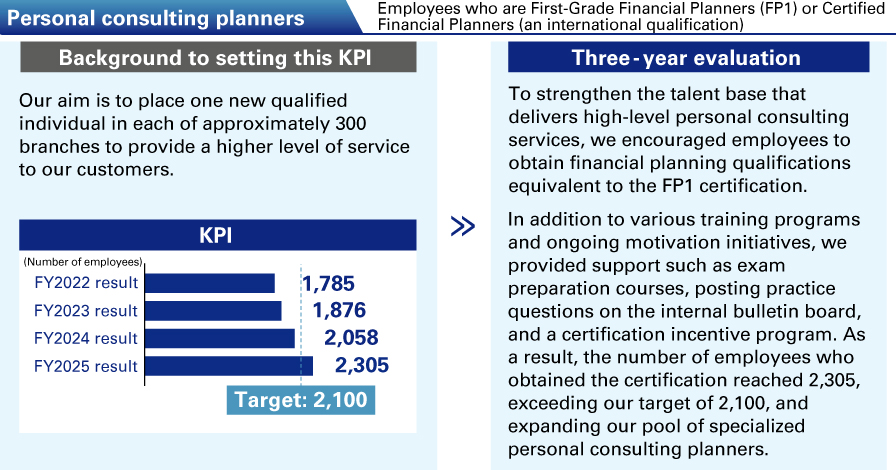
In our retail business in Japan, where we are focused on improving customer experience and supporting the doubling of asset-based income, we will review our digital, remote, and in-person approaches, move forward with the full digitalization of office procedures, and transform branches from places of administration into places for consultation. Given the increasing importance of personnel who possess the knowledge and experience to provide customer-oriented, face-to-face consulting that supports asset accumulation, management, and succession, we have focused on talent development by setting “personal consulting personnel” as a KPI.
Corporate business in Japan


The corporate business, where we are aiming to enhance the competitiveness of Japanese companies, calls for the insight to delve deeper into industry trends and client needs and the creativity to design growth narratives with corporate clients. We are focusing in particular on the area of business succession, which requires specialized knowledge and practical experience. We have set a KPI for the number of in-house certified personnel who can support business succession and are strategically assigning personnel to this area. Similarly, in the area of support for startups and innovative companies, we have set a KPI for the number of in-house certified personnel in order to systematically develop personnel with experience in providing support in leading-edge technology fields and expertise in responding to the needs of companies at different stages of growth. We have achieved our target KPIs in each area and will continue to focus on meeting client needs to realize our growth strategies.
Sustainability-related business

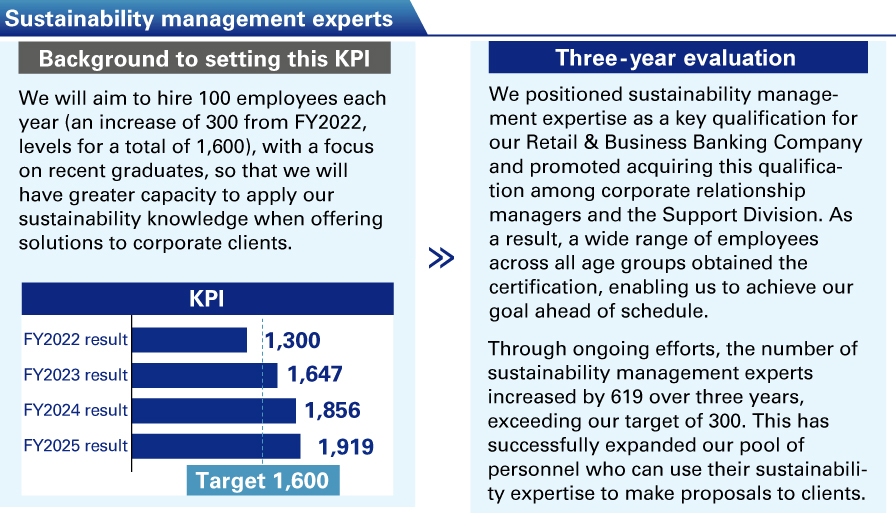
In the area of sustainability and innovation, to respond to the various challenges our large corporate and other clients face, we have been increasing the number of environment and energy sector consultants at Mizuho Research & Technologies.1 At the same time, advancing sustainability in the wider community requires action not only by large companies but also by the small and medium-sized enterprises that make up supply chains. Because of this, we have set a KPI for the number of sustainability management experts as well and have been working to ensure that employees, as they acquire the relevant qualifications, obtain the knowledge necessary to conduct sustainability transformation discussions with a wide range of corporate clients.
- Mizuho Research & Technologies has been integrated into Mizuho Bank, effective April 1, 2026.
Global business
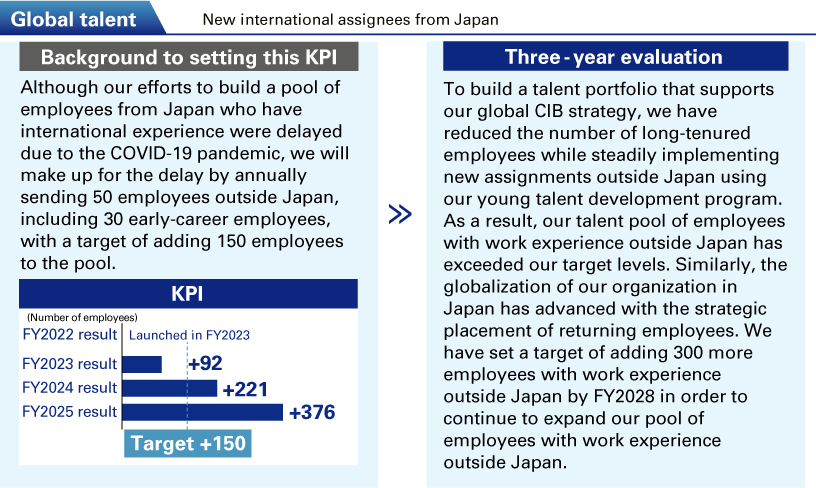
We are advancing our global Corporate & Investment Banking (CIB) business model in the US and EMEA, as well as expanding our transaction banking and capital markets businesses in Asia. In order to strengthen our business in each of these markets, we have secured personnel who are familiar with the local market and maintained a high ratio of local personnel in management positions at our offices outside Japan.
We have also worked to enhance the pool of Japanese employees with work experience outside Japan who can collaborate effectively with local personnel. We have steadily implemented new assignments outside Japan for early-career employees, allowing them to gain one year of practical experience in banking and one year of experience in internal management, thereby enhancing the quality of Japanese employees with outside Japan work experience. We will continue to build a sustainable portfolio of talent with international experience.
Enhancing digital transformation capacity

- Mizuho Financial Group, Mizuho Bank, Mizuho Trust & Banking, Mizuho Securities, and Mizuho Research & Technologies2
- Mizuho Research & Technologies merged with Mizuho Bank on April 1, 2026.

Digital transformation is a priority area of our medium-term business plan, and we need personnel who have advanced expertise in digital transformation and technologies and can facilitate business transformation for our clients and Mizuho. To achieve this, we have systematized and rolled out a digital transformation talent development program by skill level and employee type. We have also established a certification system that evaluates experience with digital transformation projects and skill levels based on common standards. This clarifies development goals and the progress toward them, encouraging a systematic progression from basic digital transformation personnel to higher levels.
Moving forward, through the continuous development of digital transformation talent, we will enhance our ability to translate cutting-edge technologies into business value and strengthen the talent base that underpins Mizuho’s digital transformation initiatives.
Second and third lines of defense to support business

One of the priority areas of our medium-term business plan is maintaining stable business operations, which uphold all that Mizuho represents. As Mizuho being called on to implement more rigorous and sophisticated governance, securing expert personnel in the areas of risk and compliance management and internal auditing —our business’s second and third lines of defense —is becoming increasingly important, and we have been promoting these areas by setting their enhancement as a KPI.
Further information
Sustainability Report "Data section - Human capital supporting growth strategies" (PDF/5,811KB)
Elevating individual employees' capabilities
Mizuho has published the Human Capital Report since 2024 to comprehensively explain how we create value together with our customers, the economy and society through "Enhancing Human Capital" and "Transforming Corporate Culture." Since 2026, the report has been incorporated into the Sustainability Report "Human capital section". For details on our various human capital initiatives, please refer to the above section in the Sustainability Report.
Please note that the names and terms used on this page and in the report reflect those in use at the time of publication and may differ from current names and terms.
Sustainability Report "Human capital section"
Career Development Management encourages employees to achieve career autonomy
Support system for considering careers together
Active investment in employee self-development
System that gives opportunities for considering careers together
For Mizuho to realize its sustainable growth strategy, it is crucial that each employee proactively seeks to grow by taking steps to improve their skills and abilities needed for their desired career development. We are investing in learning and providing opportunities for growth through our Career Development Management as a way to support this attitude of self-motivation among our employees. We are also enhancing programs to develop and strengthen the managerial ranks so they can support employees as they pursue career autonomy.
To help each employee realize a career that is true to themselves, we are enriching training content, improving convenience, and disseminating information to increase the number of employees who take action toward career autonomy.

Career Development Management encourages employees to achieve career autonomy
Mizuho promotes Career Development Management as a way for each employee to achieve the career that’s right for them. The Career Development Management initiative encourages our employees to achieve their aims through a cycle of self-understanding, learning about career fields and examples, considering careers together, pursuing self-development, building careers together, and growing through work. In FY2025, we held roundtable discussions on the theme of career autonomy at each of our locations, which created venues for employees to share their thoughts and efforts aimed at achieving career autonomy. Through two-way communication, the discussions furthered understanding of career autonomy and fostered the adoption of this mindset, while also expanding related support systems. The roundtable discussions led to a steady increase in the number of employees proactively taking on the challenge of building careers that are right for them.
Aiming to realize Mizuho’s corporate identity through career autonomy cycles

Support system for considering careers together
In order for our employees to take concrete action toward building careers that align with their individual aspirations, it is important for them to understand what opportunities for growth are available at Mizuho and to consider what they want to achieve. Across our five core Group companies1, we provide tools and opportunities for our employees to consider their careers together with Mizuho, along with training content for them to understand the company.
In FY2025, in addition to our three existing programs, we launched a new program called Everyone’s Careers, which showcases career examples from Mizuho employees. To encourage greater use of the programs, we are working to enrich the programs’ content, improve their usability, and promote awareness of the programs.
We have also established a support system consisting of career interviews with managers and career advisors (approximately 30 people) who are permanently assigned to HR departments, to provide our employees with opportunities to reflect on their strengths, challenges, and career perspectives through dialogue.
- Mizuho Financial Group, Mizuho Bank, Mizuho Trust & Banking, Mizuho Securities, and Mizuho Research & Technologies2
- Mizuho Research & Technologies has been integrated into Mizuho Bank, effective April 1, 2026.
Four programs to learn about the company

Active investment in employee self-development
Mizuho set up the Funds for Learning and the Funds for Qualification as self-development support programs to assist the self-development of employees in acquiring the knowledge and skills needed to build their careers. It is more important than ever that all of our employees engage in reskilling and upskilling, given the rapid changes in technology and the business landscape. To maximize support for employees who intentionally pursue self-development, we have implemented programs that enable diverse learning opportunities.
The specific programs are the Funds for Learning, which provides up to JPY 150,000 per year per employee to support any learning necessary for their current duties or future career development, and the Funds for Qualification, which provides incentive payments, costs for books, and ongoing fees for obtaining company-recommended certifications (incentive payment: up to JPY 200,000 per certification; books and ongoing fees: JPY 150,000 per year per employee).
As these programs have become more widely adopted, they are being used for a broad range of purposes, including obtaining qualifications that benefit personal business ventures and qualifications related to digital transformation. The number of participants has increased by 1.2 times compared to FY2024, with over 10,000 employees now utilizing these programs.
Overview of the Funds for Learning and the Funds for Qualification

System that gives opportunities for considering careers together
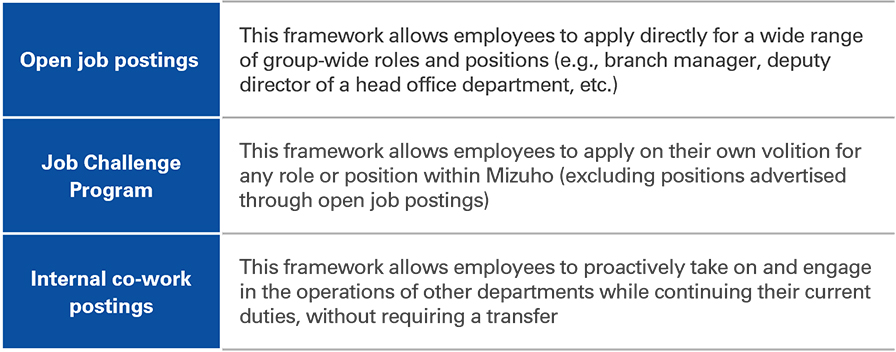
We have created conditions so that employees can, on their own volition, take on new roles within Mizuho by using open job postings, the Job Challenge Program, and internal co-work postings. We have consistently received more than 1,000 applications every year for the past five years.
In FY2025, we saw an increase in appointments for employees who applied after preparing themselves thoroughly through self-development and other means. In addition to the establishment, to a certain extent, of the mindset of taking charge of one’s own career, a steadily increasing number of employees are practicing the cycle of career autonomy to reach their desired roles.
Overview of Mizuho’s internal posting programs
Fair evaluation and compensation; appointment and promotion independent of seniority
Mizuho has published the Human Capital Report since 2024 to comprehensively explain how we create value together with our customers, the economy and society through "Enhancing Human Capital" and "Transforming Corporate Culture." Since 2026, the report has been incorporated into the Sustainability Report "Human capital section". For details on our various human capital initiatives, please refer to the above section in the Sustainability Report.
Please note that the names and terms used on this page and in the report reflect those in use at the time of publication and may differ from current names and terms.
Sustainability Report "Human capital section"
Details of employee evaluations and mechanisms that support employee development
CANADE is our HR framework designed to boost employee motivation and foster growth by providing compensation commensurate with the roles they assume and the results they achieve. We maintain a role-based pay system where salaries are determined by the difficulty and the level of responsibility of the role. The practice for determining bonuses remains based on both organizational and individual evaluations, but we have adjusted the system so that the organizational evaluation is based solely on the Group’s overall performance, thereby significantly increasing the weight of individual evaluations.
This framework enables us to appoint and promote the personnel best suited to realizing our strategies, regardless of their seniority or years of experience. It also boosts compensation for individuals who achieve results. At the same time, with a view to nurturing the next generation, we are advancing initiatives aimed at strengthening the organization’s capabilities over the long term, such as deliberately assigning higher-level roles to mid-career and younger employees.
The introduction of role-based compensation has allowed us to offer competitive remuneration to mid-career hires. This has increased our presence in talent markets, including those for specialized talent.
Details of employee evaluations and mechanisms that support employee development
The evaluation system’s specific mechanisms
Mizuho’s evaluation system is an opportunity for our employees to reflect on their actions and performance, with one aim being to tie this reflection to growth. Specifically, we conduct two types of annual evaluations —Performance Evaluation and Action-based Evaluation —for all employees. The evaluations include feedback to the individual on their specific performance as well as their strengths and areas for improvement. They also include dialogue regarding action plans toward building careers.
Performance Evaluation
Performance Evaluation involves employees setting their own personal objectives, as part of their organization’s targets and goals and in view of their role, at the beginning of the term and then evaluating their level of achievement, at the end of the term. Through this mechanism, each employee’s achievement of their objectives leads to their organization realizing its targets and goals and, thus, increasing the overall corporate value of Mizuho.
To ensure our employees are comfortable that the evaluations will be fair and to enable them to move ahead with initiatives that contribute to their organization, we put priority on dialogue between employees and managers so they are on the same page at the beginning of the term regarding specific achievement levels. Frequent, effective, and flexible dialogue between employees and managers continues throughout the term toward the achievement of personal objectives. Routine communications are established to check progress toward objectives and to consider improvements to task execution.
Action-based Evaluation
Action-based Evaluation assesses each employee’s capability to carry out their role without assigning ratings. The evaluations include the individual’s knowledge, skills, and specific abilities, and how well the individual puts Mizuho’s Values, based on our corporate identity, into practice. Action-based Evaluation is combined with Communication for Growth, which takes place at the start and mid-point of each term, as described below, to provide opportunities for growth. The evaluation also assesses how well our employees follow compliance rules as they perform their duties, as a means of instilling awareness of and adherence to legal compliance in daily operations. The actions and level of compliance of individuals determined through Action-based Evaluation are factors in assessing their capability to carry out their roles.
Feedback
Mizuho shares feedback about the evaluation results with our employees to ensure they feel the results are fair and to encourage further professional development. After the annual evaluations, managers provide feedback to all their team members on the evaluation results, the rationale behind the results, and the individual’s strengths and areas for improvement. This includes dialogue directed at encouraging further growth by the employee. We also conduct employee surveys to collect feedback from our employees and to improve the quality of organizational operations. The surveys allow us to ascertain how well the feedback was implemented and how our employees feel about the evaluations and the feedback process. The survey results are shared with the general manager of the relevant department or branch. Aside from conversations at the beginning and end of each term, routine communications take place with our employees regarding task execution and achievement of personal objectives as well as their personal and career development. As a result of ongoing improvements to the feedback sessions, the survey results showed an upward trend since FY2024.
Results of employee surveys on evaluation feedback

Mechanisms that support employee development
Mizuho creates opportunities for managers to routinely have a dialogue to spur employee growth. We also make use of 360-degree feedback to encourage middle managers to adapt their mindset and actions.
Communication for Growth and Career Talks
Our HR framework, CANADE, emphasizes employee growth through the development of necessary knowledge, skills, and specific abilities and through self-directed career-building. To better realize career autonomy, we have set up opportunities for dialogue between employees and their managers that are principally focused on employee growth. Specifically, the employee and their manager agree on an action plan based on the individual’s strengths and areas for improvement at the start of the fiscal year. Then, over the term, PDCA cycles are put in effect by means of frequent communications during the fiscal year.
Annual Career Talks are also held as part of Career Development Management During Career Talks, the employee and manager align on self-awareness and career aspirations, which can lead to personnel allocations and training.
To make these objective-setting sessions and meetings even more meaningful, we are exploring the use of AI to provide career development advice and guidance during these sessions.
360-degree feedback
Adaptation in mindsets and actions by middle managers is critical to Mizuho’s growth, as middle management is at the heart of organizational operations and is the main entity that steers employee growth. To this end, Mizuho employs 360-degree feedback to give middle managers an opportunity to reflect on their strengths and weaknesses. This leads to managers putting Mizuho’s Values into practice through improvements in their management skills and daily work execution and through changes in their mindsets and actions.
Corporate culture transformation
Mizuho has published the Human Capital Report since 2024 to comprehensively explain how we create value together with our customers, the economy and society through "Enhancing Human Capital" and "Transforming Corporate Culture." Since 2026, the report has been incorporated into the Sustainability Report "Human capital section". For details on our various human capital initiatives, please refer to the above section in the Sustainability Report.
Please note that the names and terms used on this page and in the report reflect those in use at the time of publication and may differ from current names and terms.
Sustainability Report "Human capital section"
Clear changes seen in employee surveys
Identifying issues and taking measures led by management commitment
Corporate culture is a key building block in instituting strategic HR while emphasizing employee narratives. Only when there is a positive corporate culture can personnel, who are the creators of corporate value, maximize their abilities and talents. Mizuho aims to transform our corporate culture with the goal of achieving a culture in which all executives and employees identify personally with our corporate identity, think independently to embody it, and act in unity to provide value to our clients, the economy, and society.
Improving employee engagement through transforming our corporate culture is the foundation that supports Mizuho’s growth strategies. When each employee with an inherent motivation to contribute is able to manifest their strengths and individuality and to work in a way that feels genuine to them while connecting with others, this then becomes the driver of business growth. A virtuous cycle emerges, as business growth further elevates employee motivation.
To sustain this virtuous cycle, we have to regularly and accurately ascertain the situations our employees are in. For this reason, we conduct periodic employee surveys and take actions based on the findings. Over the past several years, we have identified transforming our corporate culture as a key issue and have been actively addressing it. As a result of these efforts, we have observed tangible changes in employee attitudes, which we believe arethe outcome of regular communication of messages from management, engaging in dialogue with our employees on the frontlines of our business, and various initiatives to have employees identify personally with our corporate identity, encourage career autonomy, and improve productivity.
Clear changes seen in employee surveys
Since FY2023, we have been taking consistent measures to encourage each employee to identify personally with our corporate identity and to revitalize internal communications, and signs of change have emerged because of these measures. These have become solid and lasting transformations in the corporate culture and in the attitudes and actions of our employees. The engagement score and the inclusion score, two KPIs on the FY2025 employee survey, are the evidence of this. Both scores reached the medium-term management plan target. Scores for other KPIs have also shown steady improvements.
Percentage of positive responses to KPI questions

- Percentage of employees who selected 4 or 5 on a scale from 1 to 5.
- Based on the sustainability-related financial disclosure standards established by the Sustainability Standards Board of Japan (SSBJ), we have adopted the engagement score and inclusion score and disclose our scores on a consolidated basis. Under the SSBJ disclosure standards, our engagement score is 65% and our inclusion score is 69%.
- Percentage when the selection of 3 is also included.


Identifying issues and taking measures led by management commitment
Scores for many questions on the employee survey improved, indicating the positive impact of efforts to date. Nevertheless, there are areas where no improvement was seen or where scores remain low. An analysis of the scores identified and classified the following three issues, which are now being addressed by the group.
Improving productivity
Improvements to facilities, IT infrastructure, and other resources are essential elements supporting the work of our employees. Accordingly, we have been moving ahead sequentially with initiatives such as upgrading office equipment, replacing computers, and introducing IT tools. In addition, we have made steady progress in consolidating administrative tasks across organizations and have strived to provide our employees with information about the status of these improvements. However, we need to further enhance employees’ sense of the tangible benefits and positive impacts of these initiatives. Moving forward, as we continue to implement necessary measures while keeping track of the circumstances facing each organization, we will work to improve various business processes, including the use of AI, to eliminate outdated, tedious procedures and inefficient approval processes more aggressively than before.
Achieving career goals
We held roundtable discussions at each location on career autonomy in FY2025, as a means to further disseminate the CANADE HR framework, which encourages employee development and growth and rewards their contributions. The roundtable discussions aimed to promote further understanding and awareness through two-way communication. We have also enhanced the systems that support our employees in taking on new challenges. Looking ahead, we will implement career support tailored to employees’ career aspirations and individual circumstances in order to further increase the number of employees taking action toward career autonomy.
Fostering a culture that supports organizations and employees taking on new challenges
Since FY2023, we have carried out initiatives aimed at instilling our corporate identity. Through repeated dialogue between management and employees, such as town hall meetings and site visits, discussions have become livelier than before, and we are beginning to see changes in how employees perceive and act upon our corporate identity.
Furthermore, as a result of conducting multiple workshops designed to help executive officers and general managers of departments and branches identify personally with our corporate identity and disseminate it throughout the organization, spontaneous discussions aimed at transforming each unit into a better organization have begun to take place, and we now sense a heightened awareness among individual employees.
The results of our employee survey confirm that employees’ awareness, understanding, and empathy toward our corporate identity have improved. Moving forward, we will continue our efforts to encourage behavioral changes that empower employees to embrace challenges without fear of change, thereby fostering more concrete actions that embody our corporate identity.
We also carry out efforts to foster a sense of unity, which is the foundation for building our corporate culture, and to revitalize internal communication. Organization development initiatives taken since FY2022 to stimulate employee-to-employee relationships and to boost organizational vitality tie in with a greater sense of fulfillment at work and the fostering of a sense of unity within organizations. We also support independent employee actions to enhance interaction among our employees and to revitalize communications, through such means as employee-led projects and the use of internal social media platforms.
Issues identified from the employee survey and examples of initiatives taken

Empowering every employee through an inclusive working environment
Mizuho has published the Human Capital Report since 2024 to comprehensively explain how we create value together with our customers, the economy and society through "Enhancing Human Capital" and "Transforming Corporate Culture." Since 2026, the report has been incorporated into the Sustainability Report "Human capital section". For details on our various human capital initiatives, please refer to the above section in the Sustainability Report.
Please note that the names and terms used on this page and in the report reflect those in use at the time of publication and may differ from current names and terms.
Sustainability Report "Human capital section"
Ensuring diverse perspectives at the management and decision-making level
Creating places where individuals from all backgrounds can come together and thrive as themselves
Essential to our innovation and our continuous enhancement of corporate value are the various values and perspectives within our organization, arising from colleagues of diverse genders, citizenships, backgrounds, and other traits who work together as a team. We promote inclusion in order to incorporate such values and perspectives into our daily working practices and decision-making. Across the Group worldwide, we are striving to ensure that all employees can demonstrate their individuality and skills and feel pride and fulfillment in working at Mizuho. Indicators measuring the state of inclusion in our organization show steady progress.
Roadmap for promoting inclusion


Ensuring diverse perspectives at the management and decision-making level
We believe that incorporating a multiplicity of perspectives and values into everyday business operations leads to the creation of business value. At Mizuho, we have identified ensuring diverse of perspectives at the decision-making level as an important theme and are promoting initiatives to achieve this.
Establishing a foundation for the advancement of women in Japan
Companies in Japan are required to promote more active roles for women in the workplace under the Act on the Promotion of Women’s Active Engagement in Professional Life. To achieve our goal of women holding 30% of management positions by the early 2030s, Mizuho actively supports the advancement of female employees by promoting systematic development and promotions that take into account each individual’s career aspirations.
Specifically, we built structures to implement systematic, data-driven measures by visualizing employee data by organization, sharing issues among management, and strengthening alignment between business divisions and the HR division. We are also steadily increasing the percentage of new female graduates hired, which is an important indicator for the long-term promotion of the development and advancement of female employees.

- Japan (total of Mizuho Financial Group, Mizuho Bank, Mizuho Trust & Banking, Mizuho Securities, and Mizuho Research & Technologies2)
- Mizuho Research & Technologies merged with Mizuho Bank on April 1, 2026.
- Results through to FY2023 exclude some seconded employees.
- Figures for FY 2024 were calculated based on the new criteria in line with revisions to the human resources system. The figures include all seconded employees.
Career development support for female employees in Japan
Fine-grained support tailored to women’s issues at different stages of life is necessary for women to demonstrate their full potential and feel a sense of fulfillment and pride in their work while achieving a balance between work and private life. Mizuho launched career support programs for female employees in FY2016 as part of these efforts.
The improvements in skills among female employees and the changes in attitudes among female employees and management as a result of the programs have fostered a culture in which women can thrive. And through motivational efforts at various levels of the organization, we have formed a pool of female employees suited to be managerial candidates and contributed to reaching our KPI for the percentage of women holding management positions.
Overview of Mizuho’s career support programs for female employees

- An employee resource group (ERG) aimed at fostering mutual learning and support so that women working at Mizuho can thrive in their roles.
- An ERG aimed at ensuring everyone can thrive at work through employee career advancement.

Initiatives to promote the advancement of women among new graduate hiring in Japan
We are focusing on hiring more new female graduates to establish a foundation for women to thrive in the medium and long term. To communicate the benefits of working at Mizuho, we enriched the content on our online recruiting pages to introduce role models and provide information on Mizuho’s organization and systems. We also hold roundtable discussions for women prior to joining Mizuho, where they can interact with our employees and gain a better understanding of the company’s appeal and work environment.
Note: See the online recruiting pages for each company for more details.
Development of action plans based on the Act on the Promotion of Women's Active Engagement in Professional Life
Mizuho established an action plan aimed at creating environments in which all employees can enjoy diverse and flexible work styles and female employees can thrive at all levels of the company, based on Japan’s Act on the Promotion of Women’s Active Engagement in Professional Life.
In April 2026, we revised the action plan and under the new action plan, we are further strengthening these initiatives.
See the website below for the action plan based on the Act on the Promotion of Women’s Active Engagement in Professional Life at Mizuho Financial Group, Mizuho Bank, Mizuho Trust & Banking, and Mizuho Securities.
Initiatives for the advancement of employees with advanced expertise regardless of nationality
The advancement of employees with in-depth insights and advanced expertise regardless of nationality is essential to meet the sophisticated needs of Japanese and non-Japanese clients alike.
Mizuho recruits a wide range of talent from both Japan and other countries as well as runs training programs to maximize their abilities, and provides environments where employees from all backgrounds can thrive globally.
For local hires outside Japan, we offer a variety of training programs tailored to each region and country. We also provide a Group-wide Global Mobility Program that supports cross-border career development through transfers between locations. Furthermore, by promoting the appointment of employees hired outside Japan to our headquarters in Japan through this program, we are fostering an environment where employees from diverse backgrounds can demonstrate their expertise and thrive.
Appointment of employees hired outside Japan
To drive our increasingly diverse global business, we have set as a KPI the percentage of local hires outside Japan in management roles who possess in-depth knowledge of regional markets and business practices.
To achieve this, we are promoting the development and advancement of local hires outside Japan and formulating succession plans. At the same time, we are establishing a framework that enables these employees to demonstrate their expertise by promoting them to our headquarters in Japan through the Global Mobility Program and other programs.

Securing and retaining mid-career hires
Mid-career recruiting led by individual business divisions has allowed more flexible recruiting activities focused on priority areas. In FY2025, more than 300 mid-career hires joined the company. To retain these hires, we have implemented initiatives such as onboarding guidebooks for departments receiving mid-career hires and follow-up support by career advisors for each hire. Furthermore, since Mizuho hires mid-career employees from a wide range of industries, we conduct monthly orientation sessions to convey the mindset required for working in a financial institution and to explain internal rules. In addition, we promote the early retention of mid-career hires and full materialization of their abilities through various support systems designed to help them thrive with confidence at Mizuho and by creating opportunities for dialogue among new hires.
In FY2025, we held an event for mid-career hires who entered the company within the past three years, with the aim of fostering collaboration by building connections among them and strengthening our organizational capability by leveraging their diverse perspectives.
The proportion of mid-career hires in management positions is 16%. We will continue to actively work to retain these personnel and support their early success.
Creating places where individuals from all backgrounds can come together and thrive as themselves
It is important to ensure diverse perspectives and values in decision-making processes in order to achieve robust results. Equally important is to secure foundations on which our employees can connect with each other and with the company based on trust and respect, allowing them to take on challenges and thrive as themselves.
Our aim at Mizuho is to develop workplaces where everyone can work comfortably and take charge of their own growth. We are committed to creating environments where every employee demonstrates their many strengths and maximizes their specific abilities. Such environments promote the activation of wide-ranging networking through which our employees broaden their perspectives.
Initiatives to support employees balancing work and childcare
Mizuho has introduced work-life balance support systems that go beyond legal requirements to promote flexible work styles that are not restricted by time or location. We are further empowering our employees to balance their careers with their life stages without giving up their careers. Our goal is not merely for employees to continue working by utilizing these systems, but for them to chart their own medium-to long-term career paths in line with their own aspirations and to take on challenges and grow through their work.
Overview of support programs for childbirth and childcare

Encouraging male employees to take an active role in childcare, which will help create pleasant workplaces for everyone
At Mizuho, we have set a KPI to maintain the percentage of eligible male employees who take childcare leave at 100% in Japan, in line with the Act on Childcare Leave, Caregiver Leave, and Other Measures for the Welfare of Workers Caring for Children or Other Family Members (Childcare and Family Care Leave Act). To reach this target, we have introduced various measures to change the attitudes and behavior of all executives and employees, such as providing five business days of paid childcare leave and having managers inform male employees whose partner has given birth about our childcare leave programs and check whether they intend to use them. And since July 2019, the presidents and CEOs of the five core Group companies1 have participated in the Declaration Encouraging 100% of Eligible Employees to Take Paternity Leave, which was established by the Work-Life Balance Co., Ltd.
We hold information sessions for all employees and send congratulatory emails to employees who have had children and their managers, among other initiatives to encourage male employees to participate in childcare. Additionally, we strive to address concerns that may dissuade men from taking advantage of childcare leave by introducing role models and sharing other information.
To further encourage male employees to participate more in childcare, we recommend that they take one month or more of childcare leave, in line with a policy established in July 2024 that male employees should take a minimum of 10 days of childcare leave. In conjunction with this, we hold information sessions to promote employee understanding, have established the Childcare Leave Manual for Men, and have enhanced efforts to create environments in which male employees can confidently take childcare leave by sharing information on leave status with their department or branch general manager. By encouraging men to take an active role in childcare, we aim to drive attitude and behavioral changes related to work style reforms, operational efficiency, and corporate culture transformation. This, in turn, helps foster workplaces where everyone can pursue a career that aligns with their individual values and aspirations.
- Mizuho Financial Group, Mizuho Bank, Mizuho Trust & Banking, Mizuho Securities, and Mizuho Research & Technologies2
- Mizuho Research & Technologies has been integrated into Mizuho Bank, effective April 1, 2026.

Corporate Nursery Services
Employees have access to reserved childcare slots at more than 500 nursery centers in Japan. We support our employees’ smooth return to work by providing them with more options for nurseries located near their home or on the way to work, allowing them to select one that suits their individual work-life circumstances.
Initiatives to support employees balancing work and family care
Mizuho offers a variety of programs to help employees balance work and family care, aiming for “no employees quitting the company due to family care responsibilities”. The programs include family care leave that exceeds legal requirements; working arrangements such as reduced or flexible working hours for family care; and seminars and manuals designed to relieve worry and anxiety.
Overview of support programs for family care

Initiatives to help employees with disabilities thrive
To realize a workplace where employees with disabilities can work authentically, it is important to both support individual employees and cultivate greater understanding among their colleagues. To further deepen understanding among all employees, we introduced new initiatives in FY2025, such as simulated disability experience sessions and the distribution of videos simulating the psychological experience of developmental disabilities, in addition to the e-learning program for all employees. Participants shared feedback such as: “I realized I should focus on ‘being understood’ rather than just ‘communicating,’ and I want to deepen my understanding and consideration through real-life experiences and dialogue” and “I was reminded of the importance of an empathetic attitude toward others”. These initiatives have boosted mutual understanding and psychological safety, leading to a deeper level of understanding among employees.
Initiatives for LGBT+ and other sexual minorities
Creating an environment where LGBT+ employees can thrive as themselves remains an ongoing priority for Mizuho. Our efforts have evolved from fostering understanding within the company to taking measures that encourage voluntary action by employees. In FY2025, we worked to establish an environment that further promotes understanding of sexual orientation and gender identity (SOGI) and reviewed internal policies to ensure no employee faces disadvantages. In addition to raising internal awareness and interest, we have also set up opportunities for employees to translate that awareness into action. While these efforts have brought about positive changes, more work is still needed to eliminate unconscious biases. Moving forward, we will continue to promote awareness with the goal of becoming an organization that respects the SOGI of every single employee.
Initiatives to promote understanding of unconscious biases
Unbiased decision-making and business operations are essential to ensure equal opportunities and encourage employees to stay true to themselves. Mizuho has been raising awareness about inequalities resulting from unconscious biases by providing employees with educational content and information.
For example, we provide unconscious-bias training to all employees to help them recognize their own unconscious prejudices and stereotypes and to integrate measures to counter unconscious biases into their thoughts and actions. We also provide training and manuals to eliminate biases against LGBT+ individuals and people with disabilities. In FY2025, we held an event in which each employee submitted instances of unconscious biases they had noticed personally via an internal form. The goal of the event was to eliminate biases by making unconscious assumptions and prejudices visible and thereby foster workplaces where everyone can work comfortably.
Participants in the unconscious-bias training for all employees shared comments such as: “I realized I’d been going out of my way to be overly considerate without first confirming the other person’s intentions,” and “I realized my attempts to be considerate might have been self-serving”. Comments like these indicate progress in the shifting of individual employees’ attitudes.
Further information
Pursuit of employee well-being
Mizuho has published the Human Capital Report since 2024 to comprehensively explain how we create value together with our customers, the economy and society through "Enhancing Human Capital" and "Transforming Corporate Culture." Since 2026, the report has been incorporated into the Sustainability Report "Human capital section". For details on our various human capital initiatives, please refer to the above section in the Sustainability Report.
Please note that the names and terms used on this page and in the report reflect those in use at the time of publication and may differ from current names and terms.
Sustainability Report "Human capital section"
Creating conditions where employees can work safely and in good health
Physical and mental health: Promoting measures to achieve health management in Japan
Financial wellness: employees’ self-directed asset building
Work styles: Creating flexible work environments to address employees' diverse needs
Maintaining and improving the physical and mental health of every employee is directly linked to improved productivity and engagement and is essential to encourage our employees to take on ambitious challenges. To this end, Mizuho promotes well-being from two sides — physical and mental health and financial wellness — as a means of creating organizations in which our employees can work with enthusiasm at all times. We measure the effectiveness of various well-being promotion measures with the Health and Productivity Management Strategy Map and take additional steps as necessary.
Creating conditions where employees can work safely and in good health
The CANADE HR framework’s goal is workplaces where our employees can work comfortably and be themselves. To achieve this goal, it is important that employees are physically and mentally healthy and can work safely and securely. Through initiatives in accordance with occupational health and safety laws, such as health promotion programs, various health screenings, health management by occupational health physicians, and the establishment of a Health and Safety Committee, we aim to create safe and comfortable working conditions for our employees.

Organizational structure for promotion
The Group CHRO is designated as the person responsible for health management, and the company's HR department and health insurance society work together to establish a health management promotion system. Additionally, various committees have been formed to address critical issues, ensuring consistent execution of processes from the discussion of measures to impact evaluation.


Ensuring employee safety in emergencies
Mizuho undertakes initiatives to be prepared for emergencies and to ensure employee safety as a top priority. In particular, we have developed manuals that outline actions to ensure employee safety. These actions include risk-avoidance behavior, rescue operations, and evacuation procedures, taking into account emergencies such as large-scale natural disasters, conflicts or terrorism, and the spread of infectious diseases, both inside and outside Japan. We raise employee awareness of initial responses to emergencies through drills and ongoing updates on domestic and international situations, and also regularly evaluate the effectiveness of our manuals. In addition, we have contracted a safety check service to establish a system to immediately check on the safety of our employees and their families in the case of an emergency.
Physical and mental health: Promoting measures to achieve health management in Japan
As part of realizing our vision with health management, we promote health management measures while determining their results and status with the use of the Health and Productivity Management Strategy Map that visualizes the links between our targets and measures. We have introduced new tools and systems for mental health, which has been a particular focus in recent years, for the early detection of mental health issues and to enhance support for employees in their return to work. Absenteeism1 stands at 1.5% and has remained unchanged since FY2022. Consequently, we recognize the need to continue addressing mental health issues while monitoring the effects of the new initiatives over the medium to long term.
- The percentage of employees who have been on sick leave for 30 calendar days or more, excluding paid leave, after the start of sick leave. While striving to improve absenteeism, we recognize that employees should take time off when necessary. At the present time, we have not set a target for the level of absenteeism and will continue to monitor and analyze the factors contributing to it.


Health and Productivity Management Strategy Map

Financial wellness: employees’ self-directed asset building
Mizuho views enhancing employees’ financial security as a key priority and has been implementing financial wellness initiatives in earnest since FY2023. In FY2025, to encourage employees’ self-directed asset building, we furthered initiatives tailored to each individual and strengthened efforts that lead to changes in daily behavior. Specifically, in addition to continuing to hold financial and asset-building seminars, we are combining multiple channels, such as regular information dissemination via email newsletters and internal social media, as well as enhanced financial and economic education videos, to create conditions where employees can independently deepen their learning. Furthermore, by incorporating financial education into age-specific career training programs, we are developing a framework that enables employees to acquire the appropriate knowledge for each stage of their lives. These initiatives help alleviate employees’ future financial anxieties and contribute to creating a work environment where they feel financially secure. This is reflected in improvements in KPIs, such as the iDeCo enrollment rate and the rate at which employees select products other than principal-protected products under the defined contribution (DC) plan. Moving forward, we will continue to enhance efforts to support employees’ independent asset building and foster financial wellness.
Financial wellness initiatives

Work styles: Creating flexible work environments to address employees' diverse needs
We have established systems and advanced initiatives to reduce working hours, so that every employee can thrive while being themselves and feel at ease at work.
Initiatives for improving productivity
We work to thoroughly eliminate overwork, in compliance with labor laws and regulations, and to arrange environments in which our employees can work in good health for many years. We also promote initiatives to raise company-wide operational efficiency so that we can cut working hours while boosting productivity. One particular focus has been maximizing the use of tablets in many work situations, such as promoting paperless documentation, joining online meetings from remote locations using IT tools, and preparing presentation materials for customers both in person and remotely. Measures like these are driving more efficient business operations.
We have implemented a number of initiatives to promote varied work operations and reduce working hours. These include designated company-wide no-overtime days (Refresh Summer, Refresh Winter, Family Day), setting periods for promoting work style reforms, turning off all lights at the end of the workday in head office buildings, introducing a work-interval system to ensure at least 10 hours of rest between the end of one workday and the start of the next, and adopting flexible work styles that are in line with established rules.
Promoting flexible and diverse work styles
Mizuho aims to enhance the productivity of organizations and individuals through flexible work styles that are not constrained by specific hours or locations, contributing to the company’s sustainable growth.
Introduction of flexible work locations — Utilizing remote work
Mizuho has introduced a remote working scheme allowing all employees to work from home as well as from satellite offices, encouraging flexible work styles that are not restricted by location. We allow employees to work remotely when their job duties permit, and have established environments that enable time-constrained employees, such as those balancing work with childcare or family care, to perform to their fullest potential.
Introduction of flexible working arrangements
We have introduced flexible working arrangements, such as flex time with or without core hours and staggered working arrangements, that employees can use according to the specific work circumstances in their respective departments in order to implement efficient and productive work styles. We have implemented a shorter workday scheme that reduces regular working hours by moving back start times or moving up end times, and a shorter workweek scheme that allows employees to set two days off per week. All employees, in general, are eligible for both schemes.
We have also established many work-life balance support systems that exceed legal requirements for employees who have time constraints due to childcare or caregiving responsibilities. In particular, we have enhanced our childcare support system for employees raising children younger than middle school age, providing multilayered assistance through shorter work hours, staggered work hours, and exemption from overtime work, as well as the provision of child nursing leave days beyond those legally required.
Initiatives to encourage employees to take annual leave
Mizuho has set a target of 80% of annual paid leave taken on an ongoing basis and we encourage employees to take planned consecutive leave days. For employees balancing work and childcare or family care, we offer a variety of flexible leave options, such as paid half-days off, (which can be taken up to 32 times), paternity leave, Refresh Leave, and Volunteer Leave, allowing them to flexibly take leave according to their own circumstances.
Legal compliance and fostering amiable working conditions
Mizuho has been undertaking establishment of supportive and safe work environments where all employees’ human rights and the minimum standard of healthy and cultured living are respected.
Guaranteeing minimum wages
Mizuho guarantees that all employees receive salaries exceeding the minimum wages in their respective regions. We monitor annual trends in minimum wage increases and revise wages as necessary based on these trends. For FY2025, we adjusted the wages of some employees in light of the latest minimum wage revisions. Additionally, based on the concept of equal pay for equal work, we have established fair compensation standards regardless of the form of employment. In offices and branches outside Japan, Mizuho guarantees that employees’ wages meet or exceed the minimum wage as defined by the applicable nation’s or region’s laws while strictly adhering to the principle of equal pay for equal work, thereby ensuring fair treatment for all employees.
Pledging to provide living wages
At Mizuho, in addition to guaranteeing minimum wages, we strive to provide industry competitive wages that enable our employees to maintain an adequate standard of living.1
Furthermore, our major initiatives for employee benefits and reimbursement of costs include dormitories for single employees and housing allowances, which are intended to support our early-career employees; nursery fee support to encourage early return to work and early resumption of normal duties for employees returning from childcare leave; and enrollment in insurance to support balancing work with treatments for employees who suffer from one of the three major diseases. For those who are assigned to outside Japan entities, we set salary levels in consideration of local exchange rates and living costs and arrange mechanisms to cover expenses related to housing, medical care, and children’s education.
- The starting salary for new graduates in FY2025 was approximately 152% of the national weighted average of regional minimum wages (approximately 139% of the minimum wage in Tokyo).
Fostering amiable working conditions
We believe it is important to improve working environments so that our employees can continue working at Mizuho with reassurance. To this end, we monitor, regularly and on an ad hoc basis, compliance with minimum wages and the 36 Agreement, the status of overtime work and leave usage, and the incidence of workplace accidents. Moreover, company management and employee union representatives discuss working conditions and other work-related issues.
At Mizuho, we have set standard working hours per day or per week, and for any work exceeding these hours, we have mechanisms to monitor daily working conditions from the perspectives of legal compliance and employee health. Specifically, we promptly confirm working hours based on employees’ computer login and logoff times and we conduct thorough post-hoc monitoring by cross-referencing various data such as other system logs and building entry and exit records with recorded working hours. To prevent excessive overtime and overwork, we issue alerts regarding long work hours through the attendance management system, provide medical consultations by industrial physicians for employees working long hours, and provide individual follow-ups by HR departments. We provide appropriate compensation for overtime work and annual leave in accordance with labor laws.
Further information
Sustainability Report "Data section - Employee well-being" (PDF/5,811KB)