
Message from the Group CFO
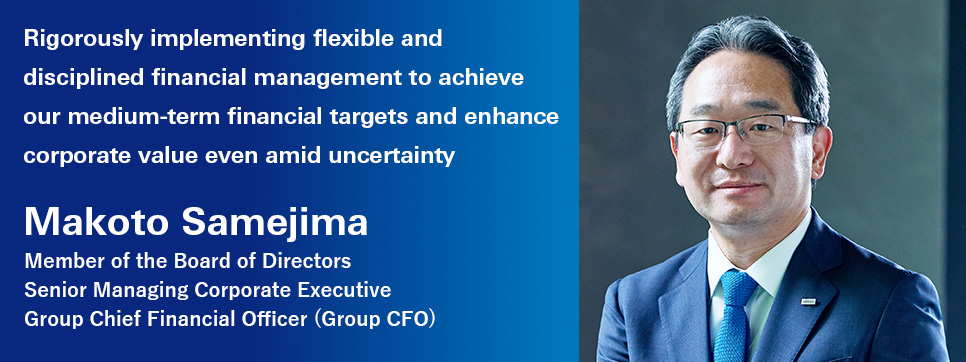
I was appointed Group Chief Financial Officer in April 2026. In my career to date, I have had extensive experience working in global Corporate & Investment Banking (CIB), and I have worked to strengthen the CIB business in the Americas, where Mizuho now enjoys competitive advantages. In my new role as Group CFO, I will leverage my experience navigating numerous tough deals, as well as my global perspective built up through working in the US for a total of ten years, to positively contribute to Mizuho becoming a truly global financial institution.
Reflecting on fiscal 2025 and the business environment
Financial markets saw a slump at the beginning of fiscal 2025 due to the announcement of US tariff policies. However, they subsequently rebounded, and our business performance was steady across all segments. We also benefited from macroeconomic tailwinds, including the Bank of Japan hiking interest rates and the weak yen. Together with temporary factors that boosted profits, these tailwinds enabled us to surpass our guidance for both Consolidated Net Business Profits, an indicator of the strength of our core operations, and Profit Attributable to Owners of Parent. The latter hit a new record high, exceeding JPY 1 trillion for the first time, and ROE also reached 11.4%, exceeding the 10% mark. In other words, within a single year, we were able to achieve the fiscal 2027 medium-term financial targets for Consolidated Net Business Profits and ROE that we had set in 2025. We also invested in inorganic growth to strengthen our unique competitive advantages by acquiring AI-oriented financial services startup Upsider; entering into the agreement to acquire, subject to regulatory approvals, a majority stake in Avendus Capital; and taking other steps aligned with our considerable accumulation of capital. At the same time, we returned value to shareholders with JPY 400 billion in share buybacks. Overall, it was a year of great progress for Mizuho.
That said, escalating tensions in the Middle East have recently been amplifying uncertainty in the outlook for economies and financial markets. We now face a severe and unpredictable environment given the downside pressure on the Japanese and other economies from high oil prices and supply chain disruption. To sustain profit growth against such uncertainty, it is extremely important that we rigorously implement flexible and disciplined financial management and balance sheet control.
Figure 1: FY2025 results
(JPY billion)
FY2024
Results
FY2025
Results
Year-on-year
Consolidated Gross Profits1
2,965.6
3,515.6
+549.9
G&A Expenses2
–1,854.5
–2,091.7
–237.1
Consolidated Net Business
Profits1
1,144.2
1,461.1
+316.8
Credit-related Costs
–51.6
–133.0
–81.4
Ordinary Profits
1,168.1
1,573.1
+405.0
Profit Attributable to Owners of
Parent
885.4
1,248.6
+363.1
ROE3
8.5%
11.4%
+2.9%pts
Expense ratio
62.5%
59.4%
–3.0%pts
- FY2024 results include JPY 45.2 billion in Net Gains (Losses) related to ETFs and Others, and FY2025 results include JPY 38.3 billion for the same figure.
- Excluding Non-Recurring Losses and others.
- Based on Tokyo Stock Exchange principles. Including Net Unrealized Gains (Losses) on Other Securities.
New medium-term financial targets and fiscal 2026 outlook
As we achieved our financial targets for fiscal 2027 within one year, we have set new medium-term financial targets looking ahead to fiscal 2028. By that fiscal year, we aim to achieve ROE of over 12% and Consolidated Net Business Profits of JPY 1.8–2.0 trillion. Taking into account forward-looking financial measures informed by fiscal 2025 performance and temporary profit-boosting factors, we calculate our fiscal 2025 ROE on a normalized basis at 10.5%, and we will make this the starting point to push our ROE to an even higher level and bring ourselves in line with leading global peers. Further, as we set our new targets assuming a Bank of Japan policy rate of 0.75% and were not able to factor in the June rate hike to 1.0%, we will aim for a still higher ROE reflecting the impact of additional rate hikes.
To stay on track for our medium-term financial targets, we are aiming for Consolidated Net Business Profits of JPY 1,630 billion and Profit Attributable to Owners of Parent of JPY 1,300 billion in fiscal 2026. On a normalized basis, excluding temporary profit-boosting factors, we view Profit Attributable to Owners of Parent for fiscal 2025 as JPY 1,150 billion, and we aim to increase this to JPY 1,300 billion through growth in Consolidated Net Business Profits, especially in our domains of focus. As noted earlier, we currently face an uncertain business environment, but we will pursue disciplined financial management to achieve our goals.
Figure 2: Setting new medium-term financial targets

- Based on Tokyo Stock Exchange principles. Including Net Unrealized Gains (Losses) on Other Securities.
- Including Gains (Losses) related to ETFs and Others.
- Performance reflecting true operation excluding forward-looking financial measures and temporary profit-boosting factors.
Progress of measures to improve the price-to-book ratio
Mizuho's price-to-book (P/B) ratio has steadily improved due to our higher ROE and expectations for sustained growth, but it remains lower than that of our leading global peers, and we need to raise it further to be in line with them. We consider this to be crucial and will continue working tirelessly towards it.
The way to achieve this is to raise both our ROE and price-to-earnings (P/E) ratio. As shown in our medium-term financial targets, we plan to consistently achieve ROE of over 12% by fiscal 2028. In parallel, we aim to execute a high-quality growth strategy based on Mizuho's unique competitive edge and raise the P/E ratio. To that end, we will endeavor to maintain a sound and stable portfolio, thoroughly implement disciplined financial management, strengthen our competitive edge, and address challenges in our business focus areas. On the business side, we will give a detailed explanation of our business model for value creation later, so here I will describe our efforts in the finance area.
Figure 3: P/B ratio comparison to global peers1
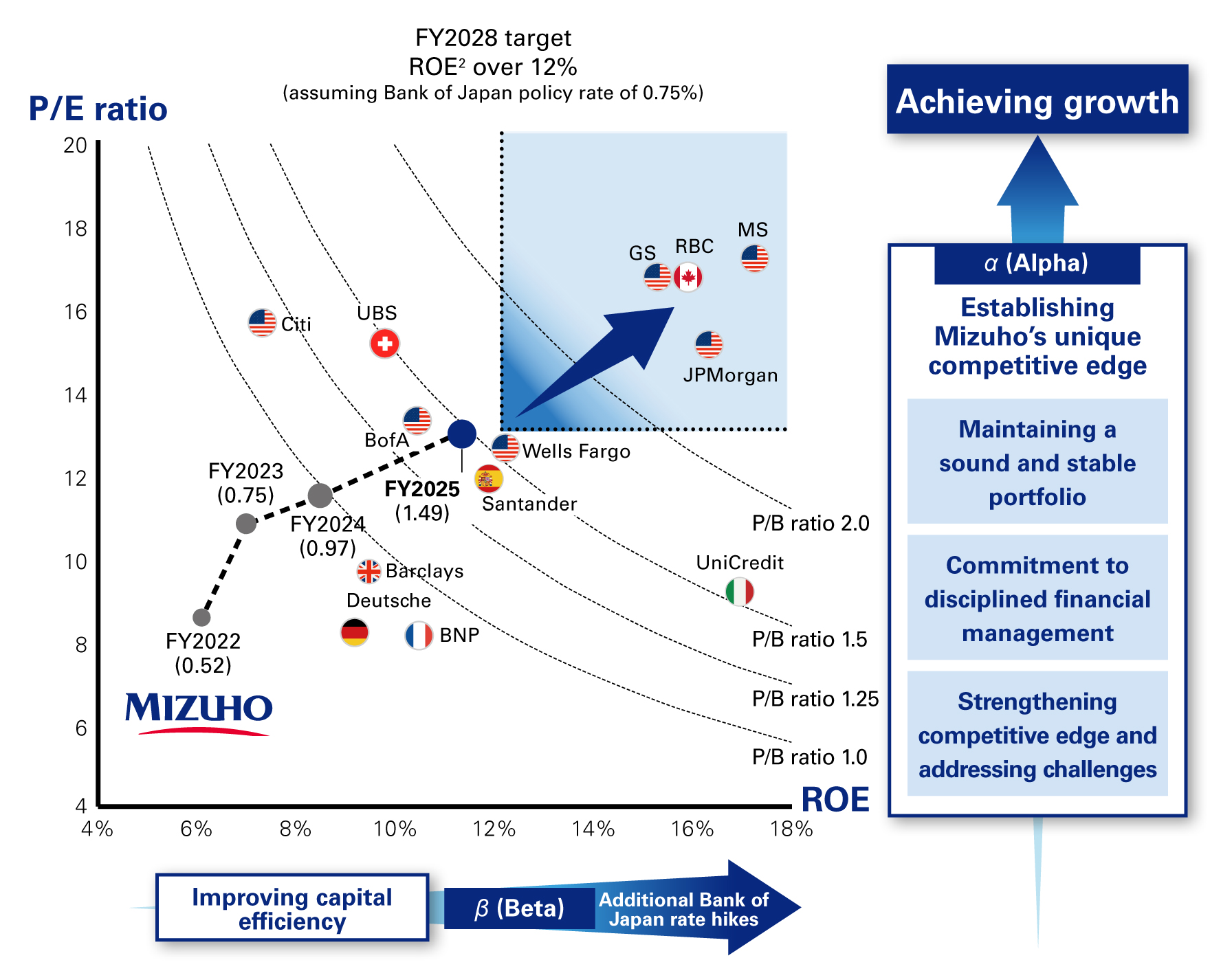
- Created by Mizuho based on Bloomberg data. Closing stock prices as of April 30, 2026 used for P/B ratio.
- Based on Tokyo Stock Exchange principles. Includes Net Unrealized Gains (Losses) on Other Securities.
To improve our P/B ratio, the key financial priorities we should focus on are improving earnings per share (EPS), optimal balance sheet control, limiting of profit volatility, and generation of growth expectations, as shown in the Figure 4 logic tree. In this regard, we will drive forward six specific initiatives with unwavering commitment and continue to produce steady results, thereby winning greater trust from shareholders and investors.
Figure 4: Logic tree for improving P/B ratio

1) Achieve steady profit growth
In fiscal 2025, Consolidated Gross Profits went up by JPY 549.9 billion to a record JPY 3,515.6 billion. Growth in interest income in Japan was a major growth driver here. The Bank of Japan raised rates, leading to an increase in the deposit-loan yield spread, and Japanese companies initiated more corporate actions, contributing to overall growth in event-driven finance. With these positive factors, growth in interest income in Japan accounted for around JPY 150 billion of the increase in Gross Profits.
More importantly, non-interest income also served as a growth driver. In particular, in our business supporting the growth of Japanese companies, we delivered strong results by providing various proposals and financing solutions, including M&A advisory in connection to corporate actions by large and middle-market firms. In the global CIB business, too, our collaboration between banking and markets segments has been delivering solid outcomes, especially in the US, and has driven profit growth. Going forward, we will reinforce our four business domains, namely mass-market retail business in Japan, asset and wealth management in Japan, supporting the growth of Japanese companies, and global CIB, so as to maximize our earnings potential in Japan's rising interest rate environment, as well as realize earnings growth that is not dependent on rate hikes.
2) Improve asset profitability and secure stable funding
To further raise the ROE, we will continuously improve return on risk-weighted assets (RORA). In the client business, we will set profitability standards; measure profitability for all clients, transactions, and products; and shift corporate resources to higher RORA businesses. Specifically, we are reducing mortgage loans, where there is fierce competition around interest rates and where RORA is insufficient relative to our profitability standards, as well as reducing other lending areas where RORA has not improved for many years. We will allocate the corporate resources freed up by this into high-RORA businesses where we can expect various ancillary revenues. To respond appropriately to growing funding demand, it will be vital for us to have optimal control over not only risk-weighted assets (RWA) but the balance sheet as a whole. As well as making progress in exiting unprofitable assets, we will thoroughly implement an originate-to-distribute (OTD) approach, particularly for long-term loans, and increase balance-sheet turnover.
Figure 5: Risk-weighted assets (RWA)1 and RORA2
(JPY trillion, rounded figures)

- Calculated on an internal management accounting basis. Considers factors including interest rate risk in the banking book. FY2025 management accounting rules.
- RORA: Gross Profit RORA.
- Mark-to-market.
On the liability side, we will focus on securing deposits as a stable source of funds for the financing we provide clients. Higher interest rates have intensified the competition for deposits, and we are taking action to attract more low-cost and so-called sticky deposits that customers are unlikely to take to other financial institutions. We will also ensure stable balance sheet management with medium- to long-term funding, including issuing corporate bonds.
Meanwhile, we are continuing to reduce our cross-shareholdings. The book value of our cross-shareholdings, which stood at approximately JPY 2 trillion at the beginning of fiscal 2015, is most recently down to just around JPY 0.7 trillion. Based on stock prices as of the end of March 2025, we are still targeting bringing the outstanding market value of cross-shareholdings, including deemed shareholdings, to below 20% of net assets by fiscal 2027.
3) Control expense ratio
At Mizuho, even amid ongoing cost pressures in the current inflationary environment, we have kept our expense ratio in the 55–60% range through disciplined cost management, maintaining this ratio on a par with major US and European banks despite a large gap in policy interest rates across regions. As uncertainty in the business environment increases and the risk of exposure to severe business conditions rises, we will continue to hold down fixed expenses to strengthen our profit resilience on the downside, and, over a period of three years, will implement JPY 150 billion in fixed cost reductions. As a financial institution, we will proactively invest to ensure stable operations and build a unique competitive edge. At the same time, we will streamline operations by boldly scaling back or exiting products, services, and businesses where there are significant hurdles to gaining a unique competitive edge, while aggressively redesigning entire operational processes through proactive, AI-related investment.
4) Manage credit-related costs and maintain a risk control-focused approach
Many US tariff policies are still in effect, tensions in the Middle East are triggering high oil prices and supply chain disruptions, and the yen's trend towards weakening is becoming entrenched. These among other factors have the potential to cause our clients' finances to deteriorate, which could lead to larger credit-related costs. In fiscal 2025, we moved to fortify our finances to prepare against future risks, posting a new JPY 54.7 billion in loan-loss reserves as a forward-looking measure for sectors where Middle East tensions and other factors may impact earnings. We will support our clients by closely monitoring their business performance and finances; detecting signs of change at the earliest stage possible; and making proposals for improvement, including business restructuring, before they encounter serious difficulties. In this way, we will limit our credit-related costs.
In the private credit market, an area of increased concern, we are taking a conservative approach; for example, our exposure to business development companies (BDCs) is limited to JPY 0.3 trillion, and we are continuing to focus our risk-taking primarily on blue-chip companies.
5) Diversify revenue and enhance revenue stability and complementarity
Under the Bank of Japan's previous negative interest rate regime, we were in a severe business environment presenting a sharp decrease in interest income in Japan. We responded by growing our non-interest income and business portfolio outside Japan, resulting in both revenue stability and growth. For our global CIB business centered on the US, we have achieved high earnings growth with the development of synergies between our banking and markets segments, with a primary focus on highly credit-worthy global blue-chip clients and institutional investors. Relative to US and European banks, our global CIB business is characterized by a low proportion of trading revenue, which is highly sensitive to financial market conditions, and the fact that our trading business itself is client flow-based. It therefore enjoys extremely high earnings stability.
Japan's economy continues to expand in nominal terms. Since the Bank of Japan ended its negative interest rate policy in March 2024, the policy interest rate has gradually been raised, and further hikes are expected going forward. With this, interest income in Japan is also expected to continue growing. However, as further rate hikes may lead to unrealized losses on our yen bond portfolios, we will continue to manage the markets divisions' bond portfolios prudently and flexibly. By advancing the complementarity of the customer and markets divisions, we will limit overall revenue volatility stemming from changes in the policy interest rate while appropriately capturing revenue opportunities that accompany rising interest rates.
Figure 6: Breakdown of revenue performance1 and expense ratio trend
(Gross Profits, JPY trillion, compared to FY20152)

- Customer divisions + S&T.
- For S&T, the FY2016–2018 trend is relative to FY2015 and the total for in and outside Japan. The FY2019–2025 trend is relative to FY2018.
6) Use capital effectively
For our capital management policy, we will continue to pursue the optimal balance between capital adequacy, growth investment, and enhancement of shareholder returns. In terms of equity capital, our regulatory CET1 Capital Ratio (Basel III finalization fully effective basis. Excluding Net Unrealized Gains (Losses) on Other Securities.) was 9.9% as of the end of March 2026, remaining within our operational range and indicating adequate capital accumulation. Given our current capital position, we believe that we can use the Profit Attributable to Owners of Parent we will post going forward for enhancement of shareholder returns and growth investment (both inorganic and organic).
Figure 7: Historical level of CET1 Capital Ratio and allocation of Profit Attributable to Owners of Parent

- Basel III finalization fully effective basis. Excluding Net Unrealized Gains (Losses) on Other Securities.
Fiscal 2025 marked the first year when our newly announced shareholder return policy was in effect. Under this policy, we will implement progressive dividend increases on a per-share basis and carry out share buybacks flexibly. We aim to raise the per-share dividend by JPY 5 each fiscal year, based on steady growth of a stable revenue base. We will conduct share buybacks with a target total payout ratio of 50% or higher, taking into account factors such as business performance and capital, the stock price level, and growth investment opportunities. Based on the policy, in fiscal 2025 we conducted JPY 400 billion in share buybacks, bringing the total payout ratio to 60%. Going forward, we will continue to return value to shareholders based on this shareholder return policy.
For fiscal 2026, we expect to be able to raise dividends by another JPY 5 to JPY 150, a sixth consecutive year of increase. For share buybacks, we have set an initial target of JPY 100 billion, in light of the current uncertain environment; however, we will closely monitor factors such as the situation in the Middle East and its impact on economies and financial markets, and we will continue to consider share buybacks with a target total payout ratio of 50% or higher.
Figure 8: Shareholder returns and FY2026 forecast

Regarding inorganic investment, we will continue to look into opportunities in a careful and disciplined manner and conduct multifaceted and in-depth examinations of consistency with our business strategy, adequacy of investment returns, effectiveness of governance, and compatibility of corporate cultures. Since fiscal 2023, to strengthen our M&A advisory functions in and outside Japan for both our global CIB business and our business supporting the growth of Japanese companies, we have acquired advisory firms Greenhill and Augusta and agreed to acquire, subject to regulatory approvals, a stake of over 60% in Avendus Capital. In addition, we have acquired Upsider in order to use AI to enhance and improve the efficiency of our business supporting the growth of Japanese companies. Apart from this, we have strategically invested in Rakuten Card and Rakuten Securities— both part of Rakuten Group, one of Japan's leading e-commerce platform providers—to strengthen our mass-market retail and asset and wealth management businesses in Japan. We will move forward with judiciously selecting investment opportunities to build a unique competitive edge.
When we invest inorganically, we will collaborate closely with the companies we invest in, promoting business strategies, monitoring progress towards revenue targets, and integrating our organizations through personnel exchanges and building of governance systems, as we look to benefit from the investments as early as possible. We will manage investments in a disciplined manner, and if we determine that we are unlikely to obtain the benefits that we initially expected, we will move quickly to exit the investments. In fiscal 2025, we transferred our global custody business, an area dominated by large global players, to State Street Corporation.
Amid the robust client demand for funding, we are likely to increase capital allocated to organic investment, including for lending growth. In this regard as well, we will remain strictly disciplined, pursuing only profitable deals.
To our investors
Figure 9: TSR following end of Bank of Japan's negative interest rate policy
(Since Feb 2024, %)

To date, we have worked to communicate more with all our investors. Having incorporated the many insightful suggestions from our investors in and outside Japan into our management and disclosures, in fiscal 2025 we were able to receive a Best IR Award from the Japan Investor Relations Association (JIRA) for the first time. We are delighted with this development, seeing it as evidence of the overall high regard for our IR activities. We will continue to commit to advancing unique IR initiatives and creating sustainable corporate value. Since the Bank of Japan ended its negative interest rate policy, our total shareholder return (TSR) has come to rank among the top tier of our global peers, and I can sense the strong expectations that all our investors have of Mizuho. To surpass these expectations, our management will strive in a unified manner to raise shareholder value. We would appreciate hearing any candid opinions from shareholders and investors as we continue our further growth and development.
