Human Rights Policy
1. Introduction
Positioning of the Human Rights Policy
Mizuho refers to "Operating responsibly and transparently with foresight, Mizuho is deeply committed to serving client needs, enabling our people to flourish, and helping to improve society and the communities where we do business" in its Corporate Philosophy. To realize its Corporate Philosophy, we are required to pursue corporate activities in a manner that is in harmony with societal expectations.
Mizuho realizes our potential to impact human rights throughout our own operations and business relationships.
Mizuho commits to respecting internationally recognized human rights in our “Mizuho Code of Conduct”.
Mizuho's business domains include banking, trust banking, securities, and other services. This Human Rights Policy sets out in further detail the content of our commitment to meet our responsibility to respect human rights, pursuant to the UN Guiding Principles on Business and Human Rights, throughout our global operations and our value chain.
Scope of Application of the Human Rights Policy
This Human Rights Policy applies to all officers and employees of the Mizuho Financial Group, Inc. group companies.
Mizuho expects our business partners, including our clients and suppliers, to share our conviction to uphold the corporate responsibility to respect human rights.
2. International Standards
In addition to ensuring compliance with applicable laws wherever we operate, Mizuho’s approach to human rights is based upon the International Bill of Human Rights, the International Labour Organization's Declaration on Fundamental Principles and Rights at Work (“ILO Declaration”), and the UN Guiding Principles on Business and Human Rights.
In the event of discrepancies between internationally recognized human rights standards and domestic laws in a given territory, Mizuho will follow the higher standard. Where domestic laws in a given territory conflict with international standards, we will seek appropriate ways to respect the principles of internationally recognized human rights.
Mizuho is a signatory to the UN Global Compact's Ten Principles in the areas of human rights, labor, the environment, and anti-corruption, and respects the social responsibility guidance standard ISO 26000.
3. Corporate Governance
Initiatives for respecting human rights are regularly discussed at the executive level, including the Executive Management Committee, and the establishment and revision of the Human Rights Policy are approved by the President & CEO. The content is supervised by the Board of Directors.
4. Human Rights Due Diligence
Referring to the OECD Due Diligence Guidance for Responsible Business Conduct, we will continue to further integrate human rights into our existing corporate processes in order to prevent or mitigate any adverse impacts that our business activities may have on human rights. We will also strive to conduct human rights due diligence through the following: 1) Identify and assess adverse impacts on human rights; 2) Cease, prevent, or mitigate adverse impacts on human rights; 3) Track implementation and results of 1 and 2; and 4) Communicate with stakeholders on how impacts are addressed.
Through human rights due diligence, we strive to prevent or mitigate adverse human rights impacts in our operations. However, even with the best policies and practices, Mizuho may cause or contribute to an adverse human rights impact that it had not foreseen or was not able to prevent. In such cases, we will seek ways to address the adverse impact, referring to the following framework.
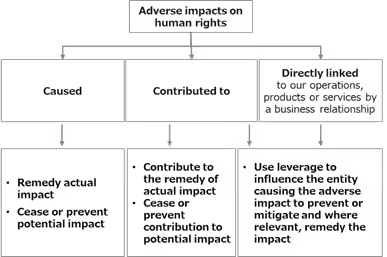
In line with the UN Guiding Principles on Business and Human Rights, we seek to cooperate in the remediation of adverse impacts through legitimate processes, and where reasonable and appropriate, encourage our clients to prevent or mitigate any adverse impacts on human rights.
Our Approach to Forced Labor, Child Labor, and Human Trafficking
Mizuho will strive to strengthen its human rights due diligence with the aim to eliminate forced labor, child labor, and human trafficking from its business and value chain.
5. Our Employees
Mizuho is committed to treating all employees with dignity and to ensuring respect for their human rights.
We assign the highest priority to fulfilling our responsibility to provide a healthy and safe working environment for our employees.
We are guided by principles such as those in the ILO Declaration, including as regards nondiscrimination, the prohibition of child labor and forced labor, and freedom of association and right to collective bargaining.
We offer equal employment opportunities to all, promote inclusion, and provide employees with opportunities for learning and development.
We do not tolerate discrimination or harassment of any kind, including on the grounds of gender, nationality, birthplace, race, age, ethnic origin, religion, political views, membership in labor unions, disability, sexual orientation, gender identity, socioeconomic status, pregnancy, marital status, or health conditions.
We believe that the physical and mental health of all Mizuho employees is indispensable, and we endeavor to maintain and improve employee health. We also strive to help employees achieve a more fulfilling life through their work.
We value an open dialogue with our employees and have established robust employee consultation systems to create a supportive work environment.
We are making every effort to provide a framework that maintains impartiality while protecting the rights of employees when addressing concerns or responding to complaints.
Mizuho has established a Committee for the Promotion of Human Rights Education, and will work diligently to enhance human rights awareness for and build the capacity of each employee with respect to their own rights and those of others.
6.Our Clients
Mizuho recognizes that we can contribute to or be linked with adverse human rights impacts by way of our business relationships in all sectors.
Mizuho strives to perform adequate due diligence to prevent or mitigate adverse human rights impacts associated with our business operations, using our leverage where appropriate.
Information Management
Mizuho is aware of the importance of managing information in a way that ensures appropriate protection and use of information assets.
We continually work to strengthen our information management practices in order to identify appropriate ways to protect and respect our clients’ privacy. This includes our aim to ensure that our security management measures and information administration methods for information assets are clear and straightforward. We also implement training and awareness-building exercises to ensure that members of our organization have a firm understanding regarding the proper protection of information assets.
Financial Crime Risk Management
Mizuho recognizes that the use of its products and services for money laundering and the financing of terrorism may result in human rights violations. We continue to look for ways to strengthen our efforts toward preventing Mizuho, its employees, and its clients from contributing to or becoming involved in money laundering. Mizuho will endeavor to positively contribute to the healthy stability and growth of the financial system.
Ensuring Safety and Soundness for Financial Service Clients
Mizuho has established its Basic Policy on Management of Finance Facilitation and believes that recognizing the social responsibility and public service mission held by financial institutions; engaging in appropriate and proactive risk-taking under an appropriate risk management framework; and actively performing financial intermediary functions contribute to the sound development of our clients and the economy, as well as to the enrichment of individual lives. Based on this belief, we strive for management of finance facilitation that is uniform across Mizuho.
Mizuho is also actively engaged in financial and economic education to support the improvement of financial literacy and to reduce the likelihood of excessive debt and financial improprieties.
Responsible Financing and Investment
We have established an Environmental and Social Management Policy for Financing and Investment Activity for the purpose of avoiding and reducing negative environmental and social impacts resulting from our financing and investment activity. This policy aims to identify human rights issues with a high risk of client involvement and sectors with a high risk of negative impacts on human rights, and to establish policies for preventing and/or mitigating these negative impacts.
When determining whether to engage in transactions, we account for the degree to which the client has taken steps to avoid or mitigate risk and other due diligence as appropriate, based on the characteristics of the services we are providing. We also regularly confirm the status of initiatives for environmental and social risks by engaging in constructive dialogue with clients in specific sectors.
Mizuho Bank implements and adheres to the Equator Principles and coordinates with clients in identifying, evaluating, and managing environmental and social risks when providing financing for large-scale development projects. The Equator Principles require the client conducting these projects to protect Indigenous Peoples' rights, to ensure occupational health and safety, and to engage in dialogue with stakeholders, including affected communities and workers. Mizuho Bank conducts appropriate environmental and social due diligence in accordance with the in–house Equator Principles Implementation Manual for project-related financing transactions which fall under the scope of the Equator Principles.
In our asset management businesses, Mizuho Trust & Banking and Asset Management One accept and implement the “Principles for Responsible Institutional Investors ≪Japan’s Stewardship Code≫” for "responsible institutional investors" to fulfill their stewardship responsibilities. In addition, these entities are signatories to the UN Principles for Responsible Investment (PRI), pursuant to which they engage with investee companies and monitor fund management companies with respect to ESG-related issues.
7. Our Suppliers
Mizuho’s operations are supported by a network of suppliers providing goods and services, such as office supplies, computer systems, and outsourced labor.
We enhance our responsible procurement practices by establishing a procurement policy including our basic procurement approach and our requirements for suppliers to consider matters relating to the environment, respect for human rights, compliance, and information management.
We will make efforts to communicate this Human Rights Policy to our primary suppliers in a phased manner and request that our suppliers uphold a standard of respect for human rights commensurate with this policy. In certain cases, we will undertake an annual process to assess our suppliers’ adherence to the responsibility to respect human rights. Where necessary, we will take action appropriate to the circumstances.
8. Communication, Engagement, and Disclosure
We are committed to disclosing our progress on our human rights journey. We will track and periodically report on our activities with respect to human rights via our website.
Mizuho will continually work on establishing appropriate mechanisms to ensure rights holders have access to remedy when needed. Concerned rights holders can bring to our attention their concerns through our branches, headquarters, call centers, designated telephone lines, and via our website.
Mizuho emphasizes engagement with our stakeholders and strives for transparency and responsiveness. We have benefited from the views of stakeholders in the drafting of this Human Rights Policy and the devising of our implementation strategy.
We are committed to remaining engaged with stakeholders and to reviewing and amending this Human Rights Policy as and when appropriate.
Human Rights Policy Development and Revision Process
We developed and revised our Human Rights Policy by following the process outlined below:
Development Process
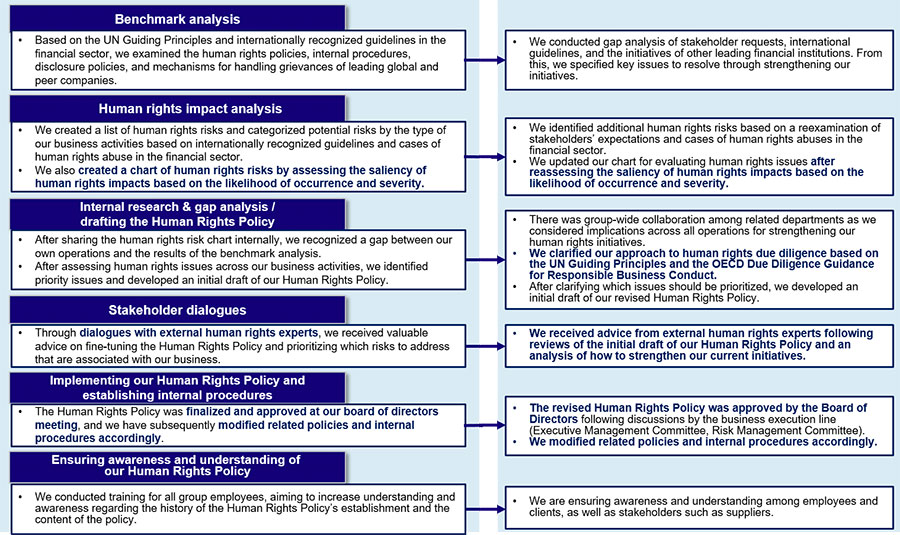
Please refer to the human rights report (PDF/1,922KB) for details.
Stakeholder Dialogues
Establishment of the Human Rights Policy
In September and October 2017, we explained the process of creating our human rights issue map and presented our draft human rights policy to human rights experts and various stakeholders, including UNEP FI, Shift (a U.S.-based non-profit organization focusing on business and human rights), and other companies and investors. We requested feedback via conference calls or written responses, focusing on the following points.
Their feedback focused on:
- Content of the draft Human Rights Policy;
- Salient human rights issues; and
Stakeholders' expectations regarding implementation of the Human Rights Policy.
Revisions to the Human Rights Policy
When we revised the human rights policy in May 2022, external experts on human rights provided recommendations and reviewed the draft revisions to the human rights policy and the proposed measures to strengthen our human rights efforts. Additionally, the Sustainability Promotion Committee held a meeting on the topic of respect for human rights in June 2022, at which an external expert on human rights presented recommendations.
Salient Human Rights Issues
Identifying and Assessing Salient Human Rights Issues
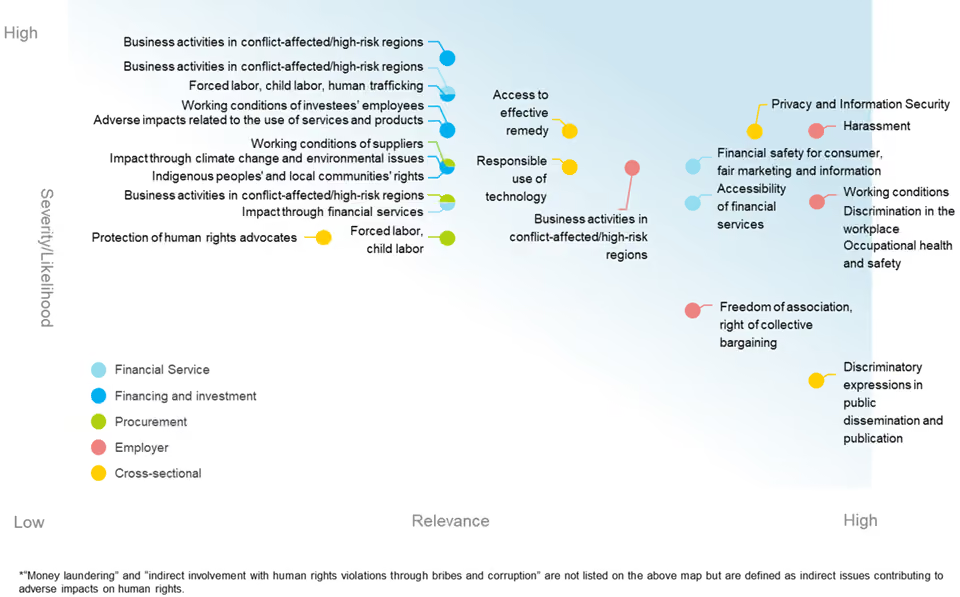
While remaining focused on all human rights issues under the Human Rights Policy, Mizuho identifies salient human rights issues and assesses their severity, likelihood and relevance which includes attribution and leverage within the framework of the UN Guiding Principles on Business and Human Rights (UNGPs). We will continue reviewing and refreshing our salient human rights issues on an ongoing basis, to account for the changing business environment inside and outside Japan.
Objective and Overview
- We identified salient human rights issues in Mizuho’s business activities in line with the UNGPs and refreshed this list based on the diversification and aggravation of human rights issues resulting from the changing business environment.
- We addressed a human rights impact assessment with advice from an external expert, covering the issues facing financing and investment clients, Mizuho Group companies, and financial service recipients and providers, to measure the severity, likelihood and relevance of their impacts on human rights.
- Compared with our previous human rights issues map revised in May 2022, new issue types were added, and some existing issues were further segmented in line with our business context. We also clarified our action plans to address each of the issues taking into consideration their relevance to our business.
Assessment Process
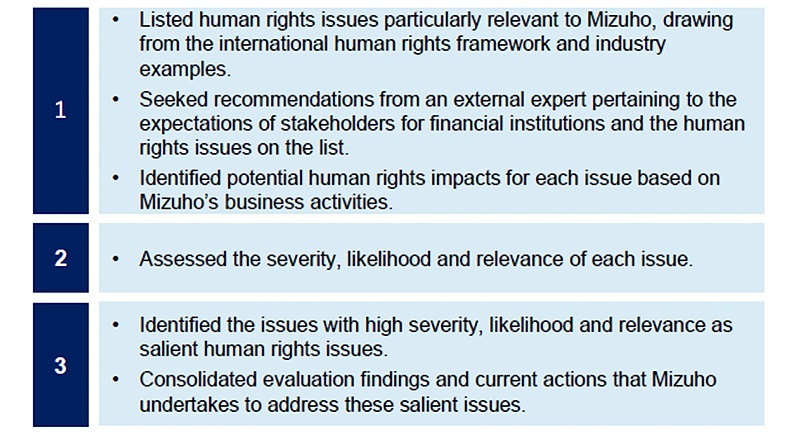
Assessment Results
- We identified 15 salient human rights issues by scoring and evaluating the severity, likelihood and relevance of associated human rights impacts.
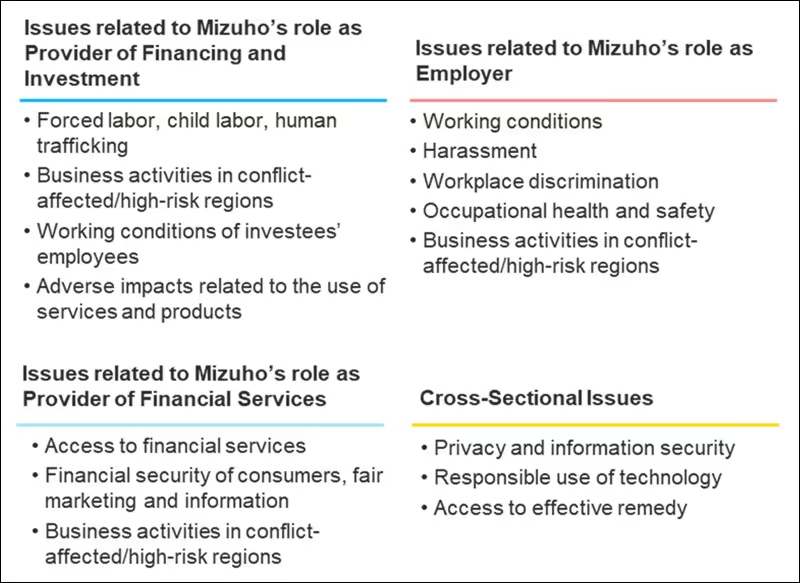
- We are engaging with stakeholders on all salient human rights issues and striving to enhance our management initiatives.
Human Rights Issues Map
We conducted a scoring assessment of each human right issue based on the severity, likelihood and relevance of associated impacts with advice from an external expert.
Major Human Rights Issues
Identifying and Assessing Human Rights Issues
In establishing and revising our Human Rights Policy, we identified potential human rights risks in our business activities and assessed their severity and likelihood of occurrence. Based on the results, we identified priority items to address in an effort to enhance our measures. We will continue to conduct periodic inspections and revisions in line with changes in the business environment both in and outside Mizuho.
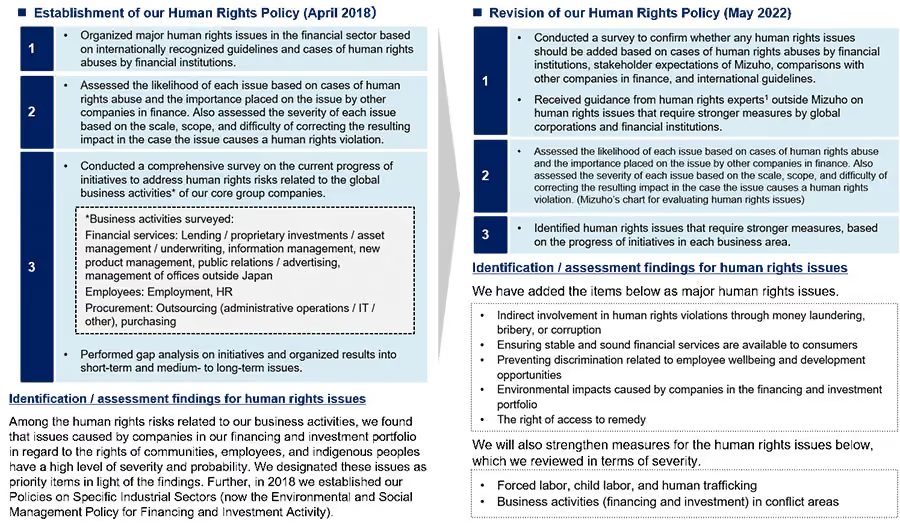
- Business for Social Responsibility (BSR): A global non-profit organization that supports companies' sustainability activities.
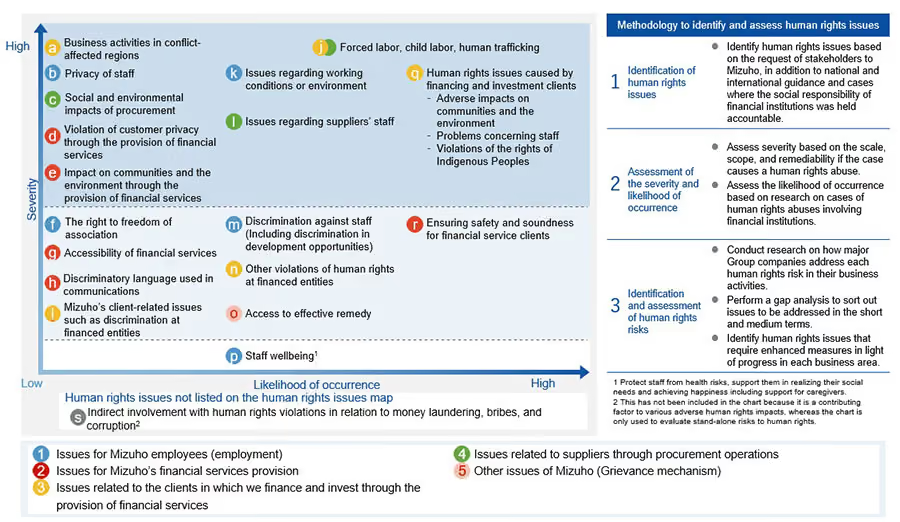
Chart for Evaluating Human Rights Issues
Based on the results of the identification and assessment of human rights issues, Mizuho has created a chart for evaluating human rights issues to identify priority issues for enhancing response. (Created in 2018, reviewed in 2022)
System for Promoting Respect for Human Rights
Structure for promoting respect of human rights
We regularly report our initiatives for respecting human rights to the Board of Directors following discussion at the business execution line (including the Executive Management Committee and the Sustainability Promotion Committee).
Oversight is also provided by the Risk Committee (which makes recommendations to the Board of Directors as their advisory body) and by the Board of Directors.
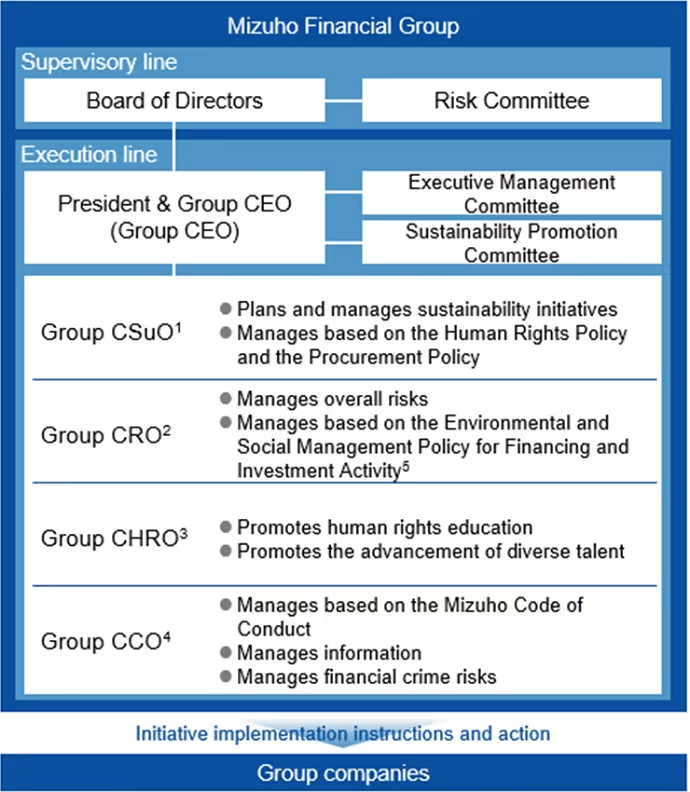
1 Chief Sustainability Officer
2 Chief Risk Officer
3 Chief Human Resources Officer
4 Chief Compliance Officer
5 The Environmental and Social Management Policy for Financing and Investment Activity is jointly managed and implemented by the Group CSuO and the Group CRO.
Supervisory and business execution line committees and roles related to respect for human rights
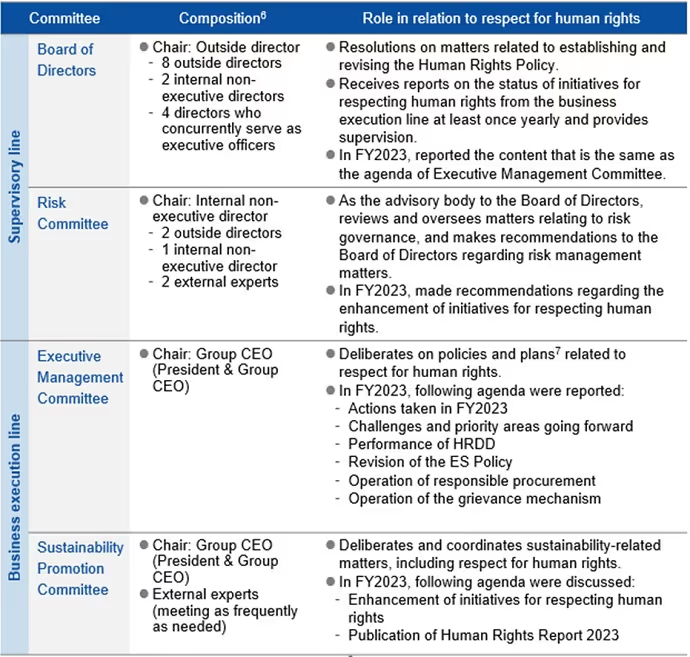
6 As of July 2024
7 Human Rights Policy, Environmental and Social Management Policy for Financing and Investment Activity, Procurement Policy, policies related to employment, and identification and assessment of major human rights issues.
Communication with Stakeholders
We have established a number of consultation systems for our employees and will continuously work on establishing appropriate mechanisms to ensure people have access to remedy when needed. Employees, customers, and other stakeholders can bring to our attention their concerns through our branches, head office, call centers, designated telephone lines, and via our website.
We place emphasis on engagement with our stakeholders and strives for transparency and responsiveness.
Grievance Mechanism
Clients
Mizuho has a grievance mechanism through our branches and headquarters. Mizuho Bank, Mizuho Trust and Banking, Mizuho Securities have designated telephone lines shown on website. Mizuho Americas also has its own grievance system on website to receive comments from stakeholders. In responding to consultations and complaints received on website, we guarantee the anonymity and confidentiality of our clients.
Furthermore, Mizuho has disclosed the grievance mechanisms in the Sustainability Report.
Contact
Specialized forms for those who are hearing or speech impaired
Employees
To address internal issues, we have established a number of consultation systems, including a regulatory compliance hotline, Mizuho's human rights helpline, and an employee consultation office. We are making every effort to provide a system that guarantees anonymity and confidentiality while maintaining impartiality and protecting the rights of employees when addressing concerns or responding to complaints.
Mizuho's human rights helpline
Outline
Mizuho's Human Rights Helpline was established in accordance with relevant laws, regulations,1 and guidelines as an internal consultation system for issues of harassment and reasonable accommodation for employees with disabilities.
- Relevant Japanese laws and regulations are as follows: The Equal Employment Opportunity Act (regarding sexual harassment and maternity-related harassment); the Labor Measures Comprehensive Promotion Act (regarding abuse of authority ("power harassment")); the Childcare and Caregiver Leave Act (regarding harassment related to maternity, paternity, and family caregiving); and the Act to Facilitate the Employment of Persons with Disabilities (regarding employees with disabilities).
Availability
Mizuho's Human Rights Helpline is available to all employees of Mizuho Financial Group, Mizuho Bank, Mizuho Trust & Banking, and Mizuho Securities (including employees seconded to group companies and other related companies).
Consultation methods
Telephone, email, written document (general postal mail, internal postal mail, etc.)
Throughout the value chain
In July 2023, Mizuho joined the Engagement and Remedy Platform provided and operated by the Japan Center for Engagement and Remedy on Business and Human Rights (JaCER) to receive complaints concerning human rights violations from stakeholders across its value chain. This platform complies with the UN Guiding Principles on Business and Human Rights, is both professional and impartial, and JaCER accepts reports of human rights violations related to Mizuho, notifies Mizuho of such reports, and provides support and promotion for complaint handling. JaCER is an organization that provides a non-judicial platform for redress of grievances based on the United Nations Guiding Principles on Business and Human Rights and receives human rights complaints relevant to Mizuho. It informs Mizuho of such complaints and support/promote its grievance mechanism. In addition to the grievance mechanisms for clients and employees described in above, Mizuho accepts human rights complaints from all stakeholders through this external professional platform. By using this platform, Mizuho will build an equitable engagement and remedy process and respond appropriately to complaints and whistle-blowing while ensuring the anonymity of the complainants and the confidentiality of information.
Disclosure and compliance with various laws and regulations
Publication of the Sustainability Report and Human Rights Report
Mizuho has published the Sustainability Report/Human Rights Report on a regular basis. The report summarizes details of initiatives related to respect for human rights based on the United Nations Guiding Principles Reporting Framework to enhance transparency. The report is compiled in the Sustainability Report "Human rights section".
Australian Modern Slavery Act 2018
In accordance with the Commonwealth Modern Slavery Act 2018, Mizuho Bank publishes a Modern Slavery Statement (PDF/555KB) and reports our actions to prevent or mitigate negative impacts on human rights related to modern slavery risks, in both our own operations and our supply chains.
UK Modern Slavery Act 2015
In accordance with the Modern Slavery Act 2015, the London Branch of Mizuho Bank publishes an Anti–Slavery and Human Trafficking Statement, and reports on its efforts to mitigate risks in its own business and supply chain.
Others
We strive to be proactive in two–way communications on human rights and environmental issues with various stakeholders, including equity holders, investors, media, and NGOs, in order to benefit from their advice to further strengthen our efforts to respect human rights.
Through our involvement in the Equator Principles Association, we carry out discussions with international NGOs and continue to promote the Equator Principles.
Contribution to Financial Inclusion
Financial assistance
Non-Financial assistance
Human Rights Due Diligence
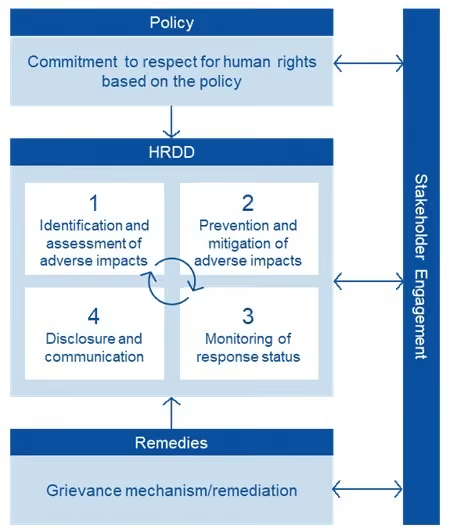
We have established a human rights due diligence framework and are actively engaged in addressing human rights issues.
Mizuho's human rights management system
Mizuho has put in place a framework to promote initiatives for respecting human rights in line with the UNGPs. Specifically, under the policy, we have established a human rights due diligence process and grievance mechanism, implement the identification and assessment of salient human rights issues, prevent and mitigate adverse impacts, implement monitoring of the response status and ensure transparency though public disclosure. We are also enhancing the effectiveness of policies, HRDD and remediation through stakeholder engagement. For more details, please see our Sustainability Report "Human rights section".
Status of human rights due diligence (PDF/5,811KB)
For Employees
We provide a healthy and safe working environment for our employees. We are also committed to offering equal employment opportunities to all and promoting success for every employee, and do not tolerate discrimination or harassment of any kind. We have established a Human Rights Education Committee, and will work diligently to enhance the awareness of each employee with respect to our own rights and those of others.
Elevating individual employees' capabilities
Supporting success for every employee
Pursuit of employee well-being
Human Rights Awareness Promotion and Activities
Initiatives that promote respect for employees' human rights (PDF/5,811KB)
For Clients
We recognize that, as a financial services provider, we can contribute to or be linked with adverse human rights impacts by way of our business relationships in every sector. We strive to perform adequate due diligence to prevent or mitigate adverse human rights impacts associated with our business operations, using our leverage where appropriate. We perform enhanced due diligence whenever we find any human rights issues in a business partner.
Performance of enhanced due diligence (PDF/5,811KB)
We are committed to protecting the privacy of our clients and promoting responsible financing that takes into consideration social and environmental impacts.
Responsible financing and investment
Taking into consideration the impact on human rights at developing new product and service
At the time of introducing a new product or service, Mizuho puts in place a mechanism for adequate assessment of potential impacts on human rights to ensure customer-oriented business operation. In developing a new product or service to individual customers we assess the risk of adverse impacts on human rights for prevention and mitigation purposes.
Procedures to oversee advertising and promotional materials
Mizuho Bank, Mizuho Trust & Banking, and Mizuho Securities have put in place a mechanism to check advertising, promotional materials to clients, and in-house corporate communication magazines to ensure that there are no controversial expressions from the perspective of human rights, and to correct any such expressions
For Suppliers
We request that suppliers of goods and services understand Mizuho's human rights policy and strives to encourage them to respect human rights at the same level as Mizuho. At Mizuho, we have established a Procurement Policy in order to enhance responsible procurement, which emphasizes ESG perspectives. The policy clarifies our basic approach to procurement and our requirements for suppliers from the perspectives of consideration for the environment (E); respect for human rights (S); and compliance and information management (G).
We provide our Procurement Policy, Human Rights Policy, and Environmental Policy to our primary suppliers and request for understanding. For certain suppliers, we also confirm the status of their response to human rights issues. In addition, we ask our contractors to understand our Human Rights Policy and expect them to respect human rights in a manner consistent with our approach. We will continue to strengthen initiatives for ensuring respect of human rights within our supply chain.
Procurement Policy (PDF/160KB)
Responsible procurement
Mizuho's business operations are supported by the cooperation of suppliers providing office supplies, IT systems, outsourcing, and other goods and services.
Mizuho recognizes that procurement operations entail the risk of causing adverse human rights impacts with respect to suppliers' employees, as well as to the environment and society. We have established a Procurement Policy, which clarifies our respect for human rights within procurement operations. The policy also establishes supplier compliance items in the Supplier Guiding Principles, for which we request the understanding and cooperation of all suppliers.
The policy clarifies our basic approach to procurement and our requirements for suppliers from the perspectives of consideration for the environment (E); respect for human rights (S); and compliance and information management (G).
Based on this policy, we are practicing responsible procurement and urging our suppliers to pursue ESG initiatives in their business operations. In doing so, we aim to contribute to the development of a sustainable society together with our suppliers.
Human Rights Awareness Promotion and Activities
Mizuho's Human Rights Education Committee
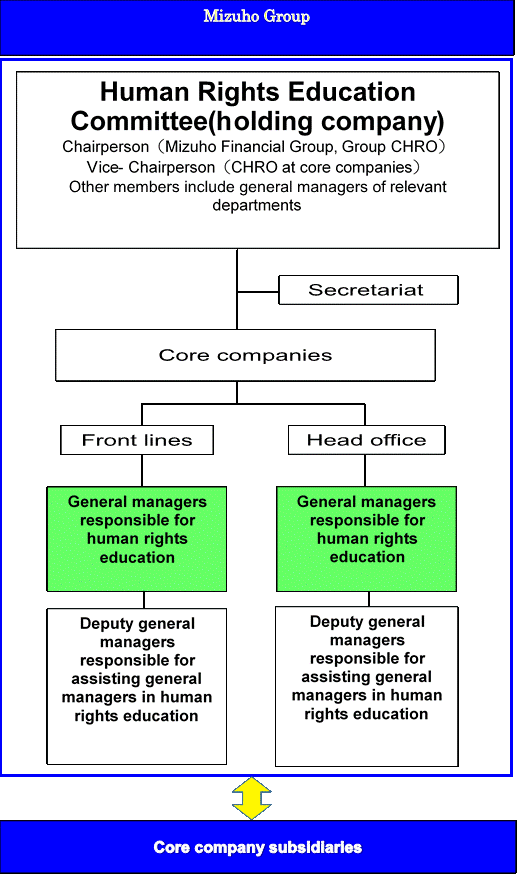
Mizuho's Human Rights Education Committee was established as part of our strong commitment to raising executive officers and employee awareness about human rights. The committee seeks to cultivate a corporate culture that embodies respect for human rights and discusses matters including human rights issues related to the Group, internal systems for human rights awareness, and the themes and content of training programs for employees.
The committee carries out its duties under the following structure: Group Chief Human Resources Officer of the Mizuho Financial Group (a member of the Board of Directors) serves as committee chairperson; general managers of all departments, offices, and branches, with the support of deputy general managers, form the framework of promotion and take responsibility for human rights education in their offices. This structure enables us to productively engage in tailored human rights promotion and training.
Human Rights Education: Organizational Structure
Human Rights Education for Executive Officers and Employees
At Mizuho, all group employees participate in annual human rights awareness training in the workplace. Each session is an opportunity for employees to learn about and reflect on human rights. Among a variety of initiatives, we hold training sessions and workshops for different target audiences, ranging from executive officers to department and branch general managers, deputy general managers responsible for assisting general managers in human rights education, new employee, and other employees and supervisors.
To address workplace harassment, we distribute informational pamphlets on our company intranet and conduct regular training, using e–learning, and video materials, on the definition of and how to respond to workplace harassment. We also conduct training aimed at raising awareness among all managers, which includes how to handle reports of harassment.
In addition, Mizuho periodically participates in fieldwork and workshops held by the Industrial Federation for Human Rights, Tokyo, to identify trends in human rights issues and learn about practical matters related to such issues in Japanese companies, and then apply these to our human rights initiatives.
Site
Type of training
Scope of participation
No. of participants
Japan
Workplace training
Training for executive officers and department/branch general managers
Training for deputy general managers responsible for assisting general managers in human rights education
Newly hired employees
All full– and part–time staff
All directors as well as department and branch general managers
Deputy general managers responsible for assisting general managers in human rights education
All newly hired employees
55,121 people1
710 people
957 people
1,206 People2
Outside Japan
Compliance training for locations outside Japan
Employees working at locations outside Japan
8,470 people3
1: Mizuho Financial Group, Mizuho Bank, Mizuho Trust & Banking, Mizuho Securities and their subsidiaries, Asset Management One, and Mizuho Research & Technologies*4.
2: Attendance from Mizuho Financial Group, Mizuho Bank, Mizuho Trust & Banking, Mizuho Securities
3: Attendance from Mizuho Financial Group and Mizuho Bank.
4: Mizuho Research & Technologies merged with Mizuho Bank in April 2026.
Mizuho posts a human rights newsletter in Japanese, Jinken no Tobira, on our company intranet for the benefit of all group employees. This newsletter is intended to enhance employee awareness of a variety of human rights issues. Mizuho's online learning system for employees also offers materials on human rights which employees can access from their own homes and use to develop their knowledge through individual study.
Our annual human rights catchphrase contest attracts over 30,000 entries yearly, from employees in all group companies. Awards are presented to excellent entries from throughout the group, and the most outstanding entry is submitted for consideration to external organizations, including the Japanese Bankers Association.
Winners of the Best Slogan for Human Rights award from the Japanese Bankers Association
FY2024 JBA Outstanding Award
Grand Prize:
Misunderstandings are born fromignorance; understanding opens up the world.
Excellence Award:
A small step for me may be a big hurdle for someone else; barriers disappear when we walk together